
Bima Arya Urges Sound Spatial Planning to Unlock Kepri's Potential
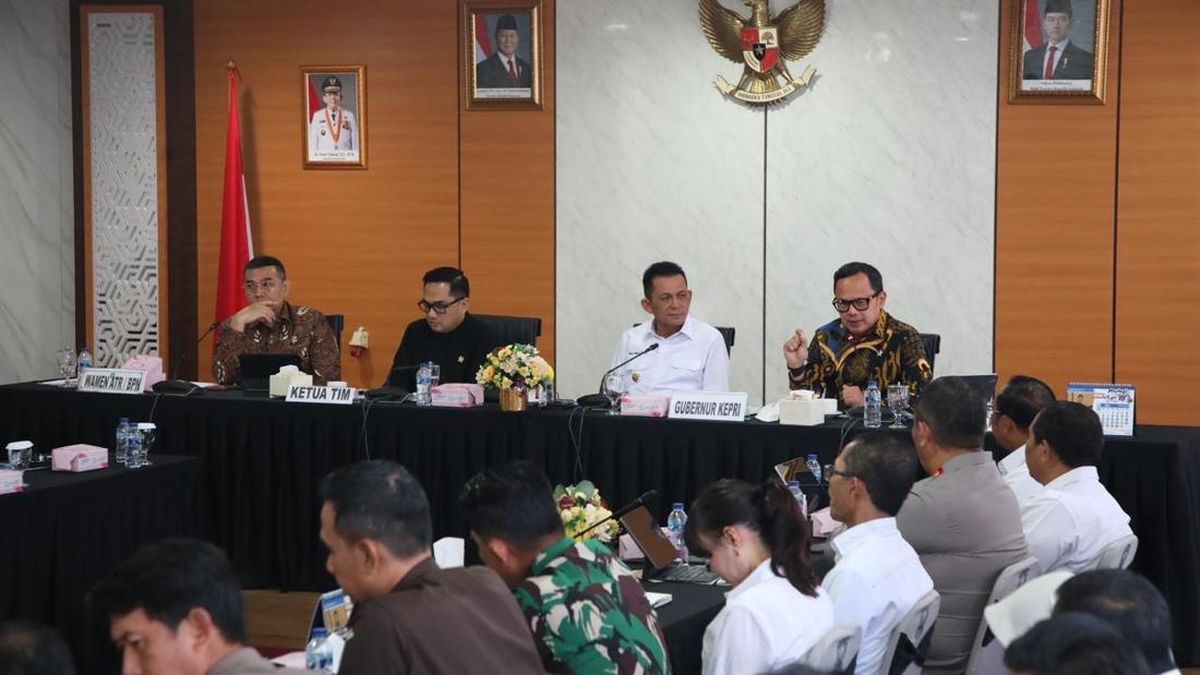
Deputy Minister of Home Affairs Bima Arya Sugiarto stated that effective spatial planning is the key to developing the various potentials held by the Riau Islands (Kepri) Province, including economic development. With well-planned and strongly coordinated spatial management, Bima noted, development can proceed optimally and sustainably while mitigating potential land conflicts.
This was conveyed by Bima during a specific working visit by Commission II of the Indonesian House of Representatives (DPR RI) regarding the role of governors as representatives of the central government in implementing national priority programmes, as well as the land and spatial planning sectors, at Graha Kepress, Batam, on Wednesday (8/7).
“We must ensure that spatial planning is controllable, and that we work together to turn it into a source of regional income,” said Bima.
Bima explained that the Riau Islands is a province consisting mostly of waters, with only a small portion of the territory being land. Nevertheless, Kepri possesses great potential across various sectors. This potential, according to Bima, ranges from manufacturing, trade, maritime, and natural resources to history-based tourism. He noted that the primary task is to ensure that the utilisation of limited land area can be carried out optimally.
Bima detailed four challenges that require the attention of local governments in the Riau Islands region: environmental degradation, vulnerability to disasters, spatial planning conflicts, and high population influx, particularly in Batam. Consequently, the Ministry of Home Affairs, together with Commission II of the DPR RI, will ensure that various regional regulations are aligned with the potential and challenges faced by Kepri.
“We are examining this very closely. Therefore, the Ministry of Home Affairs, through the Chairman of Commission II, is ensuring that all Regional Regulations (Perda) related to APBD (Regional Budget) planning take into account these factors of potential and challenges. The regulations exist, and we are ensuring they are synchronised,” he said.
He continued that, in addition to having great economic potential, Kepri also possesses historical and cultural value that distinguishes it from other regions. Kepri, particularly Penyengat Island, is an important centre of Malay culture and the birthplace of Raja Ali Haji, the figure who formulated the guidelines for the Indonesian language and authored the Gurindam Dua Belas.
As such, he appreciated the Riau Islands Provincial Government’s plan to build a language museum on Penyengat Island as an effort to strengthen the appeal of historical tourism. “This region has been the centre of the Riau Kingdom’s government since 1800. It is a centre of Malay culture, home to Raja Ali Haji, and so on. Therefore, the Ministry of Home Affairs, alongside the Ministry of ATR/BPN and the Ministry of Tourism, will provide support,” he expressed.
In addition to historical tourism, Bima also encouraged Kepri to develop the growing sport tourism sector. He believes that Batam and several other areas in Kepri have great potential to host various national and international sporting events, which could increase tourist arrivals and boost Regional Original Income (PAD).
“I am confident that for Batam and Kepri, if we pursue sport tourism—such as triathlons or marathons—it will be extraordinary,” he concluded.
The event was also attended by the Chairman of Commission II of the DPR RI, Muhammad Rifqinizamy Karsayuda, Deputy Minister of ATR/BPN Ossy Dermawan, Governor of Riau Islands Ansar Ahmad, and members of the Regional Leadership Coordination Forum (Forkopimda) of the Riau Islands Province.