
Bima Arya: Regional Heads Must Innovate Amid Tightening Fiscal Transfers
Democracy must not be controlled by groups with financial power.
The Association of Indonesian Regencies (Apkasi) has loudly voiced the urgency of expanding regional autonomy and is pressing for concrete steps in the form of a revision to Law Number 23 of 2014 concerning Regional Government. This strategic move is considered essential so that national regulations can be more adaptive in supporting innovation and strengthening the fiscal independence of regencies, especially amidst the increasingly narrowing regional budget space caused by national fiscal tightening.
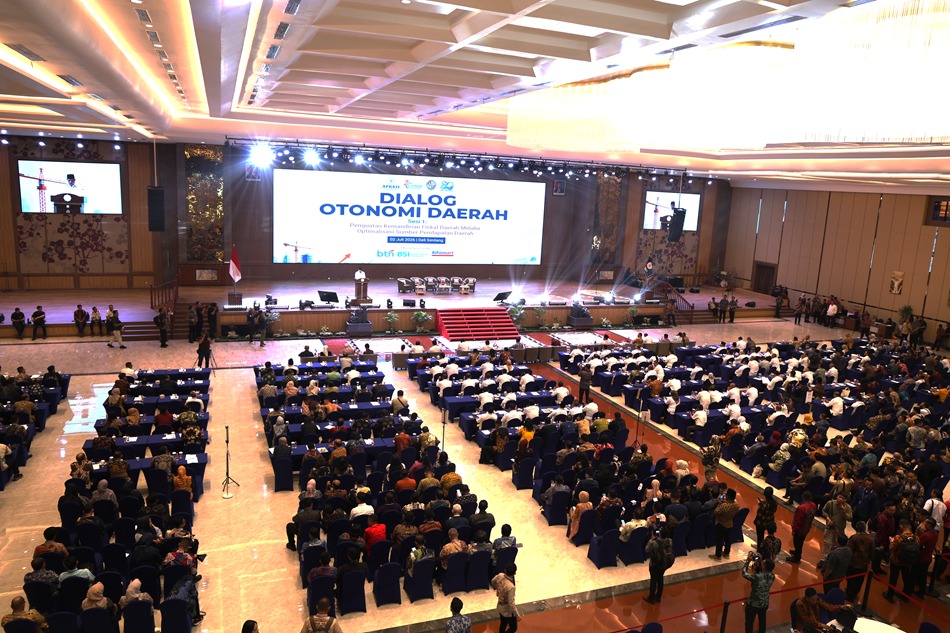
These crucial aspirations emerged during the Regional Autonomy Dialogue Forum, part of the series of events commemorating the 26th Anniversary of Apkasi. The event, themed ‘Strengthening Regional Fiscal Independence Through the Optimisation of Regional Revenue Sources’, was officially opened by Deputy Minister of Home Affairs Bima Arya Sugiarto in Deli Serdang, North Sumatra, on Thursday (2/7/2026).
In a forum attended by hundreds of participants, including dozens of regents, vice-regents, and officials from Regional Government Organisations (OPD) from various regions across Indonesia, the heavy challenges faced by local leaders were the primary focus. In addition to being required to ensure the success of national strategic programmes and fulfil campaign political promises, regional heads are now forced to face global geopolitical dynamics that directly impact local areas, as well as rapidly shifting social media algorithms.
While presenting a paper titled ‘Strategies to Realise Regional Fiscal Independence’, Deputy Minister of Home Affairs Bima Arya Sugiarto анаlogised the current position of regional heads as being at a crossroads. This is in view of Indonesia’s grand vision to transform into a developed nation within the next 20 years.
“Every leader has their trials, and every trial has its leader. There are times when regional heads are tested very severely. Previously, I was tested by the pandemic while serving as a regional head, and it felt as though I could do nothing. Some are tested by physical disasters, and now, you are being tested by the tightening of Regional Financial Transfers (TKD). This requires innovative moves and an understanding of modern algorithms so that the work performed does not merely become fodder for criticism from netizens on social media,” said Bima Arya, while conveying warm greetings from Minister of Home Affairs Tito Karnavian for the Apkasi anniversary.
Bima added that President Prabowo Subianto has outlined two absolute requirements for Indonesia to escape the middle-income trap and maximise the demographic bonus. To this end, local governments must be strictly aligned in supporting central strategic programmes. It is here, according to Bima, that Apkasi holds a central role as a collaborative platform where regional heads can replicate best practices to create alternative financing and optimise Local Original Revenue (PAD).
The General Chairman of Apkasi and Regent of Lahat, Bursah Zarnubi, emphasised that strengthening fiscal capacity is no longer merely an option, but a primary prerequisite for regions to exercise their authority optimally. Regencies serve as the frontline and strategic partners of the DPR and the Central Government in executing national programmes that directly touch the community, such as food security, basic infrastructure, poverty alleviation, and MSME empowerment.
Regarding the push for the revision of Law No. 23/2014, Bursah explained that Apkasi is not acting empty-handed. Working with the Committee for the Monitoring of Regional Autonomy Implementation (KPPOD), Apkasi has formulated a comprehensive draft of recommendations based on a series of thematic focus group discussions (FGD) involving regency governments from all corners of the country.
“For us, the revision of Law No. 23/2014 is not just a change in legal norms, but a golden momentum to evaluate the portrait of decentralisation after more than a decade of implementation. The diversity of potential and regional characteristics in Indonesia requires autonomy policies that are more aligned with the concrete needs of the regions. We hope the DPR and the government use the recommendations from the regency level as substantive evaluation material to clarify the division of authority and expand the space for local innovation,” stated Bursably.
In addition to serving as a platform for ideas, the implementation of this national-scale forum in Deli Serdang has had an instant impact on the local economy. The presence of hundreds of delegates has proven to stimulate the local real sector, ranging from hotel occupancy and transport supply chains to the culinary industry and the turnover of MSME entrepreneurs. This proves the essence of the inter-regional cooperation championed by Apkasi for 26 years: sharing knowledge while simultaneously strengthening local economies.
Source: jawawa.id (https://jawawa.id/newsitem/bima-arya-regional-heads-must-innovate-amid-tightening-fiscal-transfers-1783007492)
Originally published by Media Indonesia (https://mediaindonesia.com/nusantara/906932/bima-arya-kepala-daerah-harus-inovatif-hadapi-pengetatan-transfer-keuangan-daerah), translated from Indonesian