
Billion-Year-Old Cosmic Dust Reveals Traces of the Sun's Earliest Formation
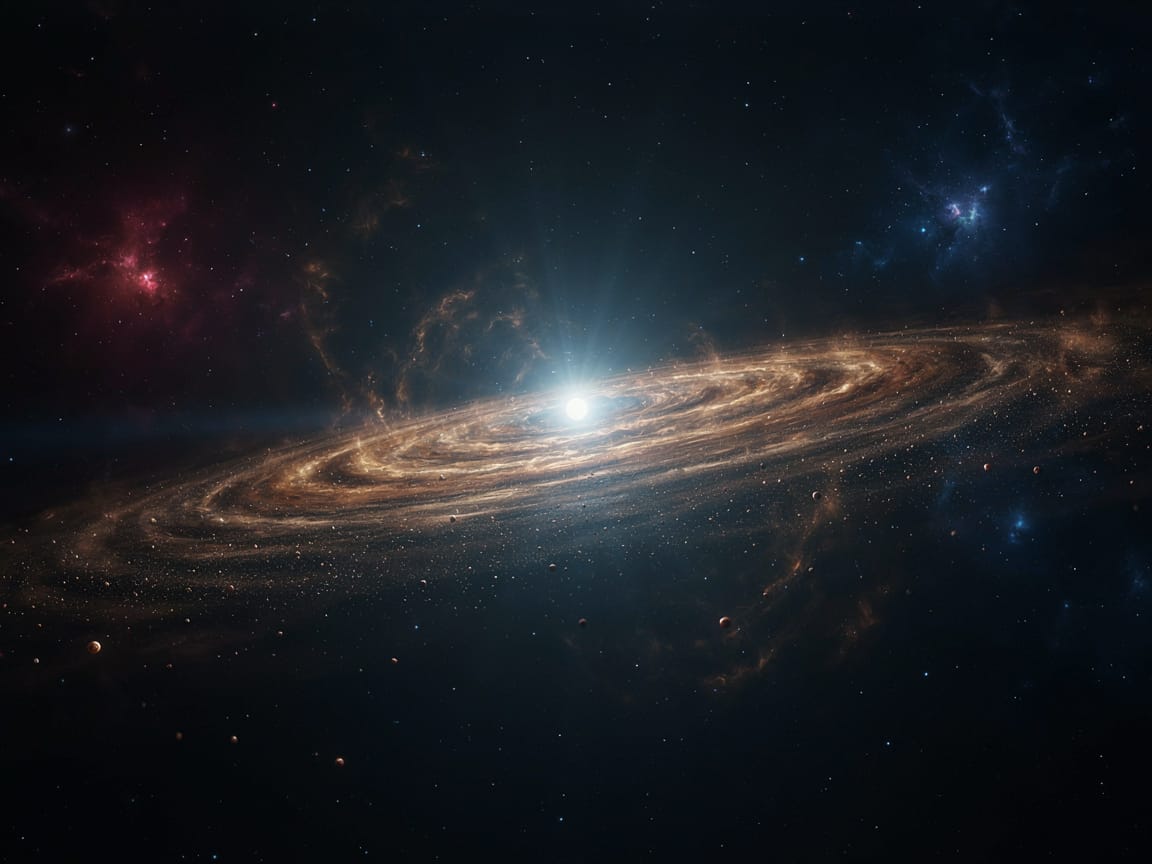
The process by which the Sun and the solar system formed around 4.6 billion years ago remains a major focus of modern astronomical research. One of the keys to understanding this distant past lies in microscopic cosmic dust particles known as presolar grains. Remarkably, these particles are older than the Sun itself.
According to NASA, presolar grains are solid particles that formed in interstellar space before the birth of the Sun. The grains originated from material flows or explosions of earlier stars, which then became part of a giant molecular cloud. When that cloud collapsed and formed the solar system, a small fraction of this material survived without undergoing significant chemical change.
Scientists have found these ancient grains preserved in various materials within the solar system.
The solar system is thought to have begun forming from a large cloud of interstellar gas and dust. The following is a brief outline of its stages based on astronomical data.
Researchers identify presolar grains through their isotopic signatures and unique chemical compositions. Differences in certain isotopes indicate that the material originated in different stellar environments before the solar system existed. By studying these compositions, scientists gain a picture of the matter that circulated in the ancient cosmic environment.
Comets are among the most valuable objects of study because they formed in the cold outer regions of the solar system. These conditions allowed the ancient material to remain preserved in its original state for billions of years. Studies of this cosmic dust also help explain how small grains can grow into large celestial bodies through collisions and the merging of solid material. (Source: NASA Science)
The findings come from two studies tracing the history of the Sun and its interaction with the space environment.
The reason space remains dark despite the Sun and millions of stars turns out to relate to the absence of an atmosphere and the expansion of the universe.
Astronomers have observed the remnants of the shattered Helix Nebula re-merging with its galaxy. The process illustrates the eventual fate of our own Sun.
One project attracting attention is Reflect Orbital, a company developing satellite technology using reflectors, or mirrors, in space.
A study published in the Journal of the British Interplanetary Society, accessible on arXiv, even suggests that, under certain theoretical scenarios, such technology could have significant implications.