
BI Replaces Rp1.51 Billion in Damaged Cash After Batang Floods
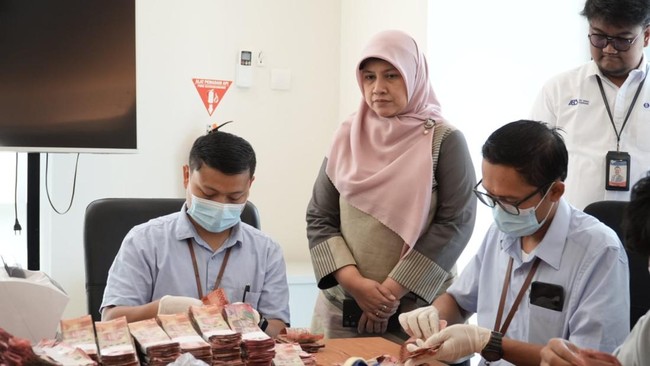
The Bank Indonesia (BI) Tegal Representative Office has provided services to exchange damaged Rupiah banknotes belonging to a resident of Batang Regency, who was affected by tidal flooding (rob).
The total amount of money involved reached Rp1.54 billion. The funds belong to Mrs Ida Murlija, a resident of Batang, whose money was damaged after her house was submerged by tidal waters.
The Head of the Bank Indonesia Tegal Representative Office, Bimala, stated that Ida completed the exchange process by registering through the PINTAR application via the website https://pintar.bi.go.id.
“The total amount submitted for exchange is claimed to be approximately Rp1.54 billion,” Bimala said in a press release on Friday.
Subsequently, BI officers conducted a thorough investigation of every banknote to ensure authenticity and to determine the replacement value in accordance with applicable regulations.
“Based on the results of the investigation, the amount of money meeting the requirements for replacement was recorded at Rp1.51 billion and has been replaced with fit Rupiah banknotes,” said Bimala.
Bimala noted that the service for exchanging damaged Rupiah is one of the forms of service Bank Indonesia provides to the public, which is carried out routinely every Tuesday and Thursday through prior booking via the PINTAR application.
Bimala added that not all damaged money can be replaced immediately.
“Replacement is only provided for authentic Rupiah that meets the requirements, including the condition that the physical size of the money remains more than two-thirds of its original size, its authenticity features are still recognisable, and it is a single unit or can be proven to originate from the same banknote,” he said.
Bimala emphasised that Bank Indonesia urges the public to store Rupiah and valuable documents in safe places to minimise the risk of damage caused by floods, fires, or other disasters.
Furthermore, he explained that the public is encouraged to utilise banking services as a safer and more protected means of storing funds, and to increasingly optimise the use of non-cash payment instruments, such as bank transfers, electronic money, and QRIS, as fast, easy, safe, and reliable payment alternatives.
“The service for exchanging damaged Rupiah is available openly, is easily accessible, and is free of charge as long as the applicable requirements are met,” he said.
Through this service, it is hoped that the public will further understand their rights and the procedures for exchanging damaged Rupiah and become more concerned with maintaining and caring for the Rupiah as a symbol of national sovereignty.