
BI Reinforces 7 Steps to Stabilise Rupiah, Optimistic on Exchange Rate Strengthening
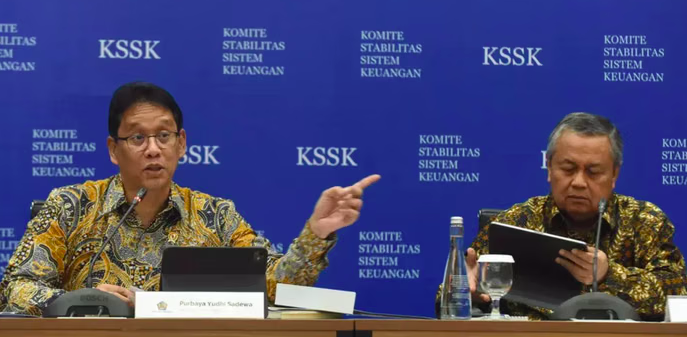
Bank Indonesia (BI) has reaffirmed its commitment to maintaining rupiah exchange rate stability and controlling inflation amidst global economic uncertainty. Various monetary policy instruments and financial market deepening efforts are being strengthened to mitigate the impact of external shocks on the national economy.
BI Governor Perry Warjiyo explained that the central bank has implemented seven key measures to maintain macroeconomic stability and strengthen financial sector resilience. The first step involves large-scale intervention in the foreign exchange market. The second is an interest rate response, both through raising the BI Rate and strengthening Bank Indonesia Rupiah Securities (SRBI) to enhance the attractiveness of foreign portfolio investment.
"The interest rate response, both the BI Rate and SRBI, is aimed at attracting back portfolio investment, and the results so far have been positive," he said during an online press conference for the BI Board of Governors Meeting on Thursday (18/6).
Additionally, BI continues to maintain adequate foreign exchange reserves and ensure sufficient liquidity in the money market and foreign exchange market. These efforts are carried out by keeping primary money growth at a double-digit level.
The central bank is also accelerating financial market deepening by developing instruments and market participants to make them more attractive. One focus is strengthening the domestic money market and foreign exchange transactions based on local currency through the Local Currency Transaction (LCT) scheme.
On the international cooperation front, BI is expanding collaboration with various central banks through LCT schemes, Bilateral Swap Arrangements (BSA), and cross-border payment system cooperation. The final step is strengthening supervision of the banking and corporate sectors.
Perry assessed that the increasingly close synergy between Bank Indonesia’s monetary policy and the government’s fiscal policy has yielded positive results for the rupiah exchange rate movement. "The rupiah exchange rate has strengthened, and we are confident it will become even stronger going forward," he asserted.
According to him, the rupiah’s strengthening is supported by BI’s consistent policy response, strong coordination with the government, and the easing of some global pressures despite remaining high uncertainty.
At this Board of Governors Meeting, BI again raised the BI Rate by 25 basis points to 5.75%. This policy was followed by adjustments to the SRBI yield structure across various tenors and the provision of swap incentives for foreign investors amounting to 10%.
"This is in the context of strengthening rupiah exchange rate stability. We are confident that the measures we continue to take, in close synergy with the government’s fiscal policy, will ensure that foreign capital flows continue to enter, and the rupiah will become increasingly stable and strengthen going forward," he explained.
BI is optimistic that the combination of measured monetary policy and close synergy with the government will sustain foreign capital inflows and encourage a more sustainable strengthening of the rupiah.
In addition to maintaining domestic stability, BI is also continuously strengthening international cooperation. One of the latest developments is the enhanced cooperation between the central banks of Indonesia and China in the use of local currencies for trade and investment transactions. Perry revealed that the value of Local Currency Transactions between Indonesia and China continues to increase significantly. Last year, total transactions reached US$18 billion, while in the first four months of this year, the value has already reached US$13 billion.
With the increasing use of the rupiah and renminbi in settling trade and investment transactions, the need for US dollars can be reduced, thereby strengthening the diversification of international payment systems and transactions.