
BI Rate Rises by 50 Basis Points, Economists Outline Its Effects on the Rupiah and the Economy
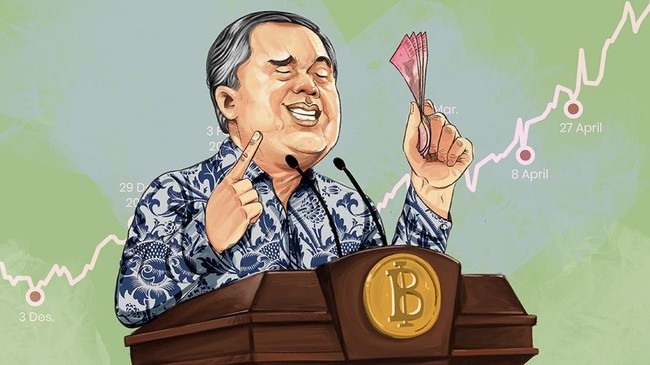
Jakarta, CNBC Indonesia – Bank Indonesia’s decision to raise the policy rate by 50 basis points to 5.25% is regarded as an aggressive step to safeguard rupiah stability. A number of economists say the policy will affect not only the rupiah’s exchange rate but also foreign capital inflows, bank lending, and domestic economic growth.
Chief Economist Fakhrul Fulvian of Trimegah Sekuritas Indonesia explained that the 50 basis point rise is the right move in response to the rupiah’s weakness. According to him, if Bank Indonesia is late to respond, stabilisation costs will be much higher.
“The BI decision is correct. This is not merely an interest rate hike; it is a statement that Indonesia’s policy anchor remains intact. In such a situation, Bank Indonesia must not be late. If late, stabilisation costs will be far higher,” he said in an official statement cited on Thursday (21 May 2026).
He argued that the pressures facing Indonesia are not just routine volatility but a phase that requires a pre-emptive monetary response. The policy rate increase will mark a turning point for the rupiah after it previously faced heavy pressure against the United States dollar (USD).
He projects the rupiah could strengthen gradually, with an initial target around Rp 17,300 per USD before moving toward a new equilibrium level around Rp 16,800 per USD.
“The rupiah has completed its overshooting phase. With a firm BI response, the market now has a new anchor. The Rp 17,300 level becomes the first stopping point, and if policy coordination goes well, the rupiah could move toward Rp 16,800,” he said.
Meanwhile, Danamon Bank economist Hosianna Situmorang regards the rate hike as a prudent pre-emptive move, but the pressure on the rupiah at present does not come solely from interest rate factors.
“There has been a surge in USD demand due to risk-off sentiment from global tensions, dividend-season repatriation, and high foreign currency needs for the Haj season,” Hosianna said.
He added that while the rate is effective in containing the pace of rupiah weakness, further appreciation will also depend heavily on the abatement of these external factors.
Hosianna disclosed that even before the BI Rate announcement, foreign investors had already begun to re-enter the domestic market in the past week.
“The decision to raise the policy rate widens the yield spread between domestic instruments and the Fed Funds Rate (FFR) as well as other Asia-Pacific regions, making them more attractive,” he said.
He noted that this situation could further boost foreign investor interest in Indonesia, especially as domestic growth prospects remain solid around 5%.
Nevertheless, the rate hike still carries consequences for the real sector and bank credit.
“However, the BI move is very rational. Maintaining exchange-rate stability is the top priority to prevent imported inflation (inflation of imported goods), whose impact could otherwise be more damaging to households’ purchasing power,” he said.
On the other hand, room for further rate hikes remains open and will depend heavily on the evolution of global economic data and rupiah volatility.
“With a BI policy stance that is pro-stability, the central bank will continue to monitor global dynamics and be ready to take further steps if volatility again threatens the rupiah’s fundamentals,” he said.
BCA’s Chief Economist, David E. Sumual, also assessed that the 50 bps rise at least could limit pressure on the rupiah, which had weakened sharply. However, he warned that stabilisation effects from the rate increase will remain limited if external and domestic pressures persist.
“This rate rise can dampen some of the pressure, because by lifting 50 bps BI signals its commitment to ongoing stabilisation. Yet if external and domestic developments persist, the fight continues, fiscal deficit risks widen, and the stabilisation effect from the rate increase will be limited,” Sumual told CNBC Indonesia on Thursday (21 May 2026).
Sumual noted that the financial sector would be the fastest to feel the impact of the policy rate increase, particularly the banking industry which will need to adjust pricing.
Additionally, exporters and importers will be affected by the rupiah’s exchange rate movements against the USD.
“For household consumption, the impact will be felt through consumer credit becoming more expensive, and the currency weakness feeding into prices via imported inflation,” he said.
Moreover, in theory, a rate increase will slow the pace of bank lending as borrowing costs rise. Nevertheless, David sees room for further BI rate rises if rupiah pressures do not ease.
Senior Economist and Executive Director at DBS Bank, Radhika Rao, also regards the BI rate hike as a front-loaded tightening strategy to maintain macroeconomic stability and the rupiah’s exchange rate, while ensuring inflation remains within the 1.5%-3.5% target.
She warned that inflationary pressures could rise in the second half of 2026 if the crisis in West Asia lasts longer, particularly as producer prices begin to outpace consumer inflation.
“A weaker rupiah despite ongoing interventions, dwindling foreign exchange reserves, and widening gaps with the SRBI have paved the way for tighter policy,” Rao said in a formal statement cited on Thursday (21 May 2026).
She stated that short-term rupiah appreciation will be helped by BI policies that better support exchange-rate stability. However, sustained appreciation will require larger capital inflows, market-friendly policies, and the easing of the global geopolitical crisis.
DBS even sees room for further increases.
Source: jawawa.id (https://jawawa.id/newsitem/bi-rate-rises-by-50-basis-points-economists-outline-its-effects-on-the-rupiah-and-the-economy-1779542699)
Originally published by CNBC Indonesia (https://www.cnbcindonesia.com/market/20260521130223-17-736679/bi-rate-naik-50-bps-deretan-ekonom-ungkap-efeknya-ke-rupiah-ekonomi), translated from Indonesian