
BI Rate Hikes Pressure Credit Demand, Banking Industry Faces Liquidity Challenges
Jakarta, TopBusiness – The aggressive increase in the Bank Indonesia (BI) Rate over recent months has begun to exert pressure on the national banking industry. In addition to increasing the cost of funds, this condition has also resulted in a slowdown in credit demand from both the public and business actors.
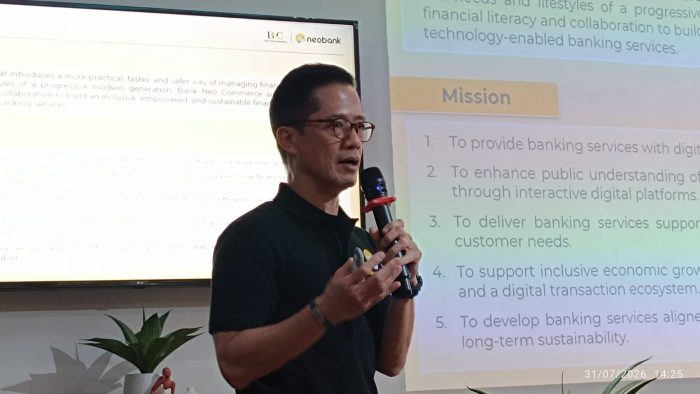
The President Director of PT Bank Neo Commerce Tbk (BND), Eri Budiono, stated that the impact of interest rate hikes is felt not only in fund collection but also affects the decisions of the public and the business world regarding financing.
“When interest rates rise and market liquidity is quite tight, companies and individuals will certainly reconsider whether they need to undertake investments or purchases involving financing,” Eri said during the Bank Neo Commerce Media Gathering in Jakarta on Friday (31/07/2026).
Between May and June 2026, Bank Indonesia gradually raised the BI Rate by a total of 100 basis points. In May 2026, the BI Rate rose by 50 basis points from 4.75% to 5.25%. Subsequently, in the weekly Board of Governors Meeting on 9 June 2026, BI raised the benchmark rate by another 25 basis points to 5.50%. In the June 2026 meeting, BI further increased the BI Rate by 25 basis points to 5.75%. Meanwhile, in the July 2026 meeting, Bank Indonesia decided to maintain the BI Rate at the 5.75% level.
According to Budiono, the business world tends to postpone expansion plans when financing costs increase. Similarly, the public is becoming more cautious in making consumption decisions that require credit facilities.
“From the corporate side, they will re-evaluate whether they need to expand or increase production capacity. For individuals, the same applies; purchasing decisions will become more selective,” he said.
He assessed that this condition is inseparable from the fact that public purchasing power is still facing pressure, meaning demand for financing has not yet fully recovered. On the other hand, increasingly tight liquidity has also triggered competition for fund collection between banks. Several banks have begun offering higher deposit rates to attract public funds.
Nevertheless, Bank Neo Commerce has chosen not to compete aggressively in raising deposit rates.
“Some banks have indeed offered deposit rates of over 8 per cent. We are certainly responding, but not by following aggressively right away. We are first observing the liquidity conditions and customer responses so that the increase in deposit rates is carried out gradually,” said Eri.
He noted that this strategy is implemented to ensure that the cost of funds remains controlled so as not to erode the company’s Net Interest Margin (NIM). As a digital bank, BNC is also focusing on optimising the growth of low-cost funds (CASA) through increased customer transactions rather than relying on high-interest deposits.
“We want to keep the funding structure healthy. What we are driving is the increase in customer transaction activity so that the composition of low-cost funds becomes larger,” he said.
Despite facing liquidity pressures, Eri believes that the fundamentals of the national banking industry remain quite strong. However, he hopes that various government policies can re-stimulate economic activity so that credit demand can increase.
According to him, the market is currently awaiting various positive catalysts, ranging from improving liquidity and increasing public purchasing power to the return of investment to Indonesia.
“We hope for more good news for the economy. If investors return, the business world expands again, and the public begins to increase consumption, then bank credit distribution will certainly grow better,” he said.
He also expressed hope that future government policies would be able to strengthen the confidence of business actors and investors, thereby revitalising national economic activity.
“The most important thing is how the public’s purchasing power can improve. If consumption increases, investment moves, and liquidity improves, the banking industry will be more free to perform its intermediation function to support economic growth,” concluded Eri.