
BI Purwokerto strengthens consumer protection education at DCF 2026
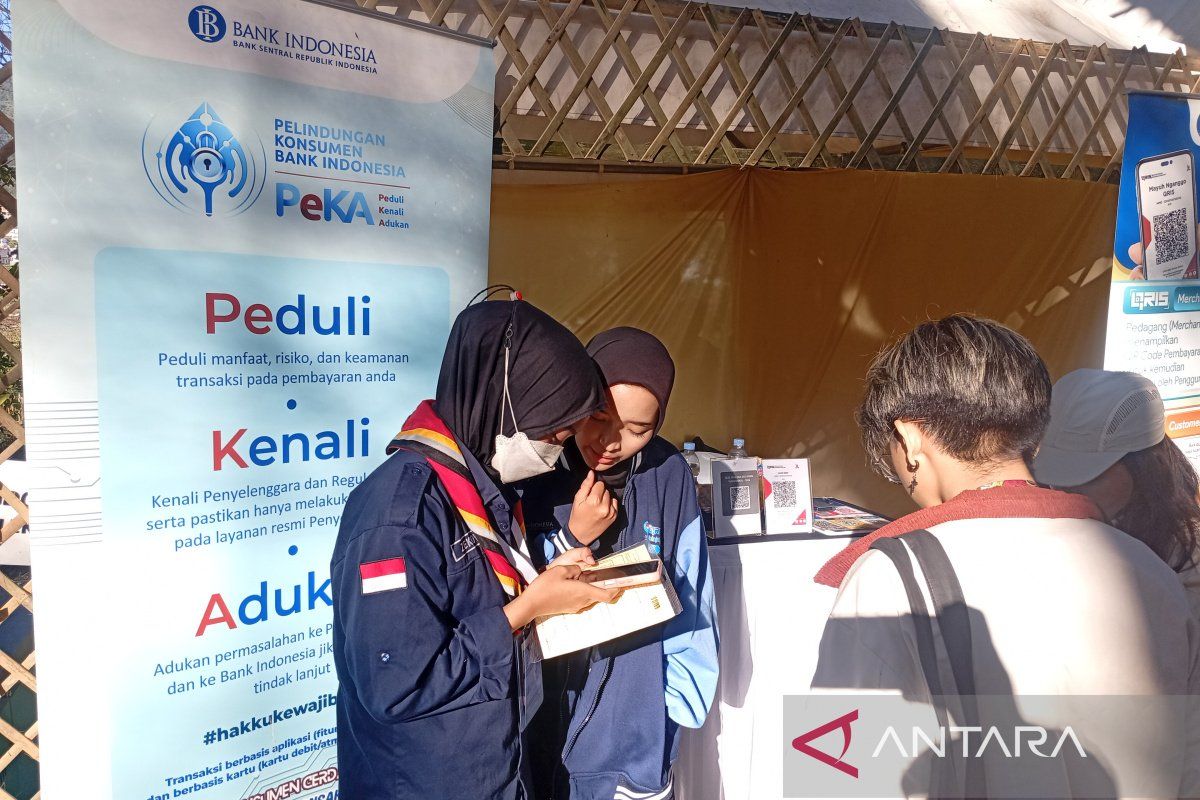
The ease of digital transactions needs to be balanced with public understanding of transaction security and the various fraud schemes that can target users of financial services.
The Purwokerto Representative Office of Bank Indonesia (KPwBI) is strengthening consumer protection education through the PeKA (Peduli, Kenali dan Adukan – Care, Recognise and Report) campaign as part of the Dieng Culture Festival (DCF) 2026 in Dieng Kulon Village, Banjarnegara Regency, Central Java, on 28–30 August.
Speaking on the sidelines of the event on Friday evening, Head of KPwBI Purwokerto Aswin Gantina said the campaign aims to increase public awareness of various fraud risks amid the increasingly widespread use of technology in financial transactions.
“Now financial transactions need to be careful. Many transactions are supported by technology. To transfer, to pay, people use QRIS, use virtual accounts,” he said.
According to him, the ease of digital transactions needs to be balanced with public understanding of transaction security and the various fraud schemes that can target users of financial services.
He reminded the public not to immediately follow instructions when receiving suspicious messages, links or communications, especially those requesting personal data or banking information.
“One of the main messages in the PeKA campaign is ‘if in doubt, stop first’,” he said.
He hopes this message will become a habit for the public when facing transactions or information whose veracity cannot yet be confirmed.
He cited the example of a fraud scheme via text message that offers a prize to the victim and then asks the recipient to click a certain link.
“If there is a suspicious SMS, if in doubt, stop first. There is an SMS like, ‘Sir, you have won a prize. Please click this link’, stop first,” he stressed.
In addition to text messages, he said, the public also needs to recognise phishing schemes through websites made to resemble official pages as well as social engineering, with perpetrators pretending to be bank officers or customer service (CS) staff.
“So we want the public to recognise the forms of fraud. There are websites that look similar, there is also OTP when called, social engineering, called by someone pretending to be a bank CS,” he said.
He explained that PeKA consists of three important steps: caring about potential fraud, recognising various digital crime schemes, and reporting suspected fraud to the appropriate parties.
According to him, the public must not remain silent when they find indications of fraud.
If they experience or discover suspicious transactions, he said, the public can report them to Bank Indonesia or the relevant bank.
Aswin said the campaign is also part of efforts to improve public literacy amid the increasing use of digital payment systems, including QRIS and virtual accounts.
A visitor to DCF 2026, Awaldian, welcomed the education provided by Bank Indonesia because it gives an understanding of consumer protection in digital transactions.
He considered the education important because the public is increasingly using digital payments, but not everyone yet understands the risks involved.
According to him, the public needs to be more careful about fraud schemes that exploit digital payment systems, including when someone shows proof or a QRIS scanning process as if a transaction has been completed.
“Sometimes there are fraudsters, when they want to pay there is already a scan to pay, even though they did not pay like that. The security is sometimes not yet safe,” he said.
Awaldian hopes the PeKA campaign can continue to be expanded so that the public increasingly understands how to transact safely and is able to recognise and report various digital fraud schemes.