
BI hopes bank liquidity is distributed more evenly through KLM PPU
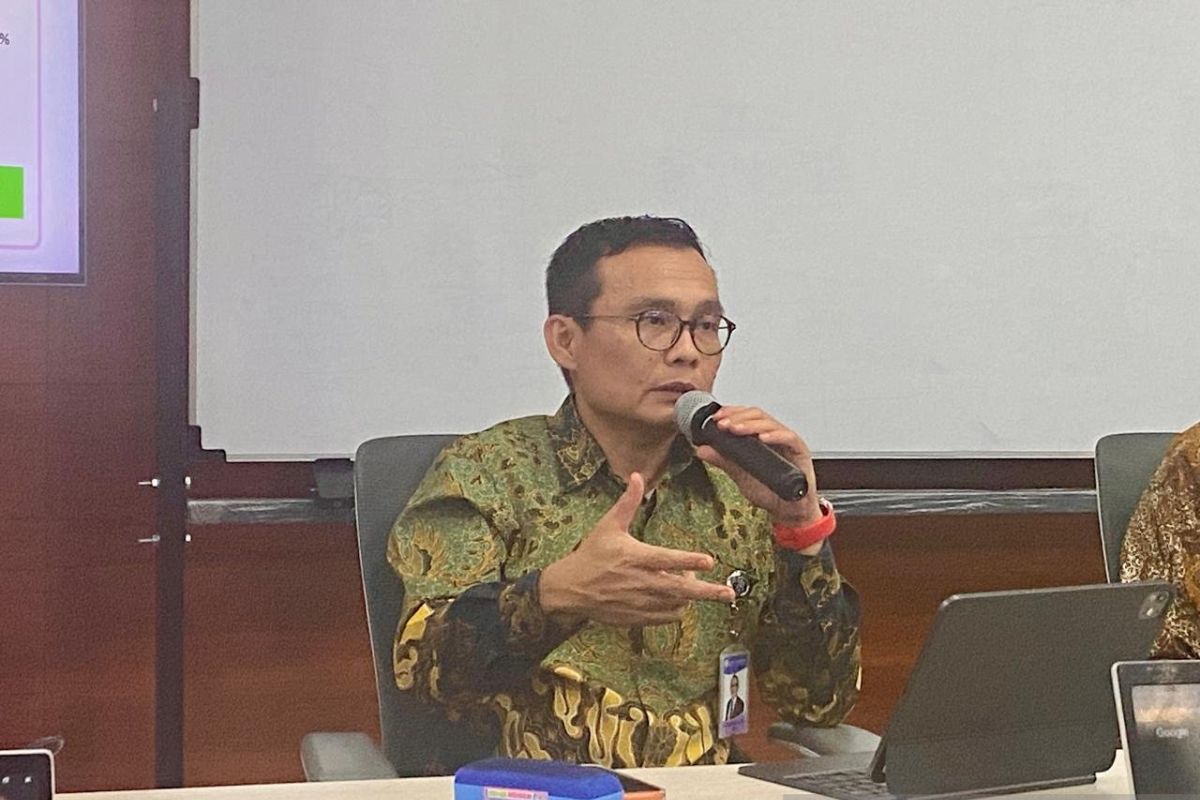
Bank Indonesia (BI) hopes that banking liquidity can be distributed more evenly among banks through the Macroprudential Liquidity Incentive Policy (KLM) for Money Market Deepening, particularly by encouraging the redistribution of liquidity from banks with a high proportion of securities holdings.
The securities referred to in this incentive include securities issued by the government or Government Securities (SBN) as well as non-repo Bank Indonesia Rupiah Securities (SRBI) in rupiah.
“We hope, first, that liquidity is optimally directed to support intermediation. Second, we encourage adequacy and redistribution,” said Alexander Lubis, Director of the Macroprudential Policy Department at BI, during a media briefing in Jakarta on Friday.
BI has mapped the liquidity position of banks into four quadrants that capture the condition of the Macroprudential Intermediation Ratio (RIM), the ratio of securities holdings to total funding, and the share of securities.
For information, RIM is an indicator for measuring the credit distribution function of banks. A RIM above 84 percent means a bank is considered active and optimal in distributing credit, while below 84 percent means the bank’s credit distribution is still considered suboptimal.
Meanwhile, the securities ratio shows the portion of bank funds allocated to securities instruments.
Interestingly, the mapping results show that the largest share of securities, namely 48.4 percent, is actually held by 25 banks in quadrant two with a RIM of less than 84 percent and a securities ratio of more than 19 percent.
BI assesses that there is a tendency for banks to increase the portion of securities holdings as investment instruments. In fact, securities holdings by banks should function as a liquidity buffer in liquidity management.
“If we look at quadrant two, this means there are banks whose portfolio decisions are investment-oriented. Now, this is what we are trying to return to: ‘Okay, these securities are a liquidity buffer’,” said Alex.
BI also noted that there are 34 banks in quadrant one with a RIM of more than 84 percent and a securities ratio of more than 19 percent, which control a securities share of 11.7 percent.
Then, there are 44 banks in quadrant four with a RIM of more than 84 percent and a securities ratio of less than 19 percent, with a securities share of 36.8 percent.
There is also a group of banks whose credit distribution is not yet optimal while also having a low portion of securities holdings, positioned in quadrant three. Banks in this group number 13 banks with a RIM of less than 84 percent and a securities ratio of less than 19 percent, with a securities share of 3.2 percent.
To address liquidity segmentation, BI has issued the Macroprudential Liquidity Incentive Policy (KLM) for Money Market Deepening, which will take effect from 1 September 2026 for conventional commercial banks, Islamic commercial banks, and Islamic business units.
Under this KLM, banks will receive a maximum incentive of 2 percent or 200 basis points (bps) of third-party funds if the bank maintains the ratio of SBN and non-repo SRBI holdings to total funding below 19 percent.
The incentive is provided through a reduction in the bank’s current account at BI in the context of fulfilling the average reserve requirement (GWM).
“If we look at it, this needs to be directed towards managing optimal banking liquidity to encourage intermediation while maintaining stability and money market deepening,” said Alex.
In addition to encouraging the redistribution of banking liquidity, Alex said this policy also simultaneously supports money market deepening. This is because if a bank has a securities ratio above 19 percent, the bank can conduct repo transactions so that the securities holding ratio decreases.
“What about, for example, ‘I have securities per funding of 23 percent, can I repo them?’ Yes, absolutely. I lend my securities to another bank, and my securities ratio goes down. Will I get the incentive? It will come in the next round,” explained Alex.
As a note, bank credit in July 2026 grew 13.58 percent year on year (yoy), up from growth in June 2026 of 12.67 percent (yoy).
On the other hand, third-party funds (DPK) in July 2026 also grew 11.21 percent (yoy). The ratio of liquid assets to third-party funds (AL/DPK) was recorded as stable at 23.10 percent in July 2026.
As of the first week of August 2026, the total KLM incentives obtained by banks were recorded at Rp446.5 trillion, with allocation to the financing channel of Rp368.4 trillion, the interest rate channel of Rp73.2 trillion, and the financing to funding channel of Rp4.9 trillion.