
BI Holds Rate at 5.75% as Economist Calls Move a Measured Step to Safeguard Stability and Growth
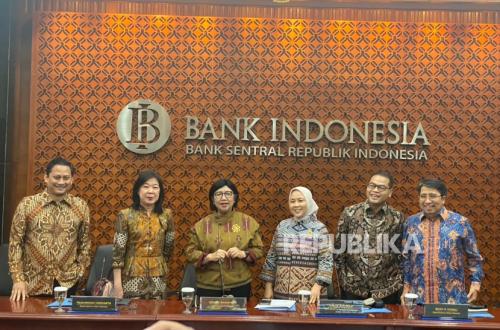
JAKARTA — Bank Indonesia (BI) has decided to maintain its benchmark BI Rate at 5.75% to strengthen rupiah exchange-rate stability and support sustainable economic growth. The decision was announced by BI Governor Destry Damayanti at a press conference following the October 2026 Board of Governors Meeting (RDG).
“The Bank Indonesia Board of Governors Meeting on 20–21 October 2026 decided to maintain the BI Rate at 5.75% and the Lending Facility rate at 6.50%, while raising the Deposit Facility rate to 5%,” Destry said at the October RDG press conference at BI’s headquarters in Jakarta on Wednesday (21 October 2026).
She said the decision was supported by an increase in incentives for the Domestic Non-Deliverable Forward (DNDF) hedging instrument with BI, intended to attract foreign capital inflows and maintain rupiah stability, as well as accelerate the deepening of the money and foreign-exchange markets (PUVA).
“This monetary policy remains consistent with the strategy of stabilising the rupiah amid continuing strong external pressures and efforts to keep inflation within the target of 2.5±1% in 2026 and 2027,” she said.
Destry said BI would continue to optimise its range of monetary policy instruments to strengthen external resilience, including taking any necessary adjustment measures to maintain economic stability.
Meanwhile, macroprudential and payment-system policies will continue to be directed towards sustaining economic growth. Easing macroprudential policy will be strengthened to increase lending and financing to the real sector while maintaining financial-system stability.
“Payment-system policy is intended to support economic activity by broadening the acceptance of digital payments, strengthening risk management in payment services, and improving the reliability and resilience of payment-system infrastructure,” she said.
Despite holding interest rates, BI is stepping up incentives, including phased reductions in the statutory reserve requirement (GWM) to increase bank liquidity. For conventional commercial banks (BUK), the requirement will be cut from 9% to 7%. The first reduction, from 9% to 8%, takes effect on 1 November 2026, followed by a second reduction, from 8% to 7%, on 1 December 2026.
The incentives also apply to Islamic commercial banks (BUS) and Islamic business units (UUS), whose reserve requirement will be lowered from 7.5% to 5.5%.
“For BUS and UUS, the first reduction will be one percentage point, from 7.5% to 6.5%, effective 1 November 2026. The second reduction will be one percentage point, from 6.5% to 5.5%, effective 1 December 2026,” she explained.
Destry said the reserve requirement cuts would be implemented through an adjustment to the Macroprudential Liquidity Incentive Policy (KLM), which will be reduced from 6% to 5%, effective 1 December 2026.
“The portion of the average rupiah reserve requirement that earns remuneration will be capped at 5% of the average rupiah reserve requirement, effective 1 December 2026,” she said.
The reserve requirement cuts are expected to add to banking-system liquidity. BI estimates the increase could approach Rp200 trillion.
“A two-percentage-point reduction in the reserve requirement means additional liquidity; our calculation puts it at around Rp190 trillion. So we are seeking to optimise all the policy tools available to us,” she said.
Source: jawawa.id (https://jawawa.id/newsitem/bi-holds-rate-at-5-75-as-economist-calls-move-a-measured-step-to-safeguard-stability-and-growth-1792975835)
Originally published by Republika (https://ekonomi.republika.co.id/berita/tncyc3502/bi-rate-tetap-575-persen-ekonom-langkah-terukur-jaga-stabilitas-dan-pertumbuhan), translated from Indonesian