
BI Governor Perry Warjiyo Resigns, the Only One to Serve Two Terms
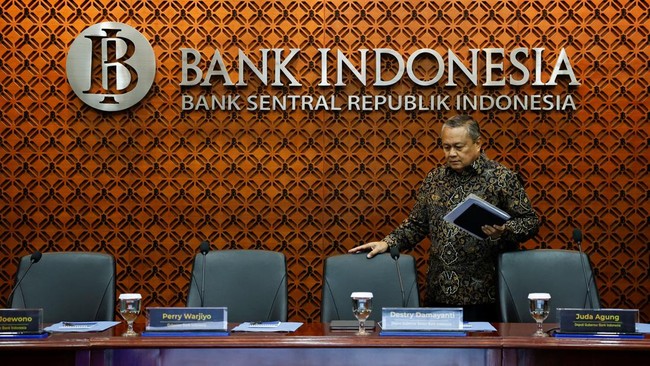
Jakarta, CNBC Indonesia – Governor of Bank Indonesia (BI) Perry Warjiyo decided to resign from his post as of Saturday (25/7/2026). His letter of resignation has been submitted to President Prabowo Subianto.
In its official statement, BI said Perry resigned voluntarily for personal reasons.
“Mr Perry Warjiyo’s resignation from the position of Governor of Bank Indonesia is voluntary and due to personal reasons,” the statement read on Monday (27/7/2026).
In accordance with Article 48 paragraph (1) letter a of Law Number 23 of 1999 on Bank Indonesia, as most recently amended through Law Number 4 of 2026 on the Development and Strengthening of the Financial Sector, the BI Board of Governors convened a meeting on Sunday (26/7/2026).
At that meeting, Senior Deputy Governor Destry Damayanti was appointed as interim Governor of BI in accordance with Article 50 paragraph (2) of the BI Law.
The BI Board of Governors assured that the duties and authorities of the central bank would continue to run, from maintaining the stability of the rupiah, preserving the stability of the payment system, to helping safeguard the stability of the financial system.
BI also affirmed it would continue to prioritise good and professional institutional governance, and to synergise and coordinate with the government in carrying out their respective duties.
Perry Warjiyo’s resignation brings his leadership of Bank Indonesia to a close after more than eight years, since 2018.
Looking further back, the history of Bank Indonesia began on 1 July 1953. At that time, De Javasche Bank (DJB) officially transformed into Bank Indonesia after the government carried out a nationalisation by purchasing around 97% of DJB’s shares.
The change was reinforced through Law Number 11 of 1953 on the Principles of Bank Indonesia, which replaced the De Javasche Bank Wet 1922. From that point, Bank Indonesia officially stood as the central bank of the Republic of Indonesia.
Sjafruddin Prawiranegara then became the first Governor of Bank Indonesia after independence. Previously, he had also led De Javasche Bank from 1951 until the institution became Bank Indonesia in 1953.
Perry is the only BI governor of the Reformasi era to serve two terms, and the longest-serving at 8 years, 3 months and 8 days. He was first inaugurated on 16 April 2018.
However, the longest-serving BI governor to hold the office was Rachmat Saleh, who served from 1973 to 1983.
Since its official establishment, Bank Indonesia has been led by 16 definitive governors.
Over the course of its history, the position of BI Governor has also been filled on an interim basis. Miranda Goeltom carried out the role from May to July 2009 after Boediono resigned to run as a candidate for vice president.
Afterwards, Darmin Nasution served as acting governor from July 2009 before being officially inaugurated as Governor of BI in September 2010.
The position is now temporarily held by Senior Deputy Governor Destry Damayanti following Perry Warjiyo’s resignation. Destry will carry out the duties of interim Governor of BI until a new governor is appointed.
From the Pandemic Crisis to QRIS: Perry Warjiyo’s Trail Leading BI for Two Terms
“The business of a central bank is to worry.” Those words, once spoken by former Deputy Chair of the Federal Reserve Alice Rivlin in the 1990s, became relevant again after the Covid-19 pandemic shook the world economy. Inflation soared, food and energy prices rocketed due to war and geopolitical tensions, while central banks were forced to take extraordinary measures to safeguard economic stability.
Perry Warjiyo was appointed and carried out the role across those two terms.
Perry’s name was first proposed as BI governor in February 2018 by President Joko Widodo (Jokowi). His name was proposed again by Jokowi in 2023 as BI governor.
Amid a global situation full of uncertainty and in the post-pandemic period, Perry was named the sole candidate for BI Governor for the 2023–2028 term, continuing his first term which began in 2018.
At the time, Jokowi judged that coordination between fiscal and monetary policy under Perry’s leadership had gone well. With the world still shadowed by crisis, the President affirmed that the government did not want to take the risk of changing the helmsman of the central bank.
The decision subsequently received approval from the House of Representatives (DPR) through the fit-and-proper test in March 2023. Perry was officially re-inaugurated on 24 May 2023, making him the first BI governor of the Reformasi era trusted to lead for two consecutive terms.
A Long Track Record at Bank Indonesia
Born in Sukoharjo in 1959, Perry Warjiyo is an economist who graduated from the Faculty of Economics at Universitas Gadjah Mada (UGM), before continuing his Master’s and PhD studies at Iowa State University in the United States.
His career at Bank Indonesia began in 1984. Over nearly four decades, Perry held various strategic positions, ranging from economic research, monetary policy, macroprudential affairs, foreign exchange management, to international relations.
Before becoming BI Governor, Perry served as a BI Deputy Governor from 2013 to 2018. He also served as Executive Director of the International Monetary Fund (IMF), representing the 13 member countries of the South-East Asia Voting Group.
Bequeathing New Instruments
In his second term, Perry did not only focus on maintaining the stability of the rupiah and inflation. BI also introduced various new instruments to deepen the domestic financial market.
Among the instruments launched were:
Foreign Currency Term Deposits (TD), to absorb export proceeds (DHE).
Bank Indonesia Rupiah Securities (SRBI), to attract foreign capital inflows while strengthening money market deepening.
Bank Indonesia Foreign Currency Securities (SVBI).
Bank Indonesia Foreign Currency Sukuk (SUVBI), as a new instrument to strengthen the stability of the rupiah exchange rate and the domestic foreign exchange market.
These instruments became part of BI’s strategy to broaden investment options whilst maintaining liquidity in the financial system amid high global turbulence.
Taking the Rupiah Global
Beyond strengthening monetary policy, Perry also pushed for the internationalisation of Indonesia’s payment system.
Under his leadership, the implementation of QRIS Cross Border began with several countries in Asia, including Thailand, Malaysia and Singapore, and was later expanded to other countries. Indonesians can transact abroad using QRIS without having to exchange cash.
Bank Indonesia also expanded Local Currency Transaction (LCT) cooperation with various central banks, including South Korea, Japan, China, Malaysia, Thailand and Singapore. The move aims to reduce dependence on the US dollar in trade and investment transactions between countries.
Maintaining Stability Amid Uncertainty
Throughout his two terms of leadership, Perry faced various challenges, from the Covid-19 pandemic, the surge in global inflation, exchange rate turbulence, to the fragmentation of the world economy.
Amid these pressures, Bank Indonesia continued to strive to maintain a balance between price stability, rupiah exchange rate stability, financial market deepening, and support for national economic growth.
Source: jawawa.id (https://jawawa.id/newsitem/bi-governor-perry-warjiyo-resigns-the-only-one-to-serve-two-terms-1785127862)
Originally published by CNBC Indonesia (https://www.cnbcindonesia.com/research/20260727095419-128-754018/daftar-gubernur-bi-perry-warjiyo-satu-satunya-menjabat-2-periode), translated from Indonesian