
BI Governor: Managing the Rupiah Is an Art of Choosing Policy Instruments
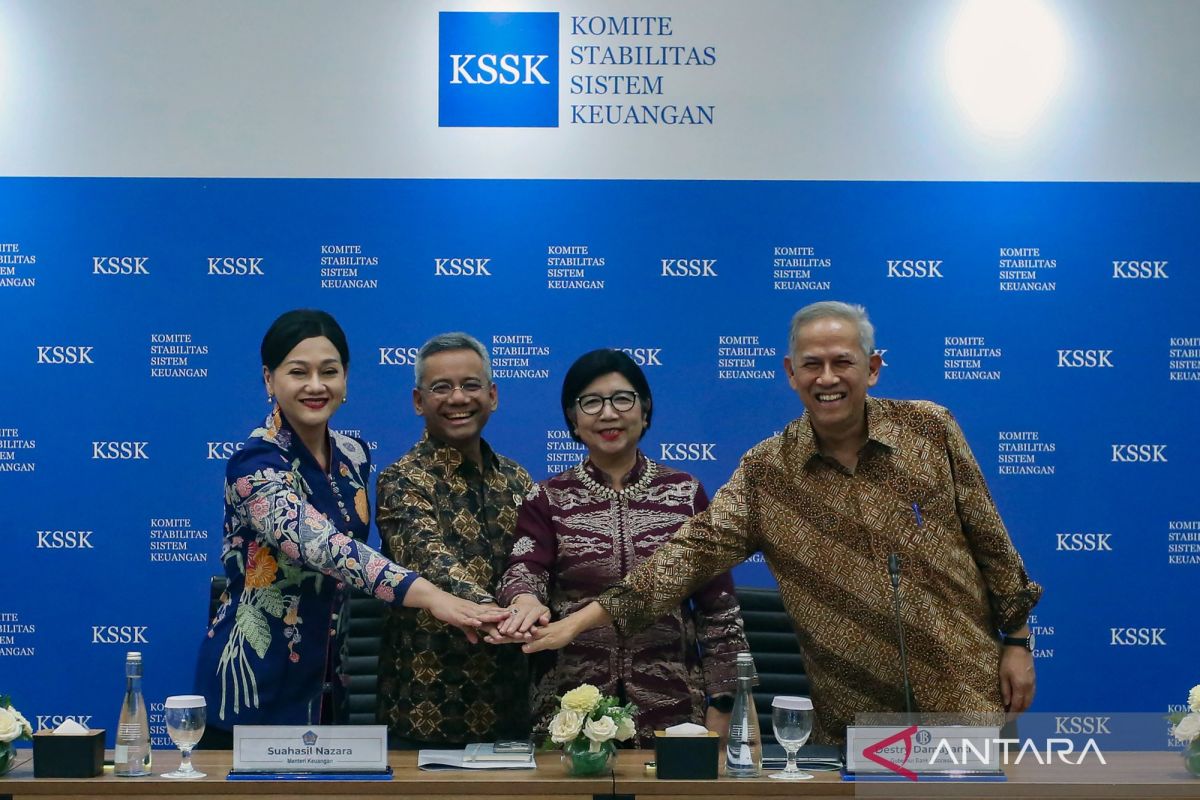
Jakarta (ANTARA) — Bank Indonesia (BI) Governor Destry Damayanti considers efforts to maintain rupiah stability an art of selecting policy instruments suited to market conditions.
“When do we focus on one tool or instrument, and when do we focus on other measures or instruments?” Destry said at a press conference of the Financial System Stability Committee (KSSK) in Jakarta on Tuesday.
Destry explained that BI’s mandate is not only to maintain stability, but also to create a conducive economic climate that encourages growth in the real sector and job creation. However, she said, stability remains the main anchor, as a conducive economic climate cannot be created without it.
To maintain stability, BI takes the rupiah’s fundamental value into account as one of its benchmarks. Destry cautioned, however, that the currency’s movements are also affected by various domestic and international factors, including market sentiment.
When sudden shifts in sentiment cause the rupiah to move away from its fundamentals, BI intervenes to balance exchange-rate movements so that they continue to reflect fundamental conditions.
Destry added that intervention is one of BI’s tools for maintaining rupiah stability, alongside interest-rate policy, the issuance of Bank Indonesia Rupiah Securities (SRBI), and the development of more targeted incentives for hedging costs.
These instruments are combined and used according to prevailing conditions. BI therefore does not rely on a single instrument to maintain the rupiah’s stability.
“So, if asked whether BI will continue to use intervention: yes, we will certainly continue to be present to maintain market stability, whether through spot transactions, Domestic Non-Deliverable Forwards (DNDFs) or Deliverable Forwards (NDFs). So far, we still consider the results quite effective,” Destry said.
According to BI data, the rupiah had strengthened through mid-September 2026, but by 2 November 2026 it had weakened by 0.11 per cent to Rp18,145 per US dollar compared with its level at the end of October 2026.
BI said the depreciation was influenced by escalating geopolitical conflict in the Middle East, continued tightening of US monetary policy, and global investor sentiment towards emerging-market assets.
Foreign portfolio investment recorded net outflows of US$0.08 billion in the third quarter of 2026, mainly due to outflows from equities. At the start of the fourth quarter, through 23 October 2026, foreign capital flows improved, recording net inflows of US$0.04 billion, supported mainly by investment in government securities (SBN) and SRBI.
As a result, foreign portfolio investment recorded net inflows of US$13.23 billion from January to 23 October 2026.
Meanwhile, Indonesia’s foreign exchange reserves remained strong at US$146.3 billion at the end of September 2026. This was equivalent to 5.3 months of imports, or 5.2 months of imports and government external debt payments, well above the international adequacy standard of around three months of imports.
Source: jawawa.id (https://jawawa.id/newsitem/bi-governor-managing-the-rupiah-is-an-art-of-choosing-policy-instruments-1793721153)
Originally published by Antara (Indonesian) (https://www.antaranews.com/berita/5829943/gubernur-bi-jaga-rupiah-ibarat-seni-saat-pilih-instrumen-kebijakan), translated from Indonesian