
BI Governor Calls for a Sharia GDP Measure to Track Indonesia’s Islamic Economy
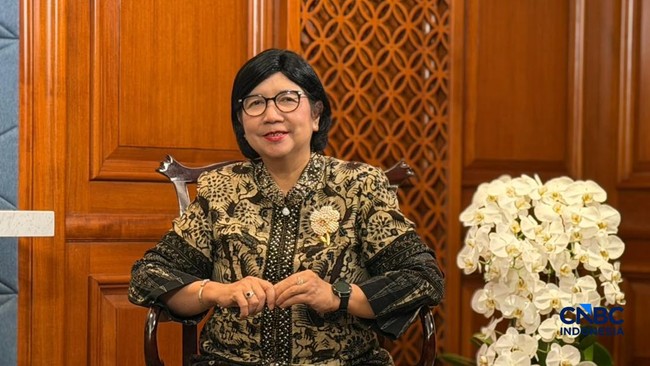
Jakarta — Bank Indonesia Governor Destry Damayanti has proposed a dedicated report on Sharia gross domestic product (GDP) to measure Indonesia’s Islamic economy.
Destry said the measure would capture the sector’s substantial potential, which, according to data cited at the event, accounts for 24.9% of Indonesia’s total GDP.
“I was just speaking quietly with Ms Amalia [BPS chief Amalia Adininggar Widyasanti], and it seems BPS should publish a Sharia GDP report soon, because it was also mentioned that the Islamic economy makes up 24.9% of GDP,” Destry said at the opening of ISEF 2026 at the Jakarta International Convention Centre on Tuesday (14 October 2026).
She said Bank Indonesia was ready to provide full support for producing a Sharia GDP measure, enabling more focused development of the sector and the creation of halal supply chains.
Indonesia’s Islamic economy still has considerable potential and room to grow. It is also an important part of the country’s efforts to achieve faster and higher economic growth.
Deputy Coordinating Minister for Economic Affairs Drajad Hari Wibowo said strengthening the Islamic economy could broaden sources of growth and improve competitiveness through financing and the development of halal industries.
“Islamic economics is one of our mainstays for achieving growth of 6% in 2027 and 8% in the medium term, as part of improving competitiveness,” Drajad said at the opening of ISEF 2026.
He said Indonesia’s Islamic financial assets had reached Rp3,131 trillion, representing 11.36% of total national financial assets.
The government said these assets could help accelerate Indonesia’s economic growth, with targets of 6% in 2027 and 8% in 2028.
Drajad said the opportunities in the Islamic economy were significant. Global Muslim spending is projected to reach nearly US$3.6 trillion by 2029, while global Islamic financial assets are expected to reach US$9.72 trillion.
The government is pursuing five strategies to develop the Islamic economy: strengthening halal industries and micro, small and medium-sized enterprises; increasing exports and international cooperation; reinforcing the halal ecosystem; developing Islamic finance; and strengthening Islamic social finance.
“This is one of the opportunities and strategies we are pursuing,” Drajad said.
The government said the country’s existing halal value chain had helped stimulate economic activity, accounting for about 25% of GDP, or Rp1,524 trillion, in the fourth quarter of 2025.
“The ecosystem is also becoming stronger: there are 4.4 million halal certificates covering 14.6 million products, 39 partner countries recognising certification through mutual recognition, and four halal industrial zones,” Drajad said.
Source: jawawa.id (https://jawawa.id/newsitem/bi-governor-calls-for-a-sharia-gdp-measure-to-track-indonesias-islamic-economy-1791967830)
Originally published by CNBC Indonesia (https://www.cnbcindonesia.com/syariah/20261014144950-29-776139/bos-bi-bps-bisik-bisik-di-acara-syariah-ternyata-bicarakan-hal-ini), translated from Indonesian