
BI Governor and Minister Discuss Support for Housing Programmes, Here are the Results
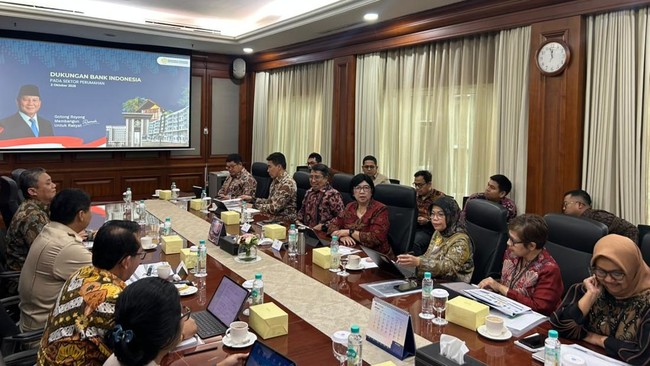
The Minister of Housing and Residential Areas, Maruarar Sirait, held a special meeting with the Governor of Bank Indonesia (BI), Destry Damayanti, regarding central bank support for President Prabowo Subianto’s housing programme.
Following the meeting, which commenced around 11:00 WIB, Governor Destry Damayanti stated that the central bank has expressed its commitment to continue supporting easier access to financing for the public through government housing programmes. “We discussed the necessary synergy between Bank Indonesia and the government to support government programmes, specifically in housing,” Destry said during a press conference on Friday (2/10/2026).
In the meeting with the Minister, commonly known as Ara, Destry revealed that BI continues to provide Macroprudential Liquidity Incentive (KLM) policies aimed at maintaining adequate banking liquidity to ensure housing finance remains affordable for the public. “In September 2026, we issued the Macroprudential Liquidity policy where the housing, real estate, and construction sectors have a ceiling of 1.4% of total third-party funds (DPK). Currently, 1.32% has been realised. Therefore, there is still 0.08% that can be optimised, Mr Minister,” Destry emphasised.
Destry noted that with the 1.32% KLM portion realised, the banking sector has obtained additional liquidity of approximately Rp118 trillion as of September 2026, resulting from the reduction of the statutory reserve requirement (GWM) at Bank Indonesia. The total number of banks receiving this incentive reached 111.
“The impact of the KLM certainly supports the credit or financing share in the housing, real estate, and construction sectors, each at 18.76%, which is equivalent to 18.9% of total banking credit in August 2026. This is the first KLM-related policy for the housing sector,” Destry explained.
Furthermore, BI is maintaining loose financing policies for banks to support the housing sector with a loan-to-value ratio of up to 100%. “This means the credit value that can be provided by banks can reach 100% of the collateral. Since housing is relatively safe, as the house serves as the guarantee,” Destry elaborated.
Additional support is also provided through the Macroprudential Inclusive Financing Ratio (RPIM). Through this policy, the modality of fulfilling RPIM via home ownership financing for low-income communities continues to increase. “In 2023, it was only around 27.8%, but in 2025, this ratio increased to 29%. We will certainly look deeper into the final position for 2026,” she asserted.
Regarding new support aimed at creating loose liquidity for banks, Destry mentioned the expansion of bank underlying repos to Bank Indonesia for securities or debt instruments from PT SMF and PT SMI, which are public service agencies under the Ministry of Finance, including support for the housing sector. “For SMF, we issued [the policy] on 26 September 2025, and banks that have conducted repos with us have reached 1.25 trillion. Meanwhile, transactions from SMF have increased sixfold, from a daily Rp31 billion to Rp180 billion. This serves not only to deepen the financial market but also to provide funding for the housing sector,” Destry concluded.