
BI and China's Central Bank Agree to Strengthen De-Dollarised Transactions
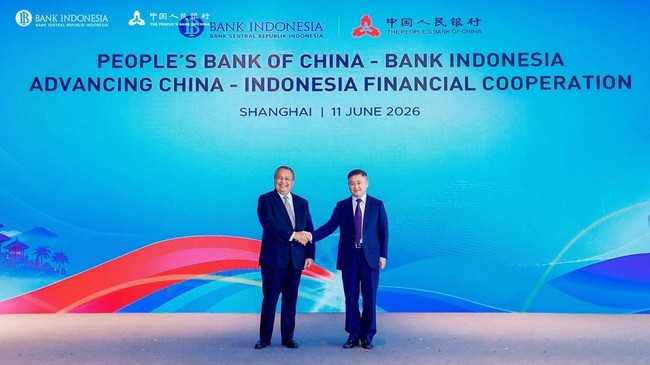
Bank Indonesia (BI) and the People’s Bank of China (PBOC) have agreed to explore increasing the value of their Bilateral Currency Swap Arrangement (BCSA). The cooperation also supports the efforts of both central banks to maintain exchange rate stability through the expanded use of local currencies and the strengthening of financial infrastructure. This was revealed by the two central banks at a High-Level Meeting attended by Governor Perry Warjiyo and Governor Pan Gongsheng in Shanghai, China, on Thursday.
On this occasion, the two central banks also reaffirmed their commitment to increasing the use of local currencies in bilateral transactions and strengthening cross-border payment connectivity between Indonesia and China through three main achievements. Firstly, Governor Perry, Governor Pan, and the Chief Executive of the Hong Kong Monetary Authority (HKMA), Eddie Yue, signed a Memorandum of Understanding (MoU) on Local Currency Transactions (LCT) covering Indonesia and Hong Kong. “This cooperation strengthens the existing LCT framework to encourage the use of local currencies in bilateral transactions, improve transaction efficiency, and support deeper regional financial market integration,” said Perry.
Secondly, BI and PBOC launched the implementation of Indonesia-China cross-border QR payments. Supported by the LCT framework, this initiative allows cross-border retail transactions to be carried out more easily, quickly, efficiently, inclusively, and reliably, while supporting closer digital economic connectivity between the two countries. “Through this launch, payment system service providers supporting cross-border QR transactions will have wider reach and participation, with the number of providers reaching 191 in China and 24 in Indonesia,” he explained.
Thirdly, Bank Mandiri has officially been designated as a direct participant in the Cross-border Interbank Payment System (CIPS), China’s cross-border payment system. This participation aims to improve the efficiency of the clearing and settlement process for Indonesia-China transactions, while strengthening the resilience of cross-border payment infrastructure. Responding to these developments, Perry emphasised that future financial cooperation will strengthen local currency transactions between Indonesia and China, develop financial infrastructure, and expand cooperation between central banks, including the establishment of an RMB Clearing Bank in Indonesia.
Governor Pan added that China and Indonesia, as major economies and strategic partners in the region, share a responsibility to deepen bilateral economic and financial cooperation. “This strengthening of cooperation is expected to contribute to the prosperity and stability of the region, while supporting the economic resilience of both countries,” said Pan. The achievements mark an important milestone in strengthening bilateral financial cooperation and are expected to help businesses reduce transaction processing costs for businesses and the public in both countries.
At the meeting, BI and PBOC also signed a Memorandum of Understanding (MoU) on the Establishment of a Renminbi Clearing Arrangement in Indonesia to support the development of the domestic RMB ecosystem through the provision of adequate Renminbi liquidity for trade, investment, and financial activities. BI and PBOC’s commitment to driving economic and financial integration through the expansion of payment system connectivity and the development of more efficient, inclusive, and robust financial markets will further strengthen economic stability and the resilience of the financial systems in both countries.