
BGN Changes Under Sudaryono as Anti-Corruption Drive Reaches MBG Kitchens
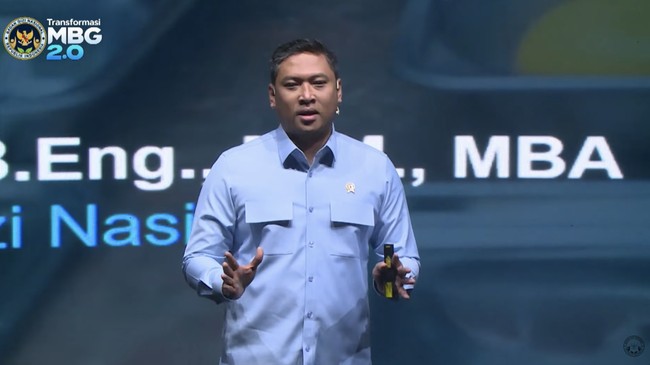
Jakarta, CNBC Indonesia – National Nutrition Agency (BGN) chief Sudaryono announced the MBG 2.0 transformation on Thursday (29 October 2026), marking 100 days in office. President Prabowo Subianto appointed him BGN chief on 22 July 2026.
Sudaryono replaced Nanik Sudaryati Deyang, who had earlier taken over from Dadan Hindayana. Dadan has been named a suspect in an alleged corruption case involving procurement for the Free Nutritious Meals (MBG) programme.
Sudaryono said corruption had become widespread within the BGN, with a culture that spread from senior levels down to the kitchens. The alleged practices included the buying and selling of MBG service locations, inflated procurement costs and a lack of clear management standards.
He said MBG had a worthy purpose, but acknowledged that the programme still faced many problems and would require continuing improvements.
In a video on the BGN’s official YouTube channel on Thursday (29 October 2026), Sudaryono said the agency had previously been run on the principle that everything should be handled internally, without involving other parties. As a result, coordination and communication were poor.
“When I first arrived, what shocked me was that the BGN had around 700 staff directly overseeing about 27,000 kitchens, with very limited oversight infrastructure and very little collaboration with other ministries and agencies,” he said.
“Corrupt practices were rampant. If the fish rots from the head, when the head steals, those below steal too, all the way down to the kitchens. This culture had spread right down to kitchen level. Some individuals are now facing legal proceedings,” Sudaryono said.
Another problem within the BGN, he said, was the buying and selling of locations for MBG services. He estimated that transactions were worth Rp300 million to Rp350 million. Citing records from the Attorney General’s Office, he said around 560 to 600 fictitious MBG kitchens were suspected of being linked to the practice.
“Before I became BGN chief, I had often heard of locations being traded for Rp350 million or Rp300 million. There were also many broker foundations. I found this after becoming chief, when I updated the cooperation agreements and saw a great many such foundations,” he said.
He explained that, ideally, a kitchen would be built by a partner or investor, who would then establish a foundation in order to distribute government assistance. The foundation should ideally be headed and owned by that investor or MBG partner.
“What happened was that some officials at the former BGN headquarters set up numerous foundations and marked out locations, but had no money. Meanwhile, people who wanted to build kitchens had no access to locations through the BGN. The foundations had no real role: they just claimed locations and acted as brokers, then demanded a cut for every meal tray – Rp500, Rp1,000 or Rp1,500 per tray, every day, across thousands of trays and multiple kitchens,” Sudaryono said.
“Imagine a kitchen serving 2,000 trays. At Rp1,000 per tray, that is Rp2 million a day for one kitchen. Across 500 kitchens, it is Rp1 billion in income – without effort, investment or doing anything, just extortion,” he said.
Overhaul to improve the MBG programme
Sudaryono said these practices had triggered a domino effect, including poor standards for MBG meals.
“That is why so many locations and findings on social media and elsewhere showed MBG menus that did not meet standards. They were affected by deductions from extortion and other unnecessary cuts,” he said.
“Now we are cleaning all of that up. It does not matter who owns the foundation. If it has no role, we will remove it,” he said.
The clean-up would also cover procurement at the BGN and for MBG services, Sudaryono said. He cited questionable purchases that had attracted public attention, including socks and bed sheets.
“When we arrived, we found a proposed procurement contract for large LED screens worth Rp535.3 billion. On my second day, the deputy chief, all the director-generals and I decided to cancel it,” he said.
He said staff had failed to carry out the cancellation order promptly. “I am sorry, but we dismissed those employees and removed them all. When we came in, we replaced everyone from security guards, receptionists and cleaners to all echelon-II officials. We stopped improper procurement,” he said.
The agency has also strengthened governance oversight and food-safety procedures throughout the supply chain, covering the procurement, receipt and storage of ingredients; preparation and cooking; portioning and labelling; and distribution to recipients.
Every MBG food tray must be sealed and labelled with its consumption deadline. Working hours have been set according to kitchen schedules, and daily roll calls are required in each region via Zoom. Kitchen CCTV must be connected to the central system, which uses artificial intelligence to detect activity.
Sudaryono has also required each kitchen to obtain a Hygiene and Sanitation Feasibility Certificate (SLHS) and to employ experienced cooks. The BGN and regional MBG task forces will conduct regular unannounced inspections.
Other measures include responding rapidly to food-poisoning incidents through inter-agency coordination, taking firm action against staff and kitchens that breach rules, communicating transparently and collaboratively, and strengthening cooperation with other ministries, agencies and local governments.
Sudaryono said that during the improvement drive from July to September 2026, 13 people had been named suspects. The Attorney General’s Office had examined 203 people, 353 people had been dismissed, and the BGN inspectorate had examined 2,600 people. A total of 1,288 kitchens had been permanently closed, while 1,999 were suspended pending checks against kitchen safety standards.
He said the programme’s measures of progress over the first 100 days included more than 57 million verified beneficiaries and 26,723 verified kitchens out of 27,485. Of the 2026 budget, Rp165 trillion had been spent. The programme employed 1.03 million people, including staff and volunteers; about 82.83 per cent of its 80,315 local suppliers were micro, small and medium-sized enterprises (MSMEs); and Rp44 trillion in public funds had been returned to the state treasury.
From MBG 1.0 to MBG 2.0
Sudaryono described the previous version, MBG 1.0, as having locations sold and procurement costs marked up; daily incentives of Rp6 million and money lost through leakage; unfit kitchens and unsafe food; weak oversight and low penalties; an agency working alone; resistance to criticism; and benefits going to schools that could afford to provide meals themselves.
Under the new MBG 2.0 approach, he said, brokers would be eliminated and procurement fixed; costs would be reduced by Rp2,000 per portion, saving Rp44 trillion; SLHS certification and food-safety procedures from farm to table would be mandatory; Zoom checks, inspections, CCTV and AI would bolster oversight and enforcement; and the agency would work with ministries, agencies and local governments through “Radar MBG”. Complaints would be followed up, while support would focus on the 3T regions – the frontier, outermost and least-developed areas – and those most in need.
As well as tackling corruption and improving transparency, Sudaryono said he was reviewing all cooperation agreements with partner Nutrition Service Provision Units (SPPGs).
“There will be no project patronage in MBG. We will eliminate broker foundations and stop problematic procurement. I do not receive visitors to discuss kitchens. We will fix and root out anything unreasonable or lacking in conscience,” he said.
“We are updating agreements with all SPPGs. Data must be verified, fictitious entries removed, and workflows monitored through a digital system,” he said.