
Beyond Tourism: Exploring Bali's New Tech-Savvy Economic Vision at Coinfest Asia 2026
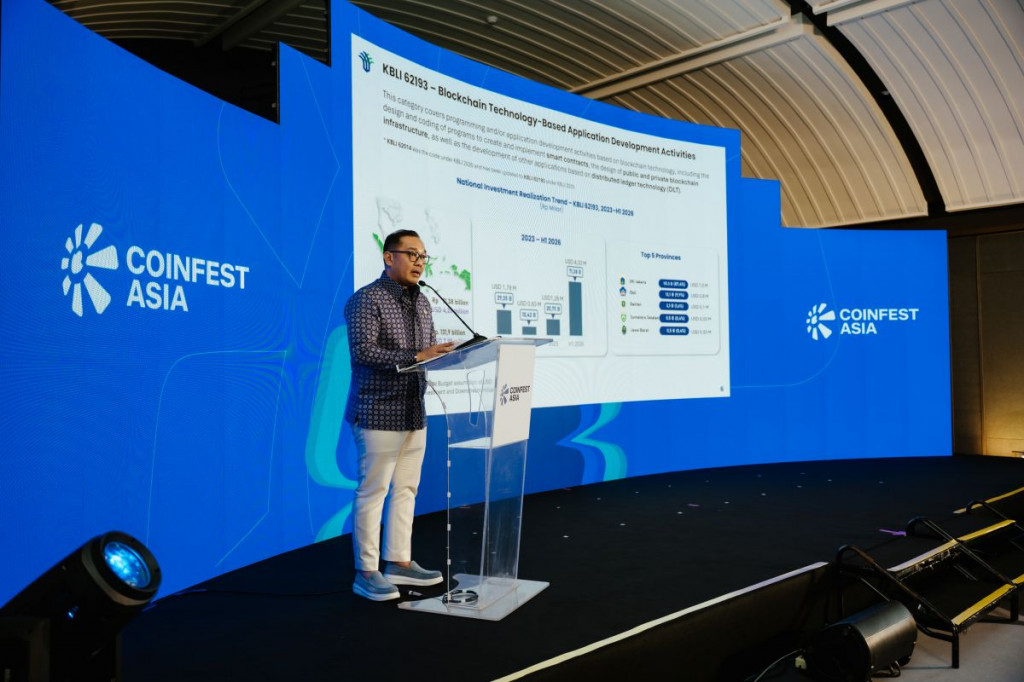
During the event held in Bali on 20–21 August 2026, discussions extended beyond cryptocurrency and blockchain to encompass new funding sources, real-sector investment, and opportunities for developing new economic hubs in Indonesia.
One prominent issue raised was the future of Bali’s economy. The Deputy Minister of Investment and Downstreaming/Deputy Head of BKPM, Todotlarua Pasaribu, encouraged Bali to expand its economic base through the financial sector, technology, digital services, professional services, and innovation, while maintaining tourism as its primary foundation.
“Bali does not have to abandon tourism. Bali must build upon the strength of tourism, while the financial sector, technology, digital services, professional services, and innovation can serve as additional pillars for Bali’s future growth,” said Todotua.
These opportunities are supported by the significant investment flowing into Bali. In the first half of 2026, investment realisation in the province reached approximately Rp23.8 trillion or US$1.44 billion. Cumulatively from 2021 to the first half of 2026, the value reached Rp147.4 trillion, with 60.9 per cent originating from foreign direct investment.
Bali Begins to Add New Economic Layers
Bali’s investment structure currently continues to show the strength of the tourism and property sectors. Hotels and restaurants were the largest sub-sectors for investment from 2021 to the first half of 2026, reaching Rp44.7 trillion or approximately 30 per cent. The housing, industrial estate, and office sectors followed with Rp42.1 trillion or 28.5 per cent.
Investment also flowed into other service sectors amounting to Rp24.5 trillion, trade and repairs at Rp14 trillion, and transportation, warehousing, and telecommunications at Rp9.5 trillion.
Amidst this dominance, technology-based investment is beginning to emerge, notably in the development of blockchain-based applications. BKPM data records Bali as the second-largest region for investment after DKI Jakarta in KBLI 62193, a business classification covering programming and the development of blockchain-based applications, the creation and implementation of smart contracts, the construction of public and private blockchain infrastructure, and the development of distributed ledger technology-based applications.
From 2023 to the first half of 2026, investment in this category in Bali reached Rp13.1 billion, representing approximately 9.9 per cent of the national total. DKI Jakarta continues to dominate with Rp115.3 billion, or 87.4 per cent.
Nationally, investment in blockchain application development reached Rp71.38 billion in the first half of 2026, more than triple the Rp20.75 billion recorded throughout 2025. Total recorded investment since 2023 has reached Rp131.9 billion.
While these figures remain small compared to total national investment, the data indicates that blockchain technology development is beginning to appear on the investment map, including in Bali.
From Digital Assets to Real-Sector Investment
At Coinfest Asia, discussions regarding technology were also linked to funding issues. Todotua assessed that the development of digital assets opens opportunities to seek new capital sources that can be directed towards real-sector investments.
In an interview during the event, he mentioned tokenisation as one mechanism that can be used to connect funding with investment realisation.
“Tokenisation is actually a very easy way to release existing funding to become realised investment,” said Todotua.
Todotua stated that the government needs to find ways to ensure that funds growing within the crypto ecosystem can enter domestic investment activities. He cited villas, hotels, and industrialisation activities as forms of investment that could be linked to such mechanisms.
In his view, tokenisation could serve as an additional pathway alongside financing that traditionally comes from venture capital, asset management, or bank loans.
The Ministry of Investment’s presentation at Coinfest Asia also positioned commodities, commercial cash flows, intellectual property, downstream products, and other real assets as fields with the potential to be linked to digital infrastructure.
Tokenisation is considered capable of expanding access to financing and connecting Indonesia’s productive assets with global investors. However, the government has not yet designated specific assets or commodities that will be officially tokenised.
Bali Enters the Development of a New Financial Ecosystem
In addition to technology and new funding sources, Bali is also included in the development plan for the Indonesia International Financial Centre (PFII). In his speech at Coinfest Asia, Todotua stated that the PFII will be developed first in Jakarta, with Bali planned as the next development location.
The PFII is designed as an ecosystem connecting global capital with investment opportunities in Indonesia and the ASEAN region. The government aims for the involvement of international banks, asset managers, fintech companies, family offices, professional service providers, and digital finance players.
With tourism remaining the primary strength, the growth of technology investment, discussions on tokenisation for the real sector, and the planned development of the financial ecosystem present opportunities for Bali to add new sources of economic activity.
Source: jawawa.id (https://jawawa.id/newsitem/beyond-tourism-exploring-balis-new-tech-savvy-economic-vision-at-coinfest-asia-2026-1788277934)
Originally published by medcom.id (https://www.medcom.id/ekonomi/ekonomi-digital/3NOxLymb-bukan-cuma-pariwisata-intip-visi-baru-ekonomi-bali-yang-makin-tech-savvy-di-coinfest-asia-2026?utm_source=newsstand&utm_medium=newsstand&utm_campaign=newsstand), translated from Indonesian