
Beyond Theory: Young Innovators' Ideas at Youth ESG Maritime 2026 Ready to Become Real Policy
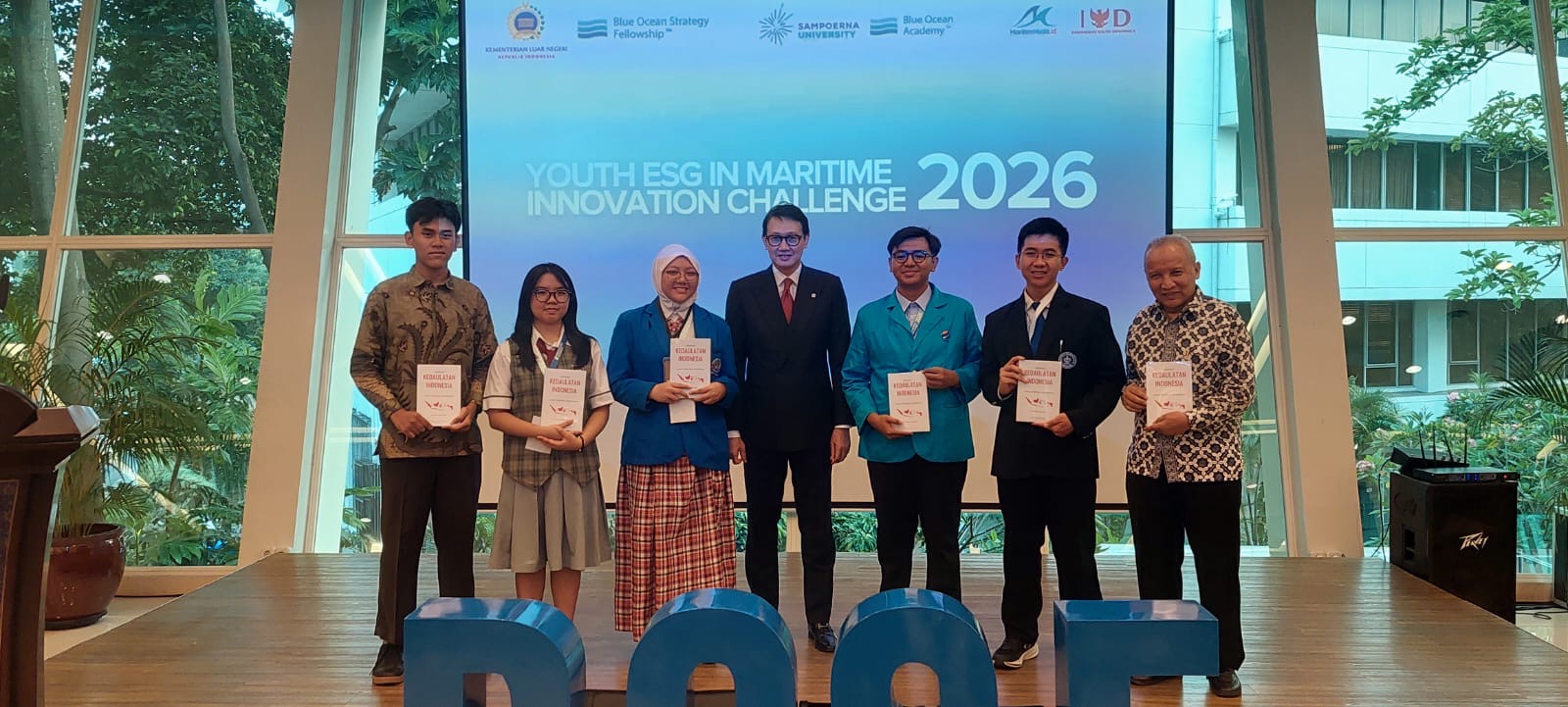
The final peak event of the Youth ESG in Maritime Innovation Challenge officially concluded on Wednesday, 3 June 2026. Eight top participants from various regions and countries were flown to Jakarta to take part in a series of intensive workshops and the final judging phase over three consecutive days. The Ministry of Foreign Affairs, in collaboration with the Blue Ocean Strategy Fellowship (BOSF), organised the Youth ESG in Maritime Innovation Challenge 2026. This strategic initiative is designed to recruit young leaders from high school and undergraduate students across the Southeast Asian region to produce real innovations in protecting the marine ecosystem. The programme is specifically designed to bridge the intergenerational gap by involving youth in strategic co-creation to build a future-ready maritime economy. The competition used the Blue Ocean framework to spark fresh ideas capable of creating uncontested market space. The collaborative programme, initiated by Sampoerna University and the Blue Ocean Academy, successfully recruited hundreds of young innovators from various countries in the Southeast Asian region ready to bring about real change through an Environmental, Social, and Governance (ESG) approach. Vice Minister of Foreign Affairs, Arif Havas Oegroseno, who is also a Distinguished Fellow in this initiative, stressed the importance of real action from the younger generation amidst the immense pressure on the maritime environment. According to him, the ocean is not just a stretch of water but the lifeblood for the majority of people in the region. Havas conveyed the idea of the sea as a common thread that needs to be elevated in cooperation with BOSF. ‘I am sure you are very aware that the sea is an important part of our lives. Seventy per cent of the Earth’s surface and nearly 70 per cent of Southeast Asia is sea,’ Havas said in his remarks to the finalists at the Diplomacy Canteen Hall, Ministry of Foreign Affairs, Jakarta. Facts show an extraordinarily high dependence between coastal areas and the sea. ‘I think only Laos does not have a sea. Other countries like Myanmar, Korea, Thailand, Malaysia, Singapore, Vietnam, the Philippines, and Indonesia are all maritime nations,’ he explained. He added that this dependence is visible in residential patterns. ‘If we talk about Indonesia, I think 60 per cent of the population lives in coastal areas and along the shoreline,’ said the former Indonesian Ambassador to Germany. However, this maritime wealth continues to face serious threats, from plastic waste issues and coral reef damage to mangrove deforestation. Through the Youth ESG in Maritime Innovation Challenge platform, participants were challenged to formulate solutions based on Environmental, Social, and Governance principles. Havas outlined how youth innovation must be able to translate these three pillars concretely in the maritime sector. Environmental means protecting the maritime environment from various damages, social means protecting the welfare of people who live and depend on the health of the sea, and governance means building trust through a strong government management system. ‘By protecting the environment, the community, and building trust through strong governance, we will be able to create a good ecosystem for our maritime environment,’ said Havas. On the same occasion, the Assistant Deputy for Infrastructure and Regional Development, Sora Lokita, as a senior associate fellow of BOSF, stressed that the government and industry cannot move alone in facing increasingly complex maritime issues in Southeast Asia. New methods and the full involvement of the younger generation are needed to save the future of the regional seas. ‘Today is not just about choosing a winner, but also about celebrating the ideas, innovations, and commitment of young people across Southeast Asia to build a more developed maritime future,’ Sora said. Sora explained that the maritime sector in Southeast Asia is currently at a critical crossroads. This sector holds a vital role from sea governance, food security, livelihoods, tourism, energy, to economic growth. However, all this great potential is overshadowed by the real threats of climate change and biodiversity loss. Facing these heavy challenges, Sora asserted that conventional and egocentric approaches from the government or industry alone are no longer relevant. ‘We always need fresh perspectives. And that is why we look to you, the young generation,’ Sora stressed. From what was initially just a student project, it is very possible that in the future it could turn into real policy. To the finalists and all participants who have participated, Sora gave high appreciation for their courage in generating creative ideas. For participants who have not yet managed to break through to the final round, he advised them not to be discouraged because true innovation is a continuous process. The government is optimistic that strong collaboration between young people’s ideas, policy support, and industrial implementation will be the main key to the sustainability of the regional maritime sector. ‘The ideas shared today may just be a student project, but tomorrow, we never know, they might become policy, business ideas, technology, or a movement that helps future progress. Thank you, and I wish everyone success,’ Sora concluded. Through the Youth ESG in Maritime Innovation Challenge 2026, the collaboration between the Ministry of Foreign Affairs and BOSF demonstrates this commitment.