
Beyond Perry Warjiyo: The Test of Indonesia's Monetary Resilience
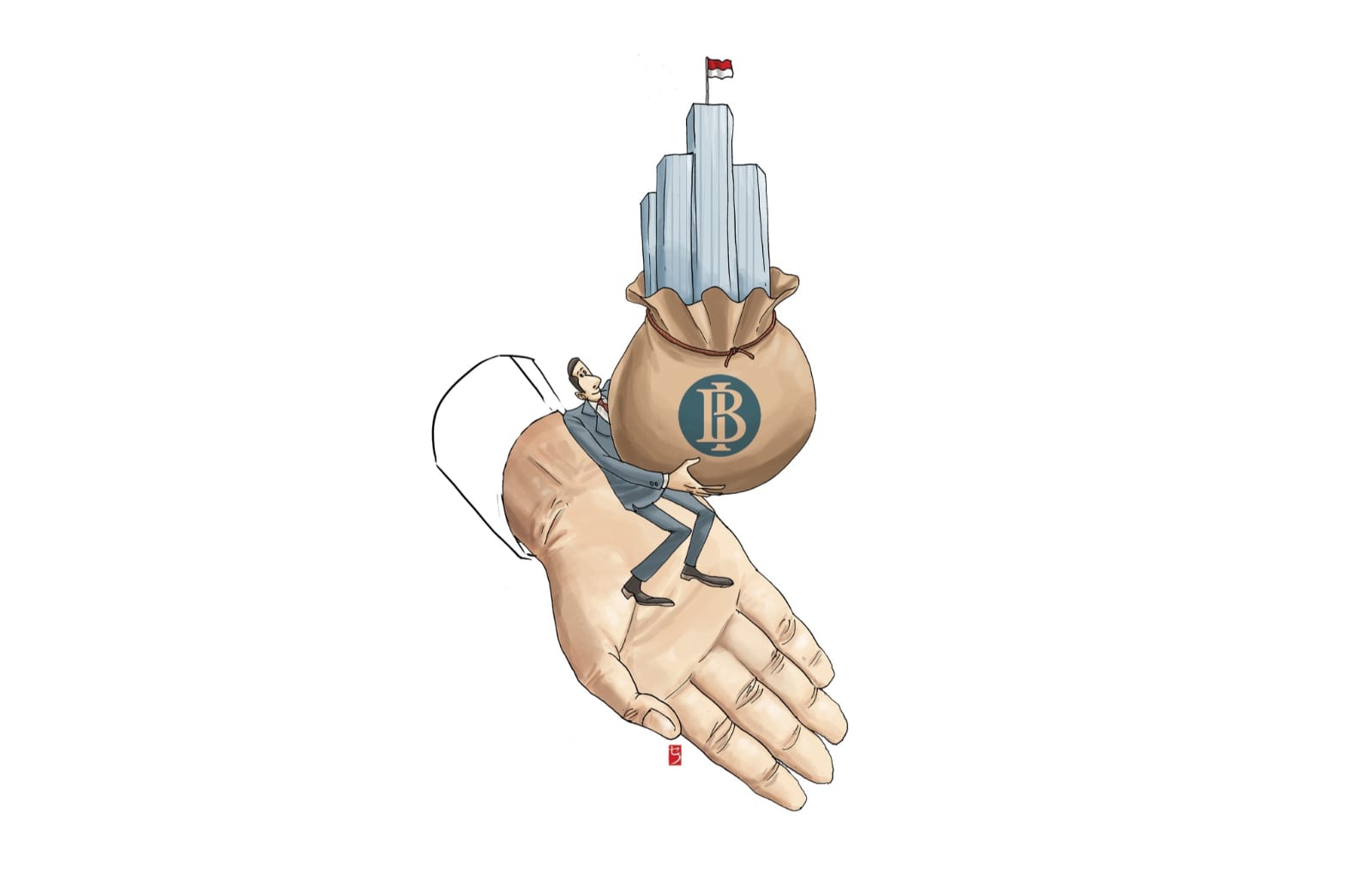
A central bank issues currency, but it truly lives off something more abstract: trust. Money has value because society believes it will continue to be accepted. Monetary policy works because markets trust the central bank to maintain stability. Therefore, Bank Indonesia’s most important asset is not just its foreign exchange reserves, policy interest rate, or intervention instruments, but also its institutional credibility.
The resignation of Perry Warjiyo as Governor of Bank Indonesia, accepted by the government on 26 July 2026, immediately drew market attention. Senior Deputy Governor Destry Damayanti is carrying out duties as acting governor until a definitive governor is appointed according to statutory mechanisms. This transition is legal and constitutional. However, at a central bank, a change of leadership always raises a larger question: will trust in the institution be maintained when the figurehead changes?
This question is relevant because Indonesia is facing a challenging monetary environment. On 21 July 2026, the rupiah was hovering around 17,885 per US dollar after being pressured by escalating geopolitical conflicts, rising energy prices, and expectations of US policy tightening. The yield on 10-year government bonds (SBN) was around 7.37% on 24 July, reflecting the risk premium and cost of funds borne by the economy.
Bank Indonesia responded by holding the BI rate at 5.75% during the Board of Governors’ meeting on 21-22 July 2026, after raising it from 4.75% earlier in the year. This policy was accompanied by interventions in the spot market, Domestic Non-Deliverable Forwards (DNDF), and offshore Non-Deliverable Forwards (NDF), enhancing the attractiveness of monetary instruments, and providing incentives for foreign portfolio flows. This shows that the defence of the rupiah no longer relies on a single instrument, but on a mix of interest rates, intervention, liquidity management, and communication.
Indonesia’s external fundamentals remain adequate. Foreign exchange reserves at the end of June 2026 were recorded at US$145.6 billion, equivalent to about 5.5 months of imports and above the international adequacy standard. Inflation in June reached 3.34% year-on-year, still within the 2.5±1% target range, although food and energy price pressures need to be monitored. In the second quarter, net foreign portfolio investment inflows also reached US$8.5 billion.
These figures are important, but not sufficient. Foreign exchange reserves can be used to dampen volatility, interest rates can be raised to strengthen the attractiveness of rupiah assets, and bonds can offer higher yields. However, if markets doubt the consistency of the mandate, the independence of decision-making, or the continuity of policy direction, the cost of defending the rupiah will become much more expensive.
This is where trust becomes the currency of a central bank. The more credible a central bank is, the smaller the interest rate hike needed to influence expectations. Conversely, when credibility weakens, the same policy may require higher interest rates, larger interventions, and impose heavier costs on growth and the fiscal position. Trust lowers the risk premium; uncertainty raises it.
Independence as Commitment
The time inconsistency theory of Finn Kydland and Edward Prescott explains the temptation for policymakers to pursue short-term gains even at the expense of long-term stability. Robert Barro and David Gordon later showed that if the public expects the government or central bank to tolerate inflation for temporary growth, inflation expectations will rise and policy will lose its effectiveness.
Central bank independence exists to overcome this commitment problem. Independence does not mean Bank Indonesia is outside democracy, does not need to coordinate, or is free from accountability. Independence means that decisions regarding interest rates, liquidity, and exchange rate stabilisation are made based on a statutory mandate, data, and medium-term economic interests, not short-term political pressures.
Therefore, rumours regarding the change of leadership should not be met with prolonged polemics. The best answer is a credible selection process, transparent governance, continuity of communication, and consistency of decisions. Rumours come and go; an institution’s track record endures.
Douglass North described institutions as the rules of the game that reduce uncertainty. Francis Fukuyama placed trust as the social capital that enables institutions to work effectively. For a central bank, the two converge: credible rules give birth to trust, while trust amplifies the power of policy.
Learning from Global Central Banks
The Federal Reserve, the European Central Bank, and the Bank of Japan demonstrate that while policy approaches may differ, the foundation remains the same: institutional credibility. The Fed maintained the federal funds rate range at 3.50-3.75% in June 2026 to balance price stability and employment. The ECB operated its deposit facility rate around 2%, while the Bank of Japan had raised its overnight rate to around 1% after years of ultra-loose policy.
There is no universal recipe. The US has a dual mandate, the ECB focuses on price stability, and Japan is still navigating policy normalisation after an era of ultra-low interest rates. However, markets do not just read their interest rate numbers. Markets read whether decisions are consistent with the mandate, supported by a collective process, and explained in a trustworthy manner.
The transitions from Ben Bernanke to Janet Yellen, then to Jerome Powell, or from Mario Draghi to Christine Lagarde, did not erase the credibility of their respective central banks. Figures remain important, but institutions provide the guardrails so that policy direction does not shift merely following personal preferences or political cycles.
Source: jawawa.id (https://jawawa.id/newsitem/beyond-perry-warjiyo-the-test-of-indonesias-monetary-resilience-1785192698)
Originally published by Media Indonesia (https://mediaindonesia.com/opini/915352/pasca-perry-warjiyo--ujian-ketahanan-moneter-indonesia), translated from Indonesian