
Beyond Murabaha: When Islamic Finance Meets the Agricultural Value Chain
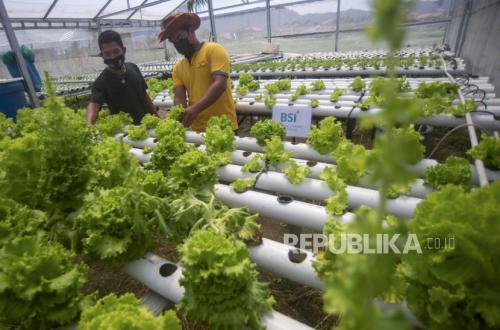
There is a paradox that has been allowed to persist for too long in Indonesia’s fields. Harvests increase, rice production sets records, yet farmers remain poor. Input subsidy programmes are rolled out, agricultural technology is introduced, and farm credit is expanded — but farmers’ welfare barely moves. Why?
The answer does not lie in the quality of seeds or the volume of fertiliser. The real problem is how we view farmers: as isolated individuals, not as part of an interconnected system.
For decades, the agricultural development paradigm has focused on a single point — increasing individual farmer output. The logic seemed sound: more production means more income. But the reality on the ground tells a different story. When harvests are abundant and commodity prices fall, farmers lack the bargaining power to hold off selling. When the lean season arrives or pests attack, farmers bear the entire risk alone. Stable market access is nearly impossible to achieve because farmers stand alone against traders and processors who are far more organised. Limited access to financing — due to a lack of physical collateral such as land certificates — forces farmers to depend on seasonal loan sharks.
This is the illusion of production. Increasing harvest volume does not automatically correlate with welfare, as long as farmers struggle as individual actors isolated from the ecosystem that truly determines the economic value of their products.
Modern agricultural understanding places the farmer not as a single entity, but as one node in a long network — from seed suppliers, fertiliser providers, and mills, to traders, distributors, retailers, and end consumers. This is known as the value chain. True economic value is not created at any single point individually. It is born from the collaboration of all interdependent actors. An agricultural commodity is not produced by the farmer alone — it is the product of the entire chain. A farmer’s success is determined by the overall health of the value chain.
From this perspective, the farmer’s problem is not merely one of productivity. It is about their position within the ecosystem: do they have market certainty, access to price information, risk protection, and adequate capital support? Without all of these, increased production merely transfers added value to other actors at the end of the chain.
This is where Islamic financial institutions need to expand their scope significantly. The financing commonly known still relies on one dominant instrument: murabaha, a sale contract with a transparent margin. Murabaha is indeed valid and beneficial, but it is only one colour in the rich spectrum of Islamic contracts.
Agriculture has far more diverse needs. Farmers need pre-harvest capital in the form of a salam contract — upfront financing with an order system that provides liquidity when the land has yet to yield. They need access to tractors and post-harvest facilities without having to own the assets, which can be fulfilled through an ijarah (lease) contract. Fair profit-sharing business partnerships are available through musyarakah and mudharabah. Protection against crop failure risk is present through agricultural takaful as collective Islamic insurance. And for the most vulnerable farmers, qard hasan — a benevolent loan with no margin — becomes a sincere inclusion instrument.
This is the essence of what is called Sharia-based agricultural value chain financing: not merely channelling financing to farmers, but designing the right financing for each stage and each need within the value chain — using appropriate, not uniform, contract instruments.
This framework finds its most complete form in the AVES-IF concept — Agribusiness Value Ecosystem Syariah – Inclusive Finance. AVES-IF is not just an expansion of the Agricultural Value Chain Financing (AVCF) concept. It is a transformation towards a comprehensive agribusiness ecosystem. AVES-IF is a model developed by the National Committee for Islamic Economy and Finance (KNEKS) to integrate AVCF with inclusive Islamic financing, empowerment and mentoring, risk management, market access, and non-financial services. This model will be implemented in a pilot project on the island of Java.
If AVCF explains how financing flows along the value chain based on the strength of business relationships between actors, AVES-IF goes further: it ensures that the entire economic, social, institutional, and Islamic financial ecosystem is built together so that value creation occurs inclusively, fairly, and sustainably.
AVES-IF stands on six pillars that operate simultaneously. The first pillar, Value Chain Integration, connects all actors — from input suppliers, farmers, cooperatives, aggregators, processors, distributors, to retailers — in one calibrated system that creates market certainty and eliminates fragmentation. The second pillar, Inclusive Finance, ensures the flow of capital reaches all nodes of the chain, using a variety of Islamic instruments tailored to the risk profile and specific needs of each actor.
The third pillar, Collaborative Innovation, positions agribusiness as a knowledge incubation centre involving farmers, cooperatives, universities, industry, government, and financial institutions in cross-sectoral shared learning. The fourth pillar, Embedded Services, ensures that financing is always paired with non-financial services: technical training, agronomic extension, access to smart farming technology, halal certification facilitation, and direct matching with institutional buyers.