
Beware of Israel Normalisation Efforts through the 'Israel-Indonesia Future Program'
I have been seriously observing reports regarding the reopening of the Israel-Indonesia Future 2027 programme promoted by the Israel-Asia Center. The programme, aimed at young people, leaders and professionals from various fields in Indonesia, is scheduled to commence in September 2026.
The Indonesian public must view this programme clearly, critically and with vigilance. We must not see it merely as an ordinary exchange, education, innovation, business, technology or people-to-people dialogue programme that appears neutral and detached from political context.
According to the organisers, the Israel-Indonesia Futures programme has for several years been building networks between Israeli and Indonesian citizens from various fields. The programme encompasses cooperation in education, health, food, technology, entrepreneurship, investment and innovation.
In fact, the Israel-Asia Center openly describes this network as part of efforts to build relations and pave the way towards normalisation of economic and other broader relations between Israel and Indonesia.
Therefore, in my view, this programme is inappropriate if it is understood merely as people-to-people cooperation. It must be read in a larger context, namely a strategy to build social, economic, intellectual and cultural acceptance of Israel that may ultimately become capital for the normalisation of diplomatic relations between Israel and Indonesia.
Our vigilance is necessary. I do not intend to say that every Indonesian citizen who participates in the programme is an Israeli agent or has bad intentions. But we also must not be naive about the strategic agenda of a state. Precisely because this programme targets future leaders, professionals, academics, entrepreneurs, innovators and various strategic groups in Indonesian society, its long-term implications need to be taken seriously.
For me, the issue is not whether we may engage in dialogue with Israelis or not. The main issue is what the dialogue is being built for, in what political context, and whether the dialogue is directly or indirectly being used to change Indonesia’s fundamental position towards Israel and Palestine.
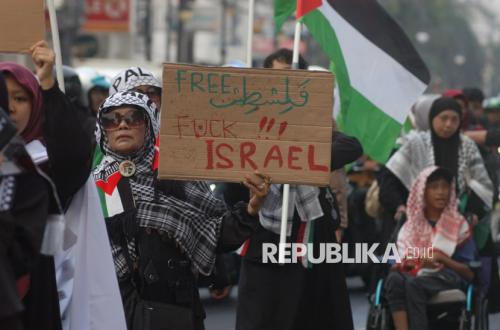
I maintain the stance I have consistently expressed: Indonesia must remain steadfast in rejecting all efforts to open and develop diplomatic relations with Israel as long as Israel continues its colonisation, occupation and various actions that contradict the principles of humanity, justice and international law against the Palestinian people.
This is Indonesia’s political, moral and constitutional stance that must be firmly upheld.
The Preamble to the 1945 Constitution very clearly states that independence is the right of all nations and that colonialism above the world must be abolished because it is incompatible with humanity and justice. The Preamble to the 1945 Constitution also affirms Indonesia’s obligation to participate in implementing world order based on independence, lasting peace and social justice.
Therefore, Indonesia’s support for Palestinian independence is not merely a political choice of the government or the stance of certain community groups. It is part of the constitutional mandate and the identity of Indonesia’s foreign policy.
The Constitutional Court itself has affirmed that Indonesia’s participation in implementing world order must be based on independence, lasting peace and social justice. Thus, Indonesia should not participate in efforts that contradict these principles.
On that basis, I call upon the Indonesian Government not to provide space for various efforts to normalise relations with Israel that are carried out gradually, whether through diplomatic channels or through economic, educational, technological, cultural, academic, business and civil society networking channels, if such cooperation turns out to be an instrument for opening diplomatic relations with Israel.
The Government also needs to conduct a comprehensive evaluation of forms of cooperation that may have been taking place directly or indirectly with Israeli entities, including in the fields of education, research, trade, technology, investment and other areas.
Such cooperation needs to be assessed not only from its economic or academic benefits, but also from its political and humanitarian impacts as well as the possibility of the cooperation being used as an entry point for normalisation.
I also call upon universities, research institutions, the business community, community organisations, philanthropic institutions and all elements of Indonesian society to be cautious and not easily accept offers of cooperation that slowly lead us towards normalisation with Israel.
We need strategic vigilance, not paranoia.
We need humanitarian dialogue, but not dialogue that erases the history of Palestinian colonisation. We can appreciate people and civilisation without having to give legitimacy to the policies of a state that commits oppression. We can be open to science and technology without having to open the way for political normalisation.
Indonesia has many options for achieving progress in education, technology, health, food, water, energy and innovation without having to make Israel a strategic partner.
Moreover, Indonesia must not lose its foreign policy independence due to the penetration of people-to-people relations that slowly shapes new perceptions about Israel without adequate awareness of the Palestinian issue.
I invite the entire public, especially the younger generation, academics, intellectuals, entrepreneurs and Indonesia’s future leaders to remain critical. Do not be easily captivated by narratives of innovation, technology, entrepreneurship, peace and cooperation if such narratives are used to conceal a more fundamental issue, namely the colonisation, occupation, injustice and suffering of the Palestinian people.
Indonesia must remain Indonesia.
We must continue to uphold the principles of a free and active foreign policy, a policy of values, humanity and peace. And in the context of Palestine, we must remain steadfast in supporting the right of the Palestinian people to be free and sovereign and reject all forms of colonisation and normalisation that disregard those rights.
Therefore, I hope the Indonesian Government takes a clear, firm and consistent stance against various efforts at Israel-Indonesia normalisation, including through programmes that use educational, economic, technological, cultural, people-to-people dialogue or professional network approaches.
Our question is simple: will relations with Israel strengthen Indonesia’s struggle to realise world order based on independence, lasting peace and social justice, or will they distance us from that constitutional mandate?
For me, the answer must be clear.
As long as colonisation and injustice against Palestine have not ended, Indonesia must remain steadfast. Do not open the door to normalisation. Do not let short-term interests displace Indonesia’s constitutional mandate and humanitarian commitment.