
Between Teaching and Weaving: A Borderland Teacher Preserves the Art of Bidai
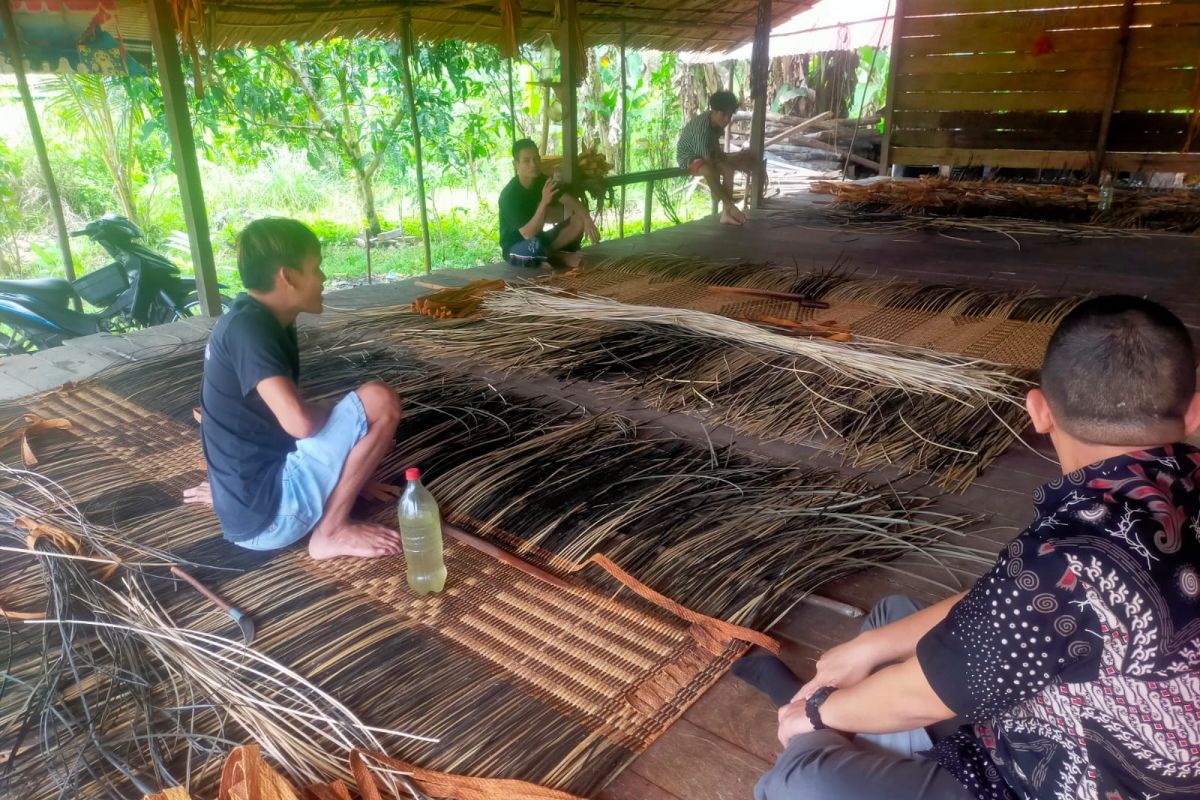
Tuti Susanti (34) moves her fingers slowly, weaving strand after strand of black and brown rattan. Before her, a piece of ‘bidai’ is nearing completion, with distinctive Dayak motifs beginning to form neat and beautiful patterns. In a corner of her home in Preges Hamlet, Seluas Village, Bengkayang Regency, West Kalimantan, lies a pile of rattan recently brought from Central Kalimantan. This raw material has been an integral part of her life since childhood, long before she became a teacher.
Today, her daily life is split between two roles. From morning to afternoon, she teaches at SD Negeri 15 Malayang. To reach the school, she must undertake a motorcycle journey of approximately one hour. Once teaching activities conclude, Tuti returns to the craft passed down through generations in her family: making bidai, a traditional Dayak rattan weave that serves as a cultural identity for the community living on the border with Malaysia.
“I have been learning to make bidai since the sixth grade of primary school. Every day after school, we would help our parents weave. Over time, I learned to do it myself,” the mother of three told ANTARA in early June. She inherited this skill from both parents, who have long been practitioners of the craft. While continuing her weaving, Tuti recalls her childhood, which was spent more often observing her parents work than playing with peers. Through this habit, she learned various motifs, how to select high-quality rattan, and the techniques of weaving that require precision and patience.
According to Tuti, not everyone is capable of making bidai. Beyond requiring perseverance, each motif possesses a specific level of difficulty that must be mastered. “In the past, almost every house made bidai. Now, fewer people are able to sustain the craft,” she noted.
In the past, her family’s woven products were primarily marketed to the Serikin Market in Malaysia, located near the Indonesia-Malaysia border. At that time, demand for bidai actually came more from the neighbouring country than from within Indonesia. From her home, the journey to Serikin Market takes only about an hour, a shorter trip than the two hours required to reach Bengkayang Town, and significantly shorter than the five-hour overland journey to Pontianak, the capital of West Kalimantan. Every weekend, her parents’ woven products were taken to Serikin to be sold to buyers interested in the uniqueness and quality of Dayak bidai. “Previously, there were more enthusiasts from Malaysia. On Saturdays and Sundays, the woven products were usually brought there for sale,” Tuti said.