
Betawi Villages Lost to Development
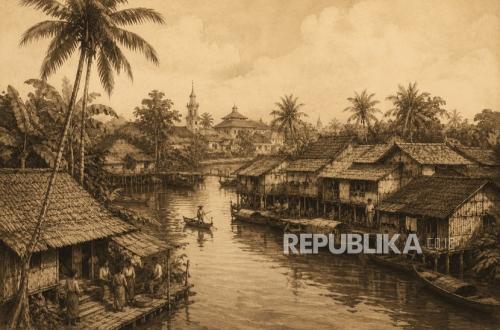
On the eve of World War II, Batavia had a population of 900,000. In the early 1950s, after the transfer of sovereignty, massive urbanisation hit the capital, triggered by the DI/TII rebellion. Many residents of West Java, particularly East Priangan, fled to Jakarta. Urban migrants also came from several areas in Central Java. Consequently, during the tenure of Mayor Soediro in the 1950s, Jakarta became a priority for the transmigration programme. To this day, transmigration from Jakarta has never succeeded. The Betawi people, who were still the majority at the time, would never have been interested in becoming transmigrants. It is no wonder that Inang was furious when Si Doel, her only child, wanted to transmigrate to Sumatra. “Why would you go to the forest? You’ll be eaten by a tiger or trampled by an elephant,” Inang grumbled with a scowl. Using an anthropological term, the Betawi people are a ‘kurung batok’ (sedentary) society. As they say, whether they eat or not, they stick together. The reason is that since the Dutch East Indies era, Jakarta has been the centre of government. All facilities and infrastructure are concentrated in Jakarta. It is said that around 70 percent of all money in Indonesia circulates in Jakarta. This continuous concentration has made Jakarta a ‘singular city’ from era to era. Inevitably, Jakarta now bears an increasingly heavy burden. When Ali Sadikin was governor, Jakarta’s population was three million. By 1999, it had swelled to 12 million during the day and 9 million at night. The swelling continues, and now it is 14 million during the day and 11 million at night. This means that more than three million people commute and seek their fortune in the city every day, not just from Botabek and Depok, but also from Cianjur and Sukabumi. Residents are willing to live in cramped conditions with a worsening environment. Groundwater is threatened by pollution. Rivers have lost their communication function, and land is increasingly scarce and expensive. In fact, most of this land has already fallen into the hands of the wealthy. Thousands of sex workers continue to flood the capital.