
Betawi Souvenir Traders in Setu Babakan Struggle to Survive Amidst Changing Times
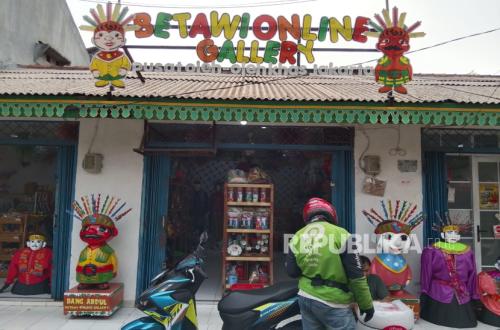
The aroma of dodol cooked over firewood can still be strongly detected in the Setu Babatan area, South Jakarta. Amidst the development of modern foods and changes in public shopping habits, several Betawi souvenir entrepreneurs continue to preserve these heritage products.
One such example is Toko ASNR, which sells various traditional Betawi souvenirs, including dodol. Established in 2017, the business is a multi-generational legacy. Ilham Fahrudin, 25, an employee at Toko ASNR, stated that dodol remains one of the most sought-after products by customers. This traditional snack is available in several variants, ranging from original and black glutinous rice to durian flavours. “It is a family legacy; we are continuing the work of our elders,” Ilham said during an interview.
According to him, the customers for the Betawi culinary shop come from various backgrounds. Jakarta residents remain the largest group of buyers, while visitors from other regions generally purchase the products to be used as souvenirs.
However, interest in traditional Betawi products is not uniform across all regions. Ilham noted that the local community around Setu Babakan remains closely connected to Betawi culture, making traditional products easier to accept, unlike visitors from outside the area. “For the local residents, it is certain, because the customs here are still very strong,” he said.
Nevertheless, the development of Toko ASNR shows signs of growth. Having previously operated from the front of a house, the business now possesses its own production facility and three branches. Sales are conducted both online and directly through the shop. “Online sales are busy, and offline is also busy, so they are balanced,” Ilham remarked.
Despite this expansion, Toko ASNR continues to maintain the traditional process of making dodol. A single production batch requires approximately eight hours. The process is still performed manually using firewood. At least two people are required to take turns during the production process to ensure the workload remains manageable.
Ilham mentioned that he occasionally assists in the dodol-making process. This tradition remains a constant element that is preserved, even as the methods of selling the products evolve to keep pace with modern times.
Source: jawawa.id (https://jawawa.id/newsitem/betawi-souvenir-traders-in-setu-babakan-struggle-to-survive-amidst-changing-times-1789966839)
Originally published by Republika (https://republika.co.id/berita//tlp5hs483/pedagang-oleh-oleh-betawi-di-setu-babakan-coba-bertahan-di-tengah-perubahan-zaman), translated from Indonesian