
Betawi Christian Figure Shares Legacy of High Tolerance in Kampung Sawah, Bekasi
The Kampung Sawah area in Bekasi City, West Java, is renowned for its deeply ingrained culture of tolerance. Here, three places of worship stand closely adjacent to one another, and followers of diverse faiths live side by side without conflicts or frictions related to beliefs.
The three places of worship include the Santo Servatius Chapel for Catholics, the Pasundan Christian Church for Protestants, and a mosque for Muslims. Interestingly, those who are Catholic, Protestant, or Muslim are all indigenous Betawi people from the area.
On the occasion of this year’s Ascension of Jesus Christ commemoration, detikcom had the opportunity to visit the Santo Servatius Church, which serves as a place of worship for the local Betawi Catholic community. Detikcom met with one of the Betawi Catholic figures named Ricardus Jacobus Napiun, alias Jacob.
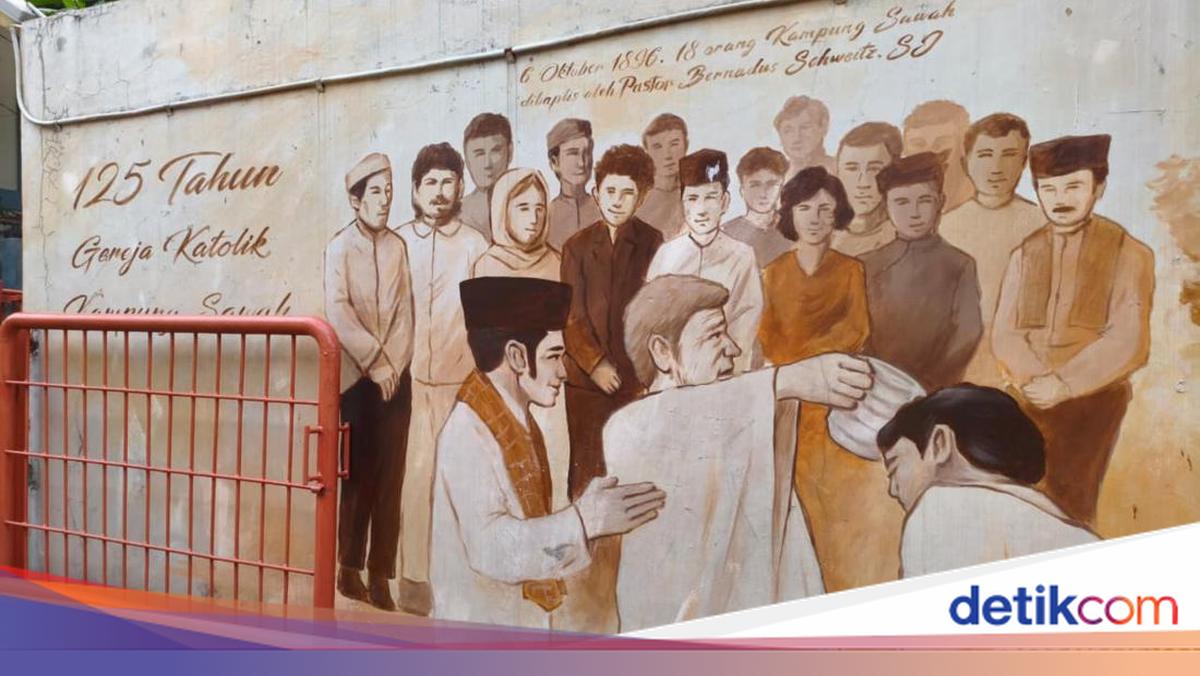
Jacob, who is over 70 years old, recounted the origins of the Catholic community in the Kampung Sawah area, which is predominantly inhabited by Betawi people. Jacob explained that the emergence of Betawi Catholics in this region began with the baptism of 18 people in 1896.
“We were born in 1896, while the Protestant Christians were born earlier, in 1874. They are 22 years older than us. Meanwhile, the Betawi Catholics of Kampung Sawah were born in 1896, marked by the Catholic baptism of 18 people from Kampung Sawah,” said Jacob when met on Thursday (14/5/2026).
Jacob explained that the baptism of those 18 people took place on 6 October 1896. The Catholic baptism was performed by Pastor Bernardus Schweitz. One of those baptised was Jacob’s ancestor.
“These individuals, including my ancestor named Sam Napiun. My name is Yakob Napiun, full name Ricardus Jacobus Napiun, commonly called Jacob. This is one of the descendants of the ancestor here, Mr Sam Napiun,” Jacob clarified.
He said that those 18 ancestors had distinctive surnames typical of Betawi people, such as Noron, Miman, and Rikin. However, he admitted to forgetting the complete list of Betawi surnames from those 18 ancestors.
“Why is that? So, during the colonial era, perhaps to facilitate the census, groups of people were formed. This is the Napiun family, all Napiuns. This is all Rikins, this is all Mimans, so it’s easy to know how large their extended families are. Thus, that became the origin of the surnames,” Jacob explained.
“So if you meet someone, for example while walking in Bandung, who introduces themselves and mentions the name Napiun, that means this person is from Kampung Sawah or a descendant of Kampung Sawah people, definitely. And definitely Christian. Because if they convert to Islam, they don’t use the surname, they use ‘bin’,” he continued.
Legacy of High Tolerance
Jacob then explained the high level of tolerance among the Betawi people in Kampung Sawah despite differences in faith. He stated that the Betawi people in Kampung Sawah have long stopped making an issue of religious differences. According to him, matters of religious differences have already been settled.
“All the major religious and community figures in Kampung Sawah have agreed to ensure that in Kampung Sawah, issues of religion and faith are settled. There’s nothing left to discuss, nothing to mention anymore. Yes, it’s done,” he said.
He added that the Betawi people of Kampung Sawah, when talking about togetherness and common interests, no longer bring up religious labels. The culture of mutual help arises naturally without needing reminders or reprimands.
For example, he said, when one of the three religions in Kampung Sawah celebrates a major religious holiday, the other two religions automatically want to provide assistance. According to him, all the Betawi residents in Kampung Sawah already feel like siblings.
“That’s already part of daily life. One example, tomorrow night on the 16th, we have an event called Sedekah Bumi. Attending will be several major religious figures. Then there’s the Interfaith Youth Brigade, they come here, they bring their respective missions, they share various things, they feel like siblings and so on,” he revealed.
He also gave an example that when Muslims celebrate Eid al-Fitr or Eid al-Adha, Catholics and Protestants automatically prepare to help ensure the worship runs smoothly. Even the tradition of eating ketupat together continues.
“If I show you pictures, every Eid al-Fitr or Eid al-Adha, in the morning for sure, they look for me at the mosque. We are already there, me and my team to secure the Eid al-Adha or Eid al-Fitr celebrations. So the Catholic friends already know, ‘Mr Yakub, we want to do this and that’, yes, they join in together. That’s what we do,” Jacob stated.
“And they also, for example, when we have Christmas tomorrow, many Muslims help out there. And that’s not, well, we don’t invite them, but they come. Even when I help with security and order at the Grand Al-Jauhar Mosque, I’m never asked by the Kiai, never rejected by the Kiai, just threatened, ‘no one goes home before eating Lebaran ketupat’,” he added.
He also mentioned that the high value of tolerance in Kampung Sawah has earned the area the nickname ‘Golden Triangle’. As far as he remembers, this term was given by Indonesia’s 13th Vice President, Ma’ruf Amin.
“The triangle refers to explaining or illustrating the shape or layout of these three places of worship that form a triangle. And where’s the ‘gold’? The gold is in the brotherhood, harmony, tolerance that you mentioned, which turns out to be very valuable now. That’s the gold,” Jacob said.
Source: jawawa.id (https://jawawa.id/newsitem/betawi-christian-figure-shares-legacy-of-high-tolerance-in-kampung-sawah-bekasi-1778781532)
Originally published by detikcom (https://news.detik.com/berita/d-8489193/tokoh-betawi-kristen-cerita-warisan-toleransi-tinggi-di-kampung-sawah-bekasi), translated from Indonesian