
Bekasi Women's Community Encouraged to Develop Green Economy
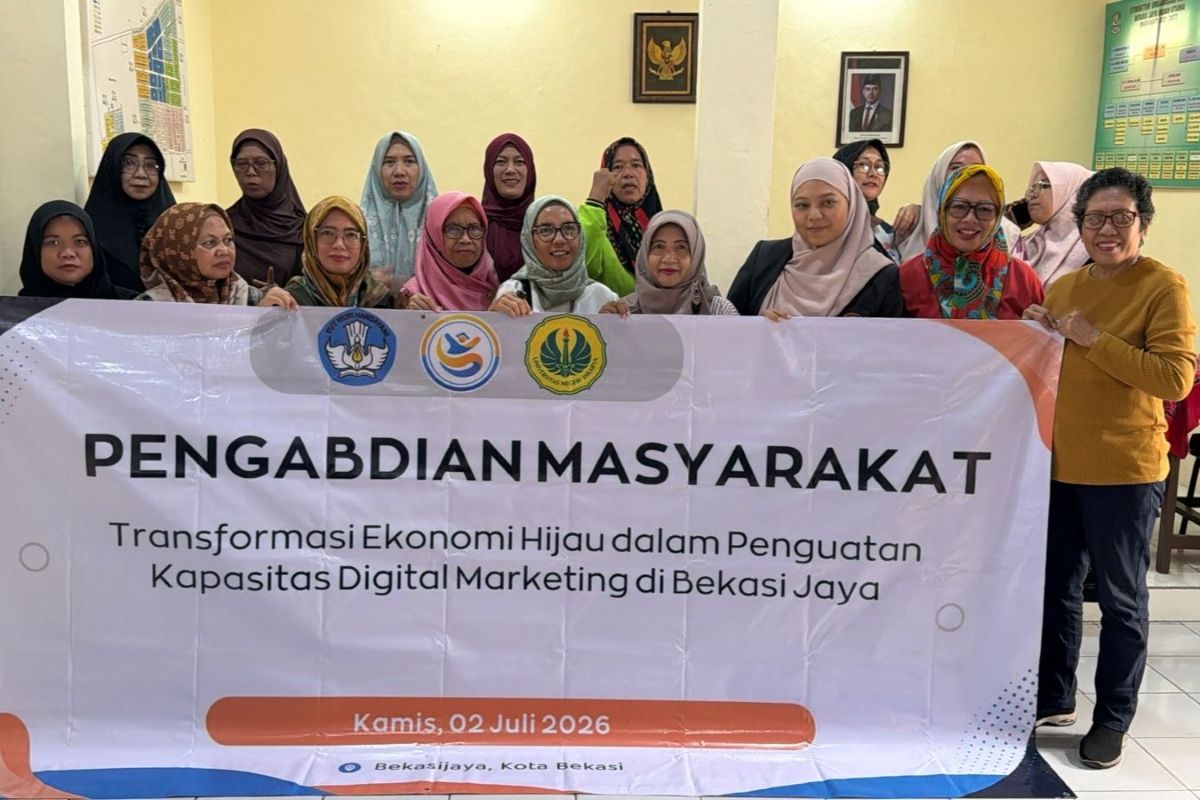
Jakarta State University (UNJ) is encouraging the strengthening of the green economy through enhancing the digital marketing capacity of a women’s community that manages recycled products in Bekasi Jaya Urban Village, East Bekasi District, Bekasi City. The effort is carried out through a Community Service Programme titled ‘Green Economy Transformation in Strengthening Digital Marketing Capacity for the Recycling Community in Bekasi Jaya’, implemented on 2 July 2026.
The programme, chaired by Sintia Nursafitri with members Tia Permata Juwita and Rayi Dwipanilih, is directed at helping the community develop business management skills, digital marketing, content creation, brand strengthening, and product documentation. Sintia said that digital capacity strengthening is necessary because the recycled products produced by the community have economic potential, but their marketing still faces a number of limitations.
‘Recycled products are not enough just to have functional value. Products also need an identity, a story, and a communication strategy that can explain their environmental value to consumers,’ said Sintia, who is also a lecturer at UNJ’s Faculty of Economics and Business.
According to her, the marketing of partner products has so far relied heavily on sub-district bazaars and word-of-mouth communication. This condition means that market reach has not developed optimally. In addition, the products are not yet fully supported by a brand identity and consistent digital promotional materials. Therefore, the mentoring programme is directed not only at the use of social media as a promotional tool, but also at the formation of a marketing strategy that can be applied sustainably.
‘Digital transformation is not just about creating a social media account. The challenge is how the account is managed consistently, has content planning, and is able to build communication with consumers,’ said Sintia.
In the activity, the UNJ team provided reinforcement on the basics of digital marketing, promotional content strategy, creating business social media accounts, product photography and video, developing logos and labels, and an introduction to managing online shops.
The mentoring also introduced the concept of storytelling in marketing. Through this approach, products are not only displayed through photos and prices, but are also accompanied by stories about the process of processing materials, the creativity of community members, and the environmental benefits of recycling activities.
‘The story of turning waste into products with economic value can be a differentiator. When the story is communicated well, consumers do not only see the product, but also understand the environmental and social value behind the product,’ said Sintia.
The team also encouraged the community to compile a simple content calendar. Publication materials can be developed from various activities that have already been carried out, such as the product manufacturing process, education about recycling, profiles of community members, product benefits, and customer experiences.
This approach is expected to make digital marketing easier for the community to implement. The use of smartphones and available digital applications can be utilised to document products, create promotional materials, interact with consumers, and expand market reach.
In addition to marketing, the programme emphasises the importance of business management and product quality. According to the implementing team, community-based business transformation cannot rely solely on digital promotion. Brand identity, product quality, business recording, and the division of tasks in managing digital channels also need to be strengthened.
The programme is implemented with a participatory approach. Partners are positioned as active actors in the process of identifying needs, training, technology application, mentoring, and evaluation.
Monitoring is an important part of ensuring that the material provided does not stop at training. Further mentoring is directed at managing digital accounts, content production, business recording, and evaluating marketing and sales development.
For the UNJ team, strengthening the recycling community is also related to the development of a circular economy and women’s empowerment. Materials previously considered waste can have their useful life extended through processing and community creativity, then be developed into products with economic value.
‘A green economy does not always have to start from complex technology. Change can start from the community through improving skills, improving product quality, strengthening brand identity, utilising digital technology appropriately, and more structured business management,’ said Sintia.
With this strengthening, recycled products are expected not only to have economic value, but also to carry a message about environmental awareness. Digital marketing strategy is one means of bringing together economic, social, and environmental value in community business development.
This Community Service Programme is an activity funded in 2026 by the Directorate of Research and Community Service, Directorate General of Research and Development, Ministry of Higher Education, Science, and Technology.