
Bekasi Regency Government Promotes Industry-Based Vocational Education to Curb Unemployment
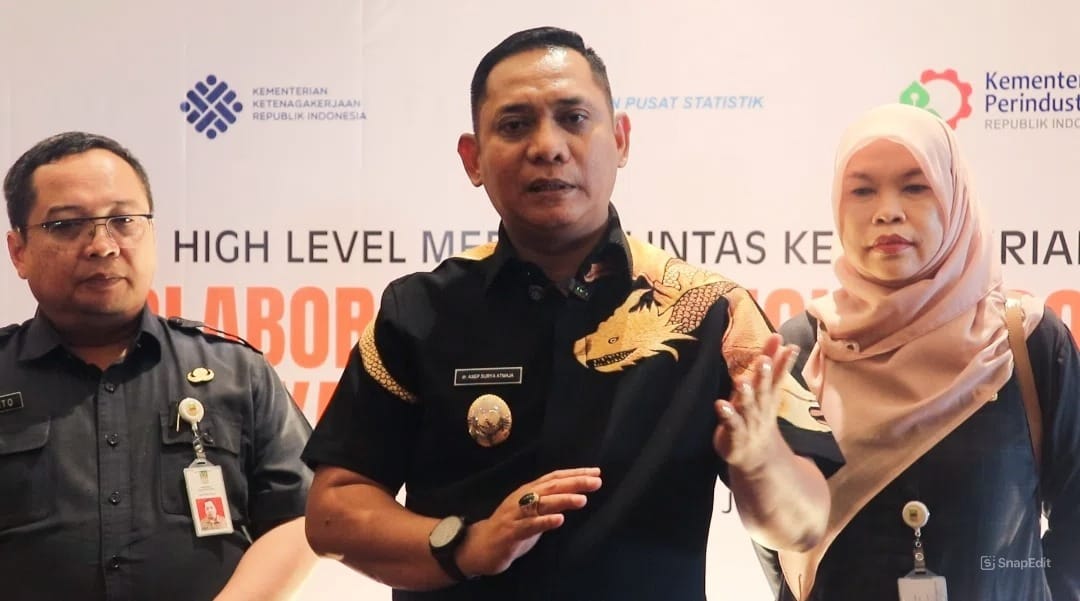
The Bekasi Regency Government continues to strengthen strategic measures to prepare competent human resources through the development of vocational education and training based on industry needs.
This effort is believed to be a solution for reducing unemployment while improving the competitiveness of the local workforce amid rapid growth in the region’s industrial areas.
This commitment was conveyed by Acting Regent of Bekasi Asep Surya Atmaja after attending a High Level Meeting (HLM) across ministries themed ‘Strategic Collaboration for the 2026 Economic Census, the Foundation of Future Industrial Competitiveness’, organised by the Statistics Agency (BPS) of West Java Province in South Cikarang on Tuesday (21/7).
The event was also attended by Manpower Minister Yassierli and the Head of the Central BPS, Amalia Adininggar Widyasanti.
“Bekasi Regency still has an unemployment rate of around 8 per cent. That is why we need to strengthen Job Training Centres (BLK) and vocational education that truly matches industry needs,” said the Acting Regent on Wednesday (22/7).
According to him, Bekasi Regency, as the largest industrial area in South-East Asia, has great potential to absorb local labour. However, this potential must be matched by the readiness of jobseekers’ competencies so they meet the needs of continuously developing companies.
“If we provide training but what is taught does not match company needs, the results will certainly not be optimal. Therefore, what must be done is to align industry needs with training materials,” he asserted.
MAPPING WORKFORCE NEEDS
Asep explained that the Bekasi Regency Government will strengthen collaboration between the Manpower Office and industrial estate managers to map workforce needs periodically. Based on this mapping, the government will design vocational training programmes that are more adaptive to developments in the business and industrial worlds.
“I will invite the managers of eleven industrial estates to sit down together. We want to know in detail what kind of workforce companies need. Only after that will we prepare them through vocational and job training programmes,” he stated.
He judged that this model would create a stronger link between education, training and the world of work. As such, training graduates would no longer face a competency gap when entering the labour market.
“Our young people must be prepared from the start. We must not have a situation where a company needs labour but the competencies do not match. Vocational training must become a bridge between industry needs and the readiness of the local workforce,” Asep continued.
He revealed that he had also held direct discussions with the Manpower Minister regarding strengthening vocational programmes in Bekasi Regency. Given that the region is one of the country’s industrial centres, central government support is considered important to expand access to job training relevant to technological developments and the needs of modern manufacturing.
SYNERGY WITH INDUSTRY
Beyond improving workforce competencies, synergy between the regional government and industry is also expected to expand opportunities for absorbing local labour.
According to the Acting Regent, the presence of thousands of companies in Bekasi Regency must deliver tangible benefits to improving the welfare of surrounding communities.
“We want cooperation between the regional government and companies to grow ever stronger. Whatever industry needs, that is what we will prepare through education and training. That way, the people of Bekasi Regency will have greater employment opportunities,” he said.
Source: jawawa.id (https://jawawa.id/newsitem/bekasi-regency-government-promotes-industry-based-vocational-education-to-curb-unemployment-1784724682)
Originally published by Media Indonesia (https://mediaindonesia.com/jabar/berita/913620/tekan-angka-pengangguran-pemkab-bekasi-dorong-pendidikan-vokasi-berbasis-industri), translated from Indonesian