
Bekasi Agriculture Office Implements PMAS Programme to Boost Farmers' Welfare
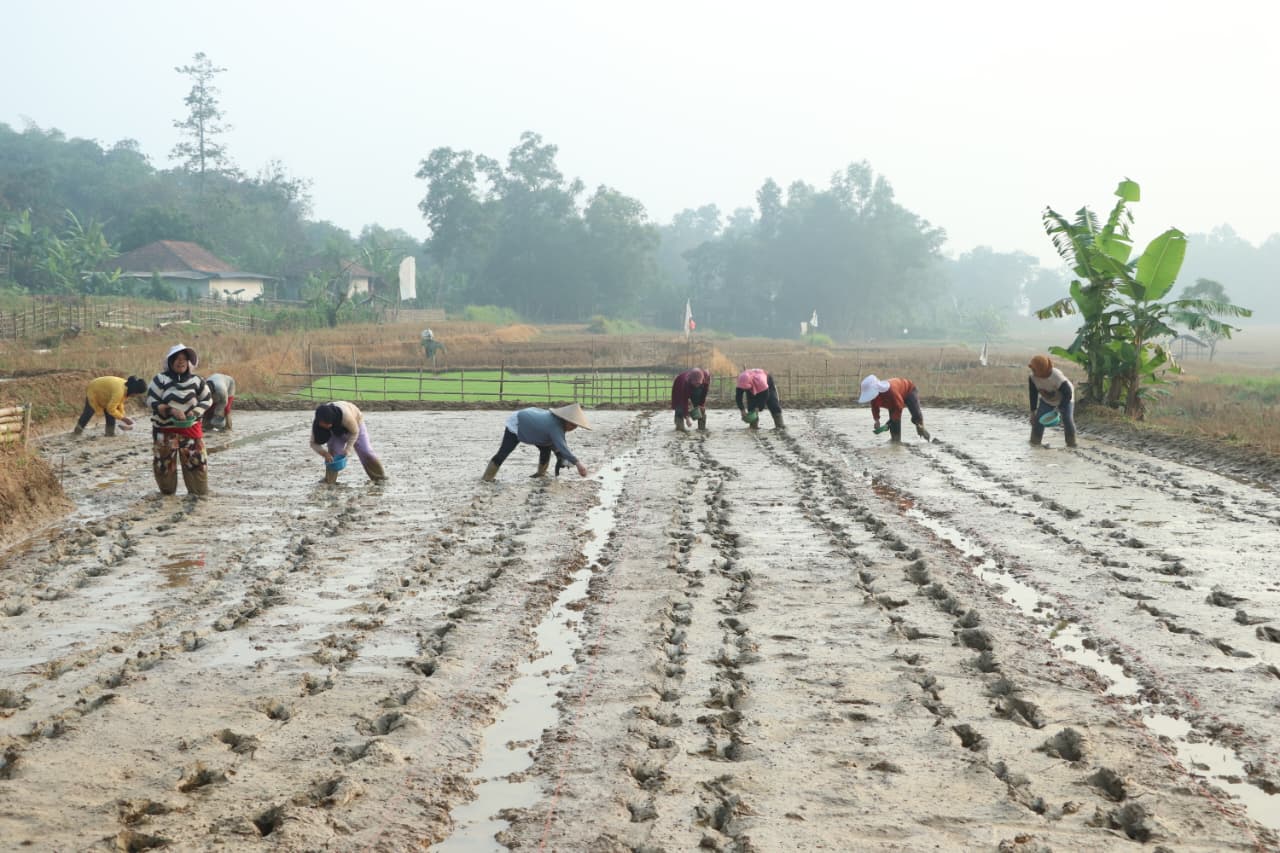
The Bekasi District Agriculture Office, through the Bojongmangu Sub-district Agricultural Extension Coordinator, has begun implementing the Modern Agriculture System (PMAS) programme using direct seeding technology for rice cultivation. The programme was applied to a 4,000 square metre demonstration plot owned by the Warudoyong I Farmers Group in Sukabungah Village, Bojongmangu Sub-district, on Wednesday (5/8).
Coordinator Ubuh Buhori stated that PMAS is a modernisation innovation from the Ministry of Agriculture, carried out in collaboration with agricultural extension workers and farmer groups to increase productivity and efficiency in rice farming. The initial phase uses the Inpari 33 rice variety with facilitation support from the Ciawi Agricultural Assembly and Modernisation Centre (BRMP).
Prior to planting, the land was tilled and soil acidity levels were checked. Tests showed the soil pH in the Bojongmangu area was 5.5, requiring the application of 500 to 1,000 kilogrammes of dolomite lime per hectare to improve soil conditions. For the 4,000 square metre plot, 500 kilogrammes of dolomite was applied in two stages: during initial soil processing and three days before planting. Herbicide was also sprayed a day before planting to control weeds.
After the seeds are planted, the field must not be flooded for the first five days to prevent seed rot and disease. Plant growth is then monitored, with the first fertiliser application given around 10 days after planting according to recommended dosages. The PMAS system requires higher fertiliser input compared to conventional methods due to denser planting patterns, but is expected to significantly boost productivity.
The programme in Bojongmangu serves as a demonstration plot, with plans to develop similar sites in every village covering a minimum of two hectares. This allows farmers to directly observe the application of modern agricultural technology. The Ministry of Agriculture targets rice productivity of 10 tonnes per hectare, while current average yields in Bojongmangu are around 5 tonnes per hectare. The demonstration plot used approximately 15 kilogrammes of Inpari 33 seeds, targeting a harvest of around 4 tonnes of grain.
Officials hope the PMAS programme will encourage farmers to transition from conventional farming systems to modern agricultural technology, thereby increasing productivity, improving farmer welfare, and supporting food self-sufficiency through collaboration between farmers, farmer groups, extension workers, the BRMP, and the Bekasi District Agriculture Office.
Yusup Saepuloh, Chairman of the Warudoyong I Farmers Group, welcomed the PMAS programme, stating that the trial results would serve as a reference before wider implementation among all group members. He expressed optimism that the modern technology, including pH regulation, measured fertilisation, and modern planting systems, would increase harvest yields. He also confirmed that water availability for the planting season is secure, with the group having received a government-assisted 6-inch water pump supported by irrigation networks. Planting on approximately 30 hectares is scheduled to begin the following week.