
Beijing, Donald Trump, and Two-Faced Geopolitics
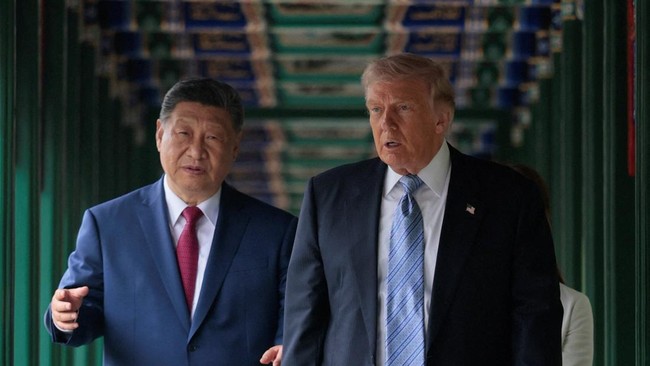
The meeting between US President Donald Trump and Chinese President Xi Jinping in Beijing from 13-15 May 2026 was more than a mere diplomatic gathering; it was a significant gamble on a volatile global chessboard. Amidst the tensions of the Iran conflict and ongoing tariff wars, the leaders of the world’s two largest economies met at the Great Hall of the People to negotiate boundaries of competition to prevent open confrontation.
For the world, and particularly for Indonesia, this summit signifies a global order searching for a new, pragmatic, and cold equilibrium. This transactional diplomacy was evident when China renewed import permits for hundreds of American beef processing plants. This move provides much-needed relief for Washington following a 67 per cent drop in beef exports to China throughout 2024 and 2025. For Trump, this represents a tangible political victory to present to his agricultural constituents ahead of the upcoming US elections.
However, Xi Jinping remains a formidable negotiator. For Beijing, reopening beef imports serves as a strategic lever to soften Washington’s pressure on their semiconductor industry. Despite the seemingly warm atmosphere, Xi issued stern warnings that missteps regarding Taiwan could lead to open conflict. Asssociate Professor of International Relations at the University of Indonesia, Asra Virgianita, noted that the meeting remains heavily symbolic, asserting China’s status as an equal strategic partner to the US, despite the threat of clashing interests.
The urgency of this meeting was further heightened by the situation in the Strait of Hormuz. For the United States, blockades in the strait have triggered fuel inflation, impacting the domestic economy and Trump’s popularity. For China, the strait is an irreplaceable energy artery, as half of its crude oil imports pass through this route. Behind closed doors, Trump requires Xi’s influence to pressure Tehran into easing tensions in the Persian Gulf. Conversely, China, as a major buyer of Iranian oil, holds leverage that no Western nation possesses. However, Xi is aware that this ‘ace in the hole’ requires significant compensation regarding AI regulations and technology investments.
The agreement to keep the Strait of Hormuz open demonstrates that in critical situations, cooperation is driven not by friendship, but by the fear of global economic collapse.
Amidst the pressure from these two superpowers, Indonesia stands at a decisive crossroads with an increasingly strong hand. Indonesia’s control of over 60% of global nickel production during 2024-2025 has positioned Jakarta as a new centre of gravity in the global green energy supply chain. With nickel reserves comprising nearly half of the global total, Indonesia is no longer merely a market for foreign products, but a vital determinant for the future technological ambitions of both Washington and Beijing.
However, this dominance is a double-edged sword requiring high-level diplomatic dexterity. Indonesia’s rapid downstreaming policies must navigate US protectionism, which often discriminates against Chinese components, without severing investment ties with Beijing. Indonesia must not remain a mere anxious spectator; Jakarta must act as an active balancer to ensure regional stability amidst global energy price fluctuations. Ultimately, national sovereignty will be determined by how effectively Indonesia can maintain its bargaining position between these two competing giants.