
Behind the Weakening of the Rupiah Exchange Rate
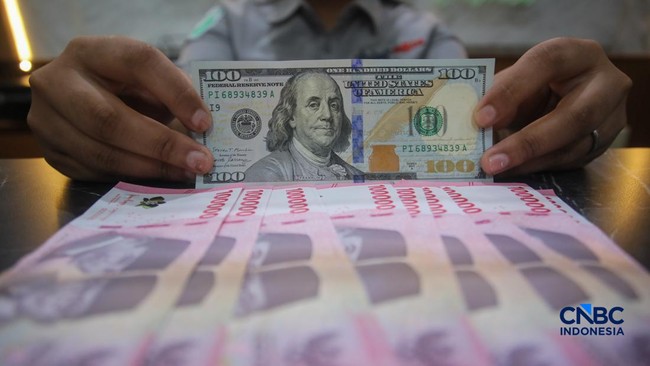
The rupiah has weakened by approximately 8% against the US dollar (USD) throughout 2026 as of 31 July. Bank Indonesia’s policy rate increase of 100 basis points to 5.75% in May-June 2026 only managed to stabilise the rupiah around Rp18,000 per USD. Although it has breached Rp18,000 per USD, the lowest since the 1998 crisis, the rupiah is not yet in a crisis state. A currency crisis is typically marked by a very sharp depreciation, at least 10% in a month or 25-30% in a year.
The government often attributes the rupiah’s depreciation to external factors such as geopolitical turmoil, rising oil prices, and a strengthening US dollar. However, if external factors were the primary cause, other ASEAN currencies should have experienced similar pressure. Throughout 2026, the US Dollar Index has only strengthened by about 1.7%, far less than the rupiah’s 8% depreciation. Over the same period, the Malaysian ringgit weakened by only about 1%, while the Vietnamese dong remained relatively stable. This proves that external and seasonal factors alone cannot explain the rupiah’s weakness.
To determine the cause, one must examine long-term exchange rate movements. Over the past 10 years, the rupiah has weakened by around 37%. The Philippine peso and Vietnamese dong depreciated by 30% and 18% respectively, while the Malaysian ringgit’s depreciation was limited to 2% and the Thai baht actually strengthened by 5%. Over a 20-year horizon, the rupiah has depreciated by about 98%, the weakest among its ASEAN peers. The Vietnamese dong weakened by around 64%, the Philippine peso by 19%, and the Malaysian ringgit by 12%, while the Thai baht appreciated by 11%. This consistent long-term underperformance indicates that external factors are not the main driver.
The persistent depreciation points to structural economic problems, specifically weak competitiveness, especially in manufacturing. Indonesia excels as a commodity exporter but lags in high-value-added manufactured products. Recurring current account deficits show that the need for foreign exchange often exceeds the economy’s capacity to generate it. A proxy for competitiveness is labour productivity. In 2023, Indonesia’s productivity per worker was around US$30 (constant PPP GDP), below Malaysia’s US$76 and Thailand’s US$39, though higher than the Philippines’ US$26 and Vietnam’s US$25. However, Vietnam’s productivity has been rapidly catching up, growing at 5.3% per year from 2000 to 2023 compared to Indonesia’s 2.9%, reaching 83% of Indonesia’s level.
Vietnam’s productivity gains are reflected in its export performance. In 2000, Indonesia’s exports were USD68 billion, four times Vietnam’s USD17 billion. By 2025, Vietnam’s exports reached USD475 billion, nearly 1.7 times Indonesia’s USD283 billion. Vietnam has successfully strengthened its manufacturing base and integrated into global supply chains, while Indonesia’s exports remain dependent on commodities. The contrast shows that Vietnam’s currency depreciation has spurred export competitiveness, whereas the rupiah’s depreciation reflects a loss of competitiveness in global export markets.
Despite structural economic weaknesses compared to Malaysia, Thailand, and Vietnam, Indonesia’s financial sector remains attractive to global investors. From 2010 to 2019, portfolio investment inflows into stocks and government bonds exceeded USD82 billion. Yet, the rupiah still weakened from around Rp9,400 per USD at the end of 2009 to around Rp14,100 at the end of 2019, a 50% depreciation. This demonstrates that even large financial inflows are insufficient to strengthen the rupiah when the economic foundation is weak. Unable to address these structural issues, economic policy often relies on fiscal and monetary stimulus to maintain growth. In the short term, such stimulus can boost activity, but in the long term, without corresponding productivity improvements, it only fuels inflation, balance of payments deficits, and currency depreciation. This is evidenced by Indonesia’s average money supply (M2) growth of 10% per year from 2011 to 2024, significantly higher than Malaysia and Thailand’s 6%, mirroring the higher depreciation rates seen in Indonesia and the Philippines compared to their more disciplined neighbours.
Source: jawawa.id (https://jawawa.id/newsitem/behind-the-weakening-of-the-rupiah-exchange-rate-1785819064)
Originally published by CNBC Indonesia (https://www.cnbcindonesia.com/opini/20260804101500-14-756322/di-balik-pelemahan-nilai-tukar-rupiah), translated from Indonesian