
Behind the Reinwardt Monument Lies the Long History of Bogor Botanical Gardens
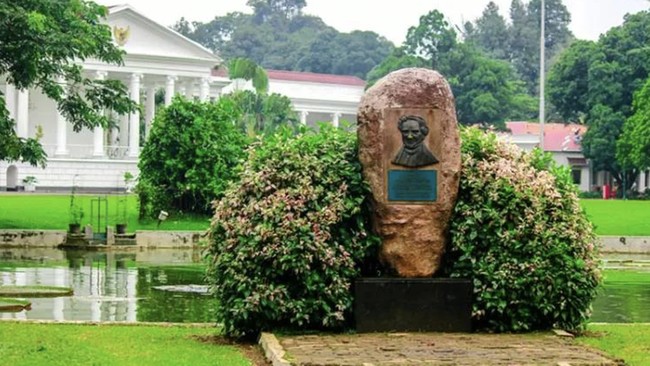
Have we ever walked through the Bogor Botanical Gardens and seen a monument that might appear simple, but holds a grand story about the early development of botanical science in Indonesia?
In the Kolam Gunting area, directly behind the Bogor Palace grounds, stands the Reinwardt Monument. This monument is more than just a marker of a name; it serves as a reminder of a figure who played a vital role in the birth of the Bogor Botanical Gardens as a centre for plant science development in the Archipelago.
That figure is Prof. Caspar Georg Carl Rein ext{r}wardt, a German-born botanist and chemist who later pursued his career in the Netherlands. His name is deeply intertwined with the history of the Bogor Botanical Gardens. In fact, the botanical scientific journal Reinwardtia, published by the Herbarium Bogoriense, takes its name to honour this figure.
From Buitenzorg, a grand idea began. In the early 19th century, the Bogor region, then known as Buitenzorg, became a hub for various scientific and agricultural activities. The idea of establishing a botanical garden eventually took a more concrete form.
On 18 May 1817, Governor-General Godert Alexander Gerard Philip van der Capellen officially established the botanical garden under the name ’s Lands Plantentuin te Buitenzorg. The construction of the garden was led by Reinwardt.
The initial area of the garden encompassed lands around the Bogor Palace. This was the starting point of the long journey of a botanical garden that would later become known as the Bogor Botanical Gardens.
Reinwardt served as the garden’s early leader until 1822. During this period, he played a key role in collecting various types of plants and seeds from across the Archipelago. Gradually, Buitenzorg developed into one of the important centres for plant, agricultural, and horticultural research.
More than just a garden. Interestingly, the history of the Bogor Botanical Gardens does not end with the existence of live plant collections. Its development subsequently became an essential part of the birth of various scientific institutions. The Bogor Botanical Gardens became a place for the development of botanical research traditions, which led to various supporting facilities and institutions, including the Herbarium Bogoriense, established in 1844.
The herbarium plays a very important role in botanical science. Plant specimens that are collected, preserved, documented, and studied serve as a source of scientific information regarding Indonesia’s plant diversity.
Therefore, when we speak about the history of the Bogor Botanical Gardens, we are essentially speaking about the long history of the documentation and research of Indonesia’s biodiversity.
Why is there a Reinwardt Monument? To commemorate Reinwardt’s services as a pioneer of the Bogor Botanical Gardens, a monument was later erected within the garden grounds. The Reinwardt Monument in the Bogor Botanical Gardens was inaugurated on 19 May 2025, as part of the 208th anniversary celebrations of the Bogor Botanical Gardens.
The inauguration was performed by the Head of the National Research and Innovation Agency (BRIN) at the time, Dr Laksana Tri Handoko, M.Sc., and was attended by the German Embassy. The inauguration of the Reinwardt Monument is part of the effort to remember the contributions of Caspar Georg Carl Reinwardt, the founder and first director of the Bogor Botanical Gardens.
The monument serves as a small point connecting us to a very long history. On one side lies the landscape of the Bogor Botanical Gardens with its trees and plant collections; on the other side lies the Bogor Palace. Between them stands a monument reminding us that this area was once the starting point of a great journey in plant science in Indonesia.
A name that lives on in the botanical world. Interestingly, Reinwardt’s name is not only immortalised through a monument. The name also lives on in the scientific world through Reinwardtia, a journal closely related to the Herbarium Bogoriense and botanical research. This journal was first published in 1950 and is a continuation of the Bulletin du Jardin botanique de Buitenzorg. Thus, Reinwardt’s legacy is not merely a monument.
That legacy has evolved into botanical gardens, plant collections, herbaria, scientific publications, research, education, and various biodiversity conservation efforts. From a single monument, we learn about the journey of science.
For some visitors, the Reinwardt Monument might just be one of the historical objects passed while walking through the Bogor Botanical Gardens. However, if we pause for a moment and view it from a historical perspective, the monument holds a much greater meaning.
It reminds us that the plant collections we see in the gardens today did not appear out of nowhere. Behind them lies a long journey of exploration, collection, identification, research, documentation, and conservation. And that journey had a significant milestone in 1817, when the Bogor Botanical Gardens began construction under Reinwardt’s leadership.
So, when one day you pass the Reinwardt Monument in the Bogor Botanical Gardens, you may no longer see just a monument. You are looking at a small gateway to the long history of botany and the conservation of Indonesia’s biodiversity.
Source: jawawa.id (https://jawawa.id/newsitem/behind-the-reinwardt-monument-lies-the-long-history-of-bogor-botanical-gardens-1789358095)
Originally published by CNBC Indonesia (https://www.cnbcindonesia.com/opini/20260914095552-14-767618/di-balik-tugu-reinwardt-ada-sejarah-panjang-kebun-raya-bogor), translated from Indonesian