
Behind President Prabowo's Criticism of Experts
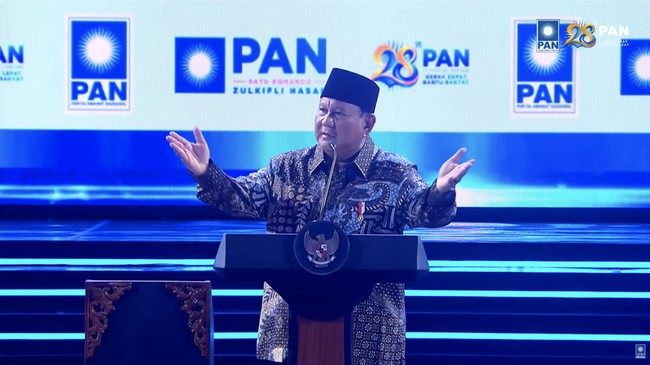
President Prabowo Subianto’s statement regarding experts who are ‘so smart’ they can quickly become ‘stupid’ has rapidly become a matter of public attention. This is unsurprising. The word is harsh, coming from a President, and is very easy to clip into short videos for debate on social media.
A head of state’s choice of diction is certainly open to criticism. However, using a single word as a conclusion to President Prabowo’s entire view of intellectuals risks losing a much more important substance. This is especially true if President Prabowo’s speech at the 28th anniversary of PAN is listened to in its entirety.
There are many other ideas that are far more worthy of discussion. President Prabowo spoke about his desire to see Indonesia become an honourable nation and its people living in prosperity. He spoke of an Indonesia that no longer has hungry people. He touched upon children going to school hungry, the issues of malnutrition and stunting, and his desire for the Indonesian generation to be able to compete with other nations.
President Prabowo also spoke about the values of struggle: courage, perseverance, fortitude, and loyalty. Even when discussing loyalty, President Prabowo emphasised that the primary loyalty must be to the nation, the state, and the Indonesian people.
All of this provides vast space for discussion. Is Indonesia capable of eradicating hunger? How can we ensure children receive adequate nutrition? How can government policy improve the quality of human resources? How can the state ensure that economic growth ultimately produces prosperity?
Unfortunately, much of the public conversation following the speech has instead concentrated on two words: ‘experts’ and ‘stupid’. Herein lies an interesting irony. A speech discussing welfare, hunger, child nutrition, values of struggle, and the future of Indonesia has ultimately been reduced to a single viral sentence fragment.
In fact, within the same series of statements, President Prablamo also raised a term that is actually important to discuss more seriously: intellectual honesty.
That is where the substance of the debate should begin. Indonesia needs experts. A modern government cannot function based solely on political intuition. Economists, academics, scientists, health experts, engineers, legal experts, and various disciplines are needed to ensure that public policy has a strong knowledge base.
However, expertise never implies a monopoly on truth. The tradition of science is built through testing. Data is checked, methodology is tested, assumptions are debated, and a conclusion can be corrected when new evidence is found.
Therefore, when President Prabowo questions intellectual honesty, there is a relevant question to ponder: does the title of ‘expert’ in itself make every opinion presented to the public true? Certainly not.
An economist may make an incorrect projection. An epidemiologist may change their prediction when data changes. Economic models can fail to read a crisis. Even scientific consensus can undergo revision when better evidence becomes available.
The 2008 global financial crisis provided an important lesson. Many risk models, financial institutions, and professionals did not foresee the magnitude of the crisis that eventually occurred. The Covid-19 pandemic also demonstrated how various scientific projections undergo adjustments as new data emerges. This is not evidence that science is useless; on the contrary, the strength of science lies in its willingness to be corrected.
Thus, President Prabowo’s criticism of some experts should not be hastily translated as an anti-expert or anti-science stance. Criticism of the use of expert authority is different from the rejection of science itself. Especially when an expert enters the public arena, that authority carries consequences.
Statements from professors, economists, or researchers can become news headlines. Their analyses can shape the perceptions of millions, influence business decisions, and, in certain circumstances, shape market expectations.
Therefore, a simple question must always apply: What is the data? What is the methodology? What are the assumptions? How large is the uncertainty? Academic titles should not make these questions taboo.
Another element often lost in the polemic is that President Prabably is not just presenting ideas. His administration is implementing several large-scale policies whose results will ultimately be tested by the public.
The Free Nutritious Meal Programme, for example, has an allocation of Rp335 trillion in the 2026 Draft State Budget (RAPBN) with a target of 82.9 million beneficiaries. The education budget reaches approximately Rp757.8 trillion, or 20 per cent of the State Budget (APBN).
These programmes are directly related to the ideas presented by President Prabowo in his speech at the PAN anniversary: not wanting to see Indonesian children go to school hungry and not wanting malnutrition to cause the Indonesian generation to lose its ability to compete.
This is not merely a matter of rhetoric. Because of the large scale, President Prabowo’s policies must certainly be open to evaluation. Has nutritional quality improved? Is the implementation safe and effective? Does the budget yield commensurate benefits? Has the quality of human resources improved?
The answer must be provided through data. But the same standard should apply when an expert claims a government programme is failing, ineffective, or dangerous.