
Behind Modi's Visit, the Fate of Rp 21 T in Palm Oil Exports Hangs in the Balance
Crude Palm Oil (CPO) remains one of Indonesia’s flagship export commodities, with India serving as one of its largest markets. Given the scale of Indonesia’s CPO trade with India, the visit of Indian Prime Minister Narendra Modi this week is of paramount importance.
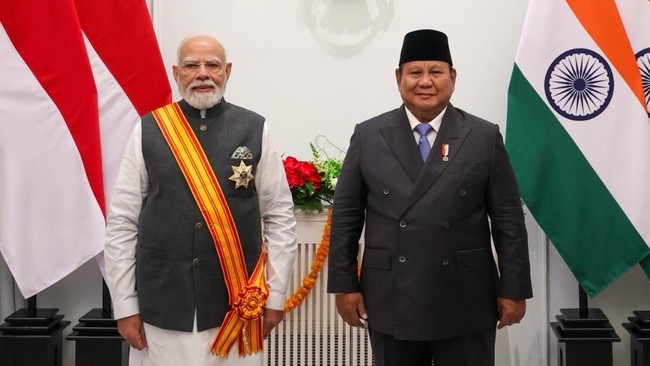
Prime Minister Modi’s visit to Indonesia serves as a return visit following President Prabowo Subiability’s attendance at the Indian Republic Day celebrations in January 2025. On Tuesday (7/7/2026), Prabowo and Modi are scheduled to hold a private meeting at the Merdeka Palace, followed by bilateral meetings and the signing of several cooperation agreements.
Foreign Minister Sugiono stated that the agreements to be signed cover several strategic sectors, including defence, education, healthcare, and technological development.
The relationship between Indonesia and India is reflected not only in inter-governmental cooperation but also in expanding trade activities. For Indonesia, India remains a major export market for various commodities, including crude palm oil and its derivatives.
According to the Indonesian Central Bureau of Statistics (BPS), India remained the primary destination for CPO and derivative exports (HS 1511) during the January-May 2026 period. The export value reached US$1.14 billion, or approximately Rp 21.42 trillion, accounting for about 11.9% of Indonesia’s total CPO exports. The total CPO export value for the January-May 2026 period stood at US$9.59 billion, or roughly Rp 172.62 trillion (at an exchange rate of US$1 = Rp 18,000).
Following India, Pakistan ranked second with export values of US$992.8 million, followed by China at US$952.8 million. Bangladesh completed the group of largest markets with a value of US$649.3 million. These four nations absorbed approximately 3lar 39% of Indonesia’s total CPO and derivative exports during the first five months of 2026.
India’s position as the largest buyer is also evident in shipment volumes. Between January and May 2026, exports to the country reached 1.06 million tonnes. Pakistan followed with 941,800 tonnes, China with 923,600 tonnes, and Bangladesh with 614,500 tonnes.
Despite remaining the largest cumulative market, shipments to India dropped sharply in May 2026. The export value was recorded at US$38.48 million, a plunge of 85.63% compared to May 2025 and a 79.14% decrease compared to April 2026. In terms of volume, exports shrank to 31,400 tonnes from 272,100 tonnes in May of the previous year.
Meanwhile, Pakistan and Bangladesh also recorded slowdowns in May. Export values to Pakistan fell by 1.67% year-on-year to US$166.9 million, while Bangladesh saw a 25.52% decline to US$82.27 million. However, cumulatively for January-May 202<0xA0>26, Pakistan still recorded exports of nearly US$1 billion, while Bangladesh reached US$649.3 million.
The impact of India and the condition of Indonesian CPO
The weakening of shipments to India occurred as Indonesia’s overall CPO and derivative exports also experienced a slowdown in May 2026. The Central Bureau of Statistics (BPS) reported that the export volume of commodity HS 1511 reached 1.19 million tonnes, down 36.71% compared to May 2025 and weakening by 36.27% compared to April 2026.
In terms of value, CPO and derivative exports were recorded at US$1.37 billion in May 2026. This value decreased by 26.14% year-on-year and shrank by 35.07% month-to-month.
Nevertheless, the cumulative export performance still recorded growth. During January-May 2026, export volumes reached 8.92 million tonnes, an increase of 7.41% compared to the same period last year. The export value also rose by 7.71% to US$9.59 billion.
The slowdown in May does not erase the export growth seen throughout the first five months of this year. The decline in shipments in the final month more closely reflects the weakening in several key markets, including India, rather than a change in the overall export trend.
This condition aligns with the decline in Indian palm oil imports. According to The Hindu Business Line, India’s palm oil imports in June 2026 fell by 10.5% compared to the previous month to 492,000 tonnes. This figure was the lowest in 14 months, since April 2025.
The decline in purchasing occurred as domestic demand weakened and the price difference between palm oil and other vegetable oils narrowed. Not only palm oil, but India’s soybean oil imports also fell by 23% to 381,000 tonnes, while sunflower oil imports plummeted by 17.5% to 244,000 tonnes. Overall, India’s vegetable oil imports shrank by 16.6% month-on-month to 1.1 million tonnes in June.
Shankar Thakkar, President of the All India Edible Oil Traders Federation, stated that the reduction in Indian purchasing has the potential to increase stocks in major producing countries such as Indonesia and Malaysia. This rise in stocks is assessed as being able to exert pressure on global palm oil prices in the near future.
India has long relied on Indonesia and Malaysia as its primary suppliers of palm oil. Therefore, the slowdown in imports in that country is one of the factors that could affect the demand for Indonesian CPO exports moving forward.
Source: jawawa.id (https://jawawa.id/newsitem/behind-modis-visit-the-fate-of-rp-21-t-in-palm-oil-exports-hangs-in-the-balance-1783491615)
Originally published by CNBC Indonesia (https://www.cnbcindonesia.com/research/20260707114703-128-748713/di-balik-kunjungan-modi-ada-pertaruhan-nasib-ekspor-sawit-rp-21-t), translated from Indonesian