
Behind Efforts to Protect the Marine and Coastal Ecosystems of Obi Island
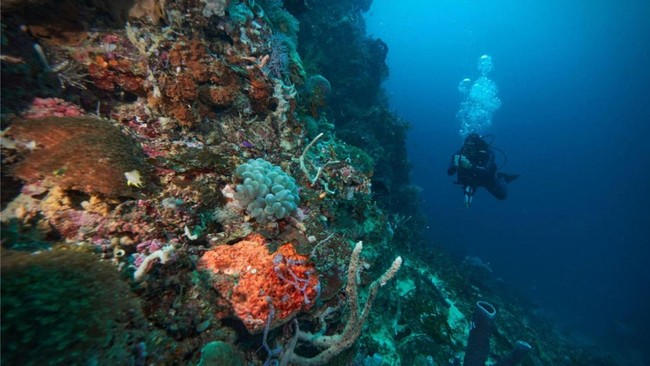
Jakarta, CNBC Indonesia – The waters around Obi Island in South Halmahera, North Maluku, are home to diverse marine life and coral reef ecosystems. For coastal communities, the sea is both a source of livelihood and a route for inter-island transport. Amid nickel mining and processing activities, protecting the health of the marine ecosystem is important for environmental sustainability and local livelihoods.
Beneath the waters off Obi, divers move among coral reefs, observing the marine life around them. They are not tourist divers or researchers who visit only occasionally to see Obi’s underwater scenery.
The divers are part of the Environmental Marine team at Harita Nickel, a nickel mining and processing company operating on the island. The team is responsible for monitoring water quality and ecosystem conditions in accordance with applicable environmental regulations.
“My team and I work intensively to monitor water quality and marine ecosystems, so that the benefits are not only for the company but also for the surrounding community,” said Putri Wullandari Hamid, Harita Nickel’s Environment Marine Foreman, on Friday (23 October 2026).
The Environmental Marine team is part of Harita Nickel’s Health, Safety and Environment (HSE) Department. Its work includes monitoring seawater quality, ecological conditions, coral growth, reef fish populations, and meteorological and oceanographic conditions.
“Monitoring is carried out regularly, from weekly and monthly to quarterly, depending on the aspect being observed,” said Windy Prayogo, Harita Nickel’s VP of Environmental Marine.
The team routinely collects seawater samples and inspects underwater conditions, including in areas that are difficult for divers to reach. To access these locations, it uses remotely operated vehicles (ROVs). Samples are analysed at accredited external laboratories and compared with the applicable quality standards.
According to Harita Nickel’s Sustainability Report, all effluent discharged from its operational facilities met quality standards in 2025. Monitoring also involves external parties, including universities, environmental consultants and non-governmental organisations. Several wastewater monitoring points are connected online to the Ministry of the Environment, allowing regulators to monitor them directly.
“Testing and monitoring are important for establishing the condition of the waters based on data. We also work with external parties so that environmental observations can be made from a range of perspectives,” Windy said.
A New Home for Reef Fish
In addition to monitoring, the Environmental Marine team undertakes rehabilitation by placing reef cubes on the seabed. These artificial structures provide surfaces for coral to attach to and grow on, while also creating habitat for various organisms.
By 2025, more than 2,500 reef cubes had been placed in Obi’s waters, with coral growth recorded at up to 18.9 centimetres. The team also identified reef fish from 28 families beginning to colonise the reef-cube areas. Coral reefs are important habitats for many types of fish, so the health of underwater ecosystems is also linked to the sustainability of fishery resources used by Obi’s coastal communities.
Coastal environmental management efforts also include mangrove conservation. Harita Nickel is working with Komunitas Tongke, a community group, to plant mangroves in Soligi Village, South Obi. Mangrove ecosystems provide habitats for various coastal species and can help reduce wave energy and the risk of coastal erosion.
“Mangrove conservation cannot rely on planting seedlings alone. Monitoring and maintenance are needed to help the plants grow well. That is why collaboration with communities such as Komunitas Tongke is important in supporting coastal ecosystem restoration,” Windy said.
Celebrating the Community’s Connection with the Sea
For the people of Obi, their relationship with the sea is not only tied to their livelihoods but is also part of social life. This connection will also be celebrated at the Harmoni Obi Festival, scheduled for 24–25 October 2026.
One of the festival’s activities is a fishing competition, bringing people together to celebrate coastal traditions. Windy said responsibility for protecting Obi’s waters rests with everyone, including companies, local residents and the wider public.
“We hope people will get to know Obi’s waters at close quarters, and that this familiarity will inspire them to protect them,” she said.
Beyond the celebrations, protecting the ecosystem will continue to require monitoring, rehabilitation and the involvement of different parties, so that Obi’s marine resources can be used by future generations.
Source: jawawa.id (https://jawawa.id/newsitem/behind-efforts-to-protect-the-marine-and-coastal-ecosystems-of-obi-island-1792767051)
Originally published by CNBC Indonesia (https://www.cnbcindonesia.com/news/20261023210632-4-779053/di-balik-upaya-menjaga-ekosistem-laut-dan-pesisir-pulau-obi), translated from Indonesian