
Behind CENTCOM: The US Military Command Executing the US-Iran War
The war between the United States and Iran has heated up once again. After a period of restraint lasting several weeks, both nations resumed mutual strikes in early September 2026.
The escalation began when the US military attacked two launchers belonging to the Iranian Revolutionary Guard Corps (IRGC) on Larak Island, near the Strait of Hormuz, on Sunday (30/8/2026). Iran subsequently retaliated by firing missiles at two US air bases in Jordan.
The conflict expanded on Tuesday (1/9/2026), as the US attacked IRGC air defence systems, radar installations, maritime facilities, mine-laying capabilities, and communication networks.
Iran responded again by launching missiles and drones at several US facilities in Jordan, Bahrain, and Iraq.
Behind this series of attacks lies U.S. Central Command, or CENTCOM, the military command responsible for US operations in the Middle East, including Iran.
CENTCOM acts as the link between political decisions in Washington and military operations on the ground. The command manages the deployment of warships, fighter jets, ground forces, Marines, and special forces involved in an operation.
In Tuesday’s attacks, CENTCOM stated that its forces struck several IRGC targets in response to attempts to attack commercial vessels in the Strait of Hormuz and US personnel.
CENTCOM also noted that more than 50,000 US military personnel are currently operating in the Middle East, prepared to execute further orders from US President Donald Trump.
What is CENTCOM?
CENTCOM is one of 11 unified combatant commands within the US military. Each command has responsibilities based on region or function. Seven commands handle specific territories, while four others perform specialised tasks such as elite force operations, military transport, strategic weapons, and cyber operations.
CENTCOM is responsible for the Middle East, Central Asia, and parts of South Asia. Iran falls within its area of operations.
The name ‘Central’ is used because the region is situated in the centre between the US commands for Europe and the Indo-Pacific.
Despite being responsible for the Middle East, CENTCOM’s main headquarters is located at MacDill Air Force Base in Tampa, Florida. From this headquarters, multi-domain operations are planned, coordinated, and supervised.
CENTCOM’s area of responsibility spans over 4 million square miles, inhabited by more than 560 million people. This region also serves as a meeting point for various global trade routes, flight paths, energy pipelines, and vital shipping lanes.
A total of 21 countries fall within CENTCOM’s area of responsibility, placing the command in several regions highly prone to conflict.
In addition to facing Iran, the command manages the threat of ISIS in Iraq and Syria, attacks by armed groups, maritime security, and the competition for influence with Russia and China.
Some of the world’s most important sea lanes are within its territory, including the Strait of Hormuz, the Persian Gulf, the Arabian Sea, and parts of the Red Sea.
No Permanent Forces
Despite leading large-scale operations, CENTCOM is essentially a command headquarters. The organisation does not have combat units permanently stationed under its direct command.
Forces are placed under CENTCOM’s control according to operational needs. These forces are drawn from various branches and are linked through six main commands.
ARCENT has its forward headquarters in Kuwait, while AFCENT and SOCCENT have forward headquarters in Qatar. NAVCENT is based in Bahrain, which also serves as the headquarters for the US Navy’s Fifth Fleet.
This structure allows CENTCOM to conduct operations involving multiple domains simultaneously. An attack can utilise Air Force bombers, Navy warships, Marine forces, ground units, and satellite support all under a single command.
Born After the Iranian Revolution
The history of CENTCOM’s formation is inseparable from Iran. The creation of this command began with major changes in the Middle East in the late 1970s.
The 1979 Iranian Revolution ended with the overthrow of Shah Mohammad Reza Pahlavi, a close US ally. In the same year, the Soviet Union invaded Afghanistan.
These two events caused great concern for the US regarding the loss of influence and access to the Persian Gulf region. US President Jimmy Carter subsequently formed the Rapid Deployment Joint Task Force in March 1980 to ensure the US could deploy troops quickly during crises.
Then, on 1 January 1983, President Ronald Reagan transformed that unit into the U.S. Central Command.
CENTCOM’s first combat operations took place in 1987-1988, during the Iran-Iraq War. At that time, the US military protected Kuwaiti oil tankers from the threat of Iranian mines in the Persian Gulf.
Its role grew significantly after Iraq invaded Kuwait in 1990. CENTum led Operation Desert Shield to protect Saudi Arabia, followed by Operation Desert Storm to liberate Kuwait in 1991.
Following the September 11, 2001 attacks, the command led the US war in Afghanistan. CENTCOM also led the invasion of Iraq in 2003 and coalition operations against ISIS since 2014.
In 2025, CENTCOM conducted Operation Rough Rider against Houthi groups in Yemen and Operation Midnight Hammer targeting Iranian nuclear facilities.
CENTCOM then launched Operation Epic Fury on 28 February 2026 under orders from the US President. This operation has become the primary US military campaign against Iran.
Admiral Brad Cooper Leads CENTCOM
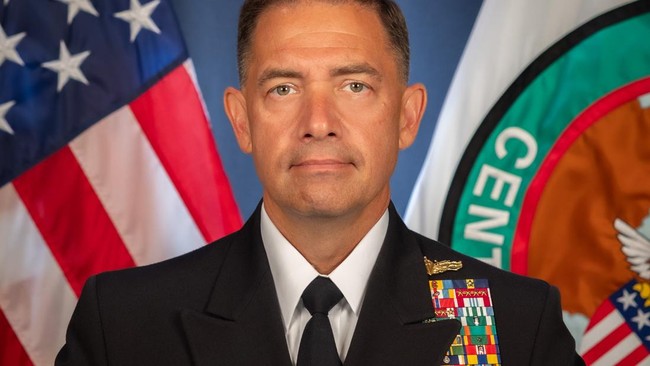
CENTCOM is currently led by Admiral Brad Cooper, a four-star officer of the US Navy. He holds control over the execution of US military operations in Iran and other regions under CENTCOM’s responsibility.
However, Cooper is not the party making the political decisions to initiate war. That authority rests with Trump and Hegseth.