
Behind ASN's Weekly Friday WFH, Public Transport Passenger Numbers Decline
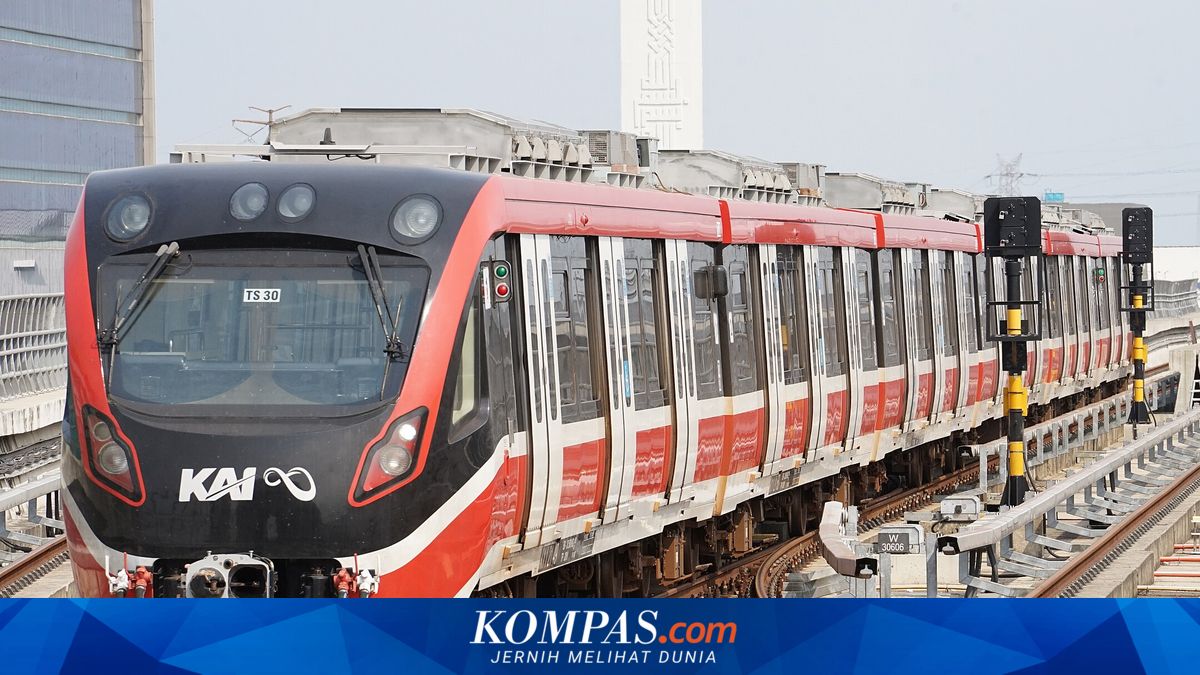
JAKARTA, KOMPAS.com - The work-from-home (WFH) policy for civil servants (ASN) every Friday, effective from 10 April 2026, has reduced mobility in Jakarta, Bogor, Depok, Tangerang, and Bekasi (Jabodetabek) using public transport.
One of the most visible indicators comes from rail-based public transport. The number of LRT Jabodebek passengers, operated and managed by PT Kereta Api Indonesia (Persero) or KAI, on Fridays has dropped by up to 17 per cent after the policy took effect in early April 2026.
LRT Jabodebek’s Public Relations Manager, Radhitya Mardika, stated that the decline is evident from comparing user volumes on Fridays in March and April 2026.
Based on internal data compiled by LRT Jabodebek, the total user volume on Fridays in March 2026 reached 253,373 people.
Meanwhile, in April 2026, the number fell to 211,293 people.
“This results in a difference of 42,080 LRT Jabodebek users, or 17 per cent,” Radhitya said.
The decline is calculated from data sampling on Fridays, 6 and 13 March 2026, as well as 10 and 17 April 2026.
Radhitya explained that the sample selection was done because March and April include holidays and red-letter days that could affect travel patterns.
“So the comparison is not for all Fridays in March, nor in April,” he said.
Although passenger numbers have decreased, station crowding patterns have not changed much. Radhitya noted that the five stations with the highest usage remain the same as before the WFH policy was implemented.
“The five stations with the most users are Dukuh Atas, Harjamukti, Kuningan, Cikoko, and Pancoran,” he said.
“Based on data during the implementation of ASN WFH every Friday, there is no significant difference between when WFH is applied and before its implementation,” he added.
Radhitya revealed that the drop in passenger volume also affects LRT Jabodebek’s operational revenue, given that the service’s fare system depends on passenger density during peak hours.
He explained that PT KAI applies a maximum fare for LRT Jabodebek of Rp 20,000 during peak hours, namely from 06:00-08:59 WIB and 16:00-19:59 WIB. Outside peak hours, the maximum fare is set at Rp 10,000.
With fewer commuters on Fridays, especially ASN who usually travel during working hours, the passenger decline occurs during the period that has previously been the largest source of revenue.
However, PT KAI has not yet provided exact figures on the impact of this decline on overall monthly revenue.
Although passenger numbers have dropped, LRT Jabodebek has not reduced trips specifically on Fridays. Operations still follow the weekday category.
“KAI operates 430 trips on weekdays and 270 trips on national holidays and weekends,” he said.
This means that as long as Friday does not coincide with a national holiday, LRT Jabodebek continues to operate on a full weekday schedule like other working days.
If Friday falls on a red-letter day, the trip pattern follows the weekend schedule.
Radhitya said PT KAI will continue to monitor developments in the ASN WFH policy and its impact on services.
“KAI will conduct periodic evaluations, including with various adjustments to rules and/or applicable policies,” he said.
KAI Commuter recorded a decline in Commuter Line Jabodetabek passenger volume on Friday (8/5/2026).
Based on data up to 13:00 WIB, the total Commuter Line users across all Jabodetabek routes reached 499,101 people.
Although passenger numbers have decreased, Commuter Line operations continue normally to ensure connectivity for the public still active outside the home.