
Before the Eruption, Do Animals Really Show Warning Signs?
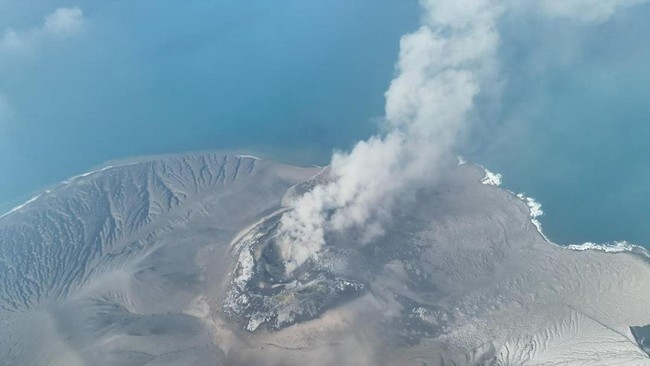
Jakarta, CNBC Indonesia – Mount Anak Krakatau has continued to spew volcanic ash since its first eruption on Friday (4/9). A number of videos circulating on social media claim that before the eruption, many sharks appeared along the coast of Lampung. Some netizens linked this to animals showing omens before a disaster strikes. But is this really the case?
Strange animal behaviour before natural disasters is not a new story. Reports have emerged across various cultures and eras, from ancient Greece to modern societies. One of the oldest accounts dates from 373 BC, when the Greek historian Thucydides reported that rats, snakes and dogs mysteriously abandoned the city of Helice days before a devastating earthquake destroyed the region.
This phenomenon suggests that animals are somehow able to detect signs of impending disaster that go unnoticed by humans.
Although for centuries such stories were dismissed as myth or coincidence, advances in technology in the fields of animal behaviour and geophysics have now provided a stronger scientific basis for understanding them.
Signs Before Major Earthquakes and Tsunamis in the Modern Era
One of the most striking events occurred during the 2004 Indian Ocean tsunami, or the Aceh earthquake, which killed more than 225,000 people.
Man-made early warning systems, such as tidal and seismic sensors, failed to give a clear warning. Many sensors were not working due to maintenance problems, whilst many coastal areas lacked tsunami siren warning systems.
Uncoordinated communications also failed to deliver warnings, with many text messages not reaching mobile phones in threatened areas or going unread.
Yet mysterious accounts came from the animals.
Some animals appeared to sense the coming danger and tried to flee. According to eyewitnesses, elephants ran to higher ground, flamingos abandoned low-lying nesting areas, and dogs refused to leave their homes.
In the coastal village of Bang Koey in Thailand, residents reported that a herd of buffalo on the beach suddenly pricked up their ears, stared out to sea, and then ran to the nearest hilltop minutes before the tsunami struck.
These reports do not stand alone. A study carried out in Italy between 2016 and 2017 observed the behaviour of cows, goats and dogs in earthquake-prone areas. The researchers found that the animals showed increased unusual activity up to 20 hours before a major earthquake occurred. The study reinforces the possibility that animals really can sense disasters earlier than man-made warning systems.
What Animals Sense Before a Major Disaster
Although there is no single consensus, several scientific theories have been put forward to explain how animals can ‘sense’ natural disasters. These include:
- Early seismic waves (P-waves)
These waves travel faster than the main earthquake waves and may be detectable by animals with keen senses.
- Electromagnetic disturbances and infrasound
Some disasters, such as earthquakes and tornadoes, trigger disturbances in electromagnetic fields and low-frequency sound waves (infrasound) that animals can detect.
- Air ionisation and chemical changes
High stress in the Earth’s crust before an earthquake can create electrical charges that ionise the air, releasing substances such as ozone, carbon monoxide or hydrogen peroxide – all of which can be detected by animals’ sense of smell.
- Sensitivity to electric and magnetic fields
Many animals possess special receptor cells or iron compounds in their bodies that make them sensitive to changes in the geomagnetic field.
A similar story occurred during the 2010 tsunami, when an undersea earthquake near Sumatra struck and killed nearly 500 people in the Mentawai Islands.
Here too, some animals, such as elephants, were reported to respond as though they had advance knowledge of the event. Only a few days ago, a newly released sea turtle suddenly turned back two days before a volcanic eruption in Tonga in January.