
Before Prabowo, Riau Police Chief Outlines Forest Fire Mitigation Strategy and Green Policing
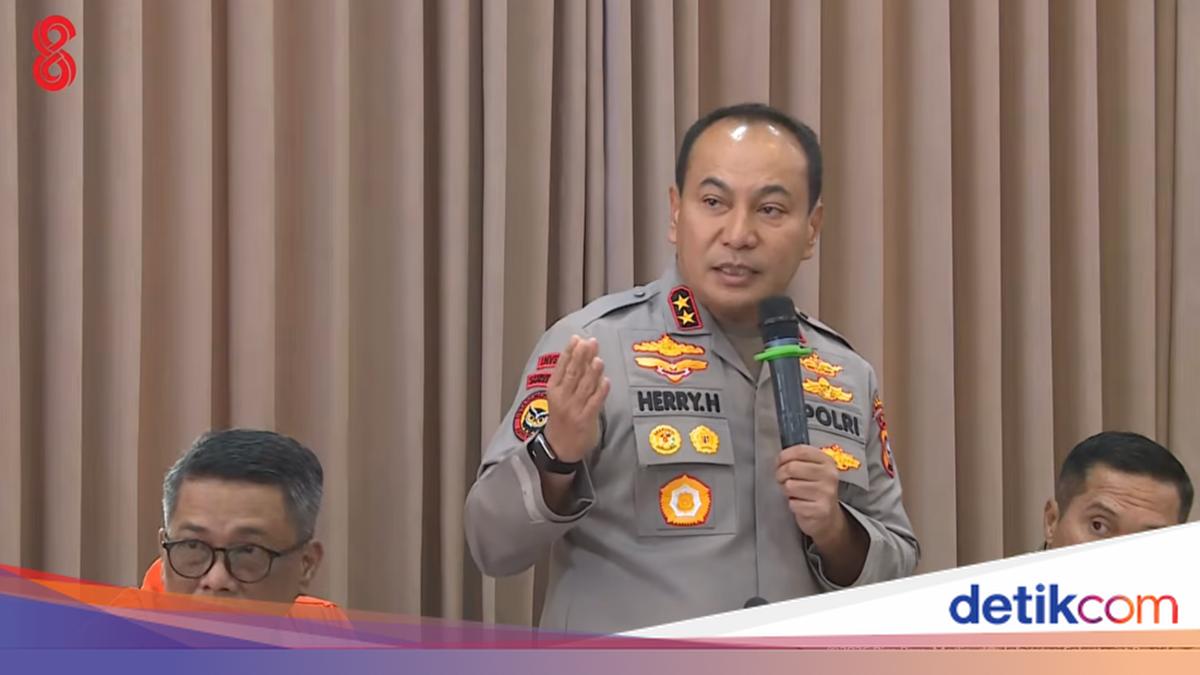
Riau Police Chief Inspector General Herry Heryawan reported various mitigation efforts for forest and land fire disasters to President Prabowo Subianto. In addition to law enforcement, the Riau Police together with the TNI and Forkopimda have also carried out various prevention and restoration efforts.
This was conveyed by the Riau Police Chief during a meeting with President Prabowo at the Riau Province Forward Post, Roesmin Nurjadin Air Base, Pekanbaru, Monday (24/8/2026). Also present at the meeting were Home Affairs Minister Tito Karnavian, State Secretary Minister Prasetyo Hadi, Cabinet Secretary Teddy Indra Wijaya, Head of BIN M Herindra, TNI Commander General Agus Subiyanto, National Police Chief General Listyo Sigit Prabowo, Acting Governor of Riau SF Hariyanto, Commander of Regional Military Command XIX/Tuanku Tambusai Major General TNI Agus Hadi Walyuo, and Head of the Riau BPBD M Edy.
In his report to President Prabowo, Riau Police Chief Inspector General Herry Heryawan explained that law enforcement efforts carried out from 2025 to August 2026 have resulted in action against 94 police reports with 106 suspects.
“Specifically for 2026 from January to August, there are a total of 33 police reports and 36 suspects with a burned area of 806.57 hectares,” said Inspector General Herry Heryawan, Monday (24/8/2026).
He stated that the law enforcement efforts were also carried out to break the chain of forest and land fires caused by humans, both intentional and unintentional. One of these efforts involved creating hundreds of warning signs prohibiting land clearing on former forest fire land.
“We have created a new approach, we made 513 forest fire law enforcement warning signs so that it does not happen again. This happened last year, sir, in 2025 in Rokan Hilir Regency,” he said.
Herry Heryawan stated that the warning signs prohibiting the use of former forest fire land are installed permanently. According to him, forest and land fires are used as a modus operandi by palm oil companies to open new land.
“So former burned land cannot be planted. Because this is usually used as a modus operandi by large companies using farmers or small communities there, pretending to fish there and then carrying out burning,” he explained.
President Prabowo then asked for evidence indicating that corporations were ordering the burning. The Police Chief stated that this year none have pointed to corporations, but last year his party had detained 3 people suspected of being used by corporations to burn land.
“So far there are none, sir, but some suspects in 2025 after we conducted investigations, there were those who did not have gardens there but they were there (with the reason) to fish even though there was no fishing location there,” said Herry Heryawan.
“How many people did not have fields there?” asked Prabowo.
“Three people, sir,” answered Herry Heryawan.
“Please bring them to Jakarta, Police Chief, and I will ask BIN to also participate in the investigation,” said Prabowo.
In the effort to handle forest and land fires, the Riau Police together with Regional Military Command XIX/Tuanku Tambusai, the Regional Government, and related stakeholders involved 3,330 personnel. The Riau Police, TNI, and Riau Regional Government also built forest fire management infrastructure by creating boreholes.
“There are 18 boreholes. The characteristic here is that there are many rivers, hundreds of rivers here, so if we dig 2-3 metres we already find water, different from Kalimantan, sir,” said the Police Chief.
In addition, Inspector General Herry Heryawan also reported the creation of 1,390 embungs. The embungs were made with a distance of about 50 metres per point.
“Specifically for today’s incident in Kerumutan District, every 50 metres—so far 700 hectares—we have made embungs, so the water source is taken from there,” he said.
The Police Chief explained that after one embung is empty, the team will move to take water from another embung point within a radius of about 50 metres.
“When this one is empty, we move to another embung, and in 2-3 hours the water will reappear in the empty embung as it absorbs water again,” he added.
Other forest fire management efforts include creating 998 canal blocks and 268 monitoring towers owned by palm oil companies. On that occasion, the Riau Police Chief also reported that 5 corporations have been sanctioned by the Ministry of Environment for not fulfilling their obligations in forest fire prevention efforts.
“Last year there were five corporations that had law enforcement action taken by the Ministry of Environment, sir, because they did not fulfil their obligations such as building monitoring towers like this or the obligation to have a rapid reaction team if there is a hotspot in their area,” he added.
Prabowo then asked for the names of the five companies.
“Find more violators this year,” Prabowo added.
“Have the five companies fulfilled their obligation to build monitoring towers?” asked Prabowo.
The Police Chief then answered, “They have, sir, but until now the five palm oil companies are still in status quo.”
“Yes, we will investigate further in Jakarta. The point is, any company that does not want to participate in protecting, we will revoke their permits. This is the source of life for the people, the source of life for the company as well. They cannot arbitrarily fail to prevent,” he said.
In the effort to prevent forest and land fires, the Riau Police also stated that they have issued a joint proclamation with Forkopimda in the context of forest fire prevention. One of the important points in the proclamation is the prohibition of land burning and post-forest fire restoration.
“We are replacing it going forward with the Police Chief’s Presisi programme, we are implementing it with the Green Policing programme, that we are present to maintain sustainability by carrying out as much restoration as possible,” he said.
The restoration is carried out at the beginning as an effort to prevent forest and land fires. Education is carried out down to the levels of early childhood education, kindergarten, elementary school, junior high school, and senior high school to provide understanding in efforts to protect the environment.