
Before PKS Legislators, Sudirman Said Outlines Three Pillars of Leadership as Antithesis to 'Godfather'
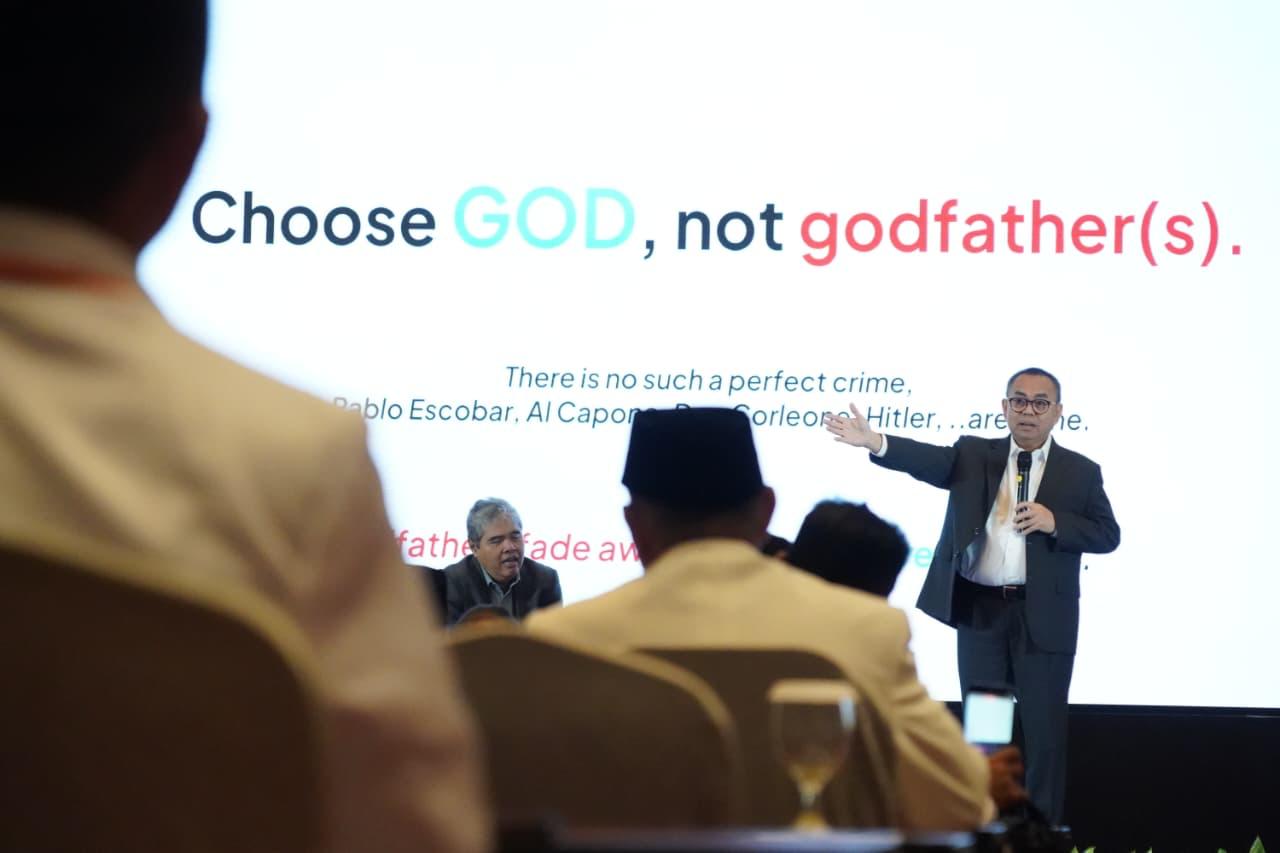
Rector of Universitas Harkat Negeri (UHN), Sudirman Said, has called on state administrators and politicians to anticipate a governance crisis by ceasing to worship the personification of power. He stressed the importance of returning the compass of leadership to the strength of values and institutional reinforcement for the nation’s future. Sudirman encapsulated his appeal in a philosophical message: ‘do not lean on a godfather, lean on God’. He clarified that the term godfather does not refer to a cartel boss in films, but rather a character of power that is centralised and cultishly focused on a single mortal figure. Reflecting on world history, great names who held absolute power in their eras, such as Pablo Escobar, Al Capone, Don Corleone, and Adolf Hitler, eventually faded and collapsed. ‘Godfathers fade, while good order persists. Therefore, our loyalty should be to eternal values, not to mortal figures,’ Sudirman said during a Technical Guidance event for PKS Regional Legislators from across Kalimantan in Jakarta. According to Sudirman, this symptom of power personification is strengthening because the national political space is increasingly impoverished of long-term ideas. Citing economist Dambisa Moyo’s book Edge of Chaos, he highlighted the phenomenon of mediocracy, where politicians are busier winning electoral contests than nurturing the long-term health of their country. ‘In a space poor in long-term ideas, figures replace systems, and personal loyalty displaces public accountability,’ he stated. Sudirman also presented an ethical ladder of state behaviour adopted from Paul Webley’s theory, ranging from the lowest level of amoral to the highest ethical level where policy stands firmly on humanitarian values. He assessed that the majority of today’s rulers are trapped and stalled at the legalistic floor, whereas true leadership demands adherence to fundamental values of goodness. ‘Spirituality is salt, not lipstick. It is invisible, but felt. A spiritual leader works in silence, not staging piety,’ Sudirman said. As an antithesis to the godfather leadership style, Sudirman offered a three-pillar leadership model: institutional (not populist), collective (not personal), and intrinsic (not nominal). Governance observer Yanuar Nugroho echoed this view, assessing that the personification of power has a domino effect on the deterioration of state governance, marked by strengthening conflicts of interest among state officials. Yanuar specifically criticised a symptom of recentralisation, the tendency to pull strategic control back to the central government, which he argued contradicts the spirit of regional autonomy fought for since the reform era. ‘The symptom of recentralisation, centralising control in the central government, must be stopped because it opposes the principles of regional autonomy. Indonesia is too large to be forced into centralised management,’ Yanuar asserted. He urged governors, regents, mayors, and regional legislative members to close ranks to safeguard the authority of autonomy, arguing that power distributed across regional institutions is the strongest fortress to prevent the state system from being easily hijacked by the interests of a single figure.