
Before Hundreds of Teachers in Kulonprogo, GSM Founder: Education is an Effort to Develop Individual Uniqueness
Indonesia possesses diverse natural resources and human capital. The challenge lies in ensuring that education can transform this potential into real capacity to build the nation’s future.
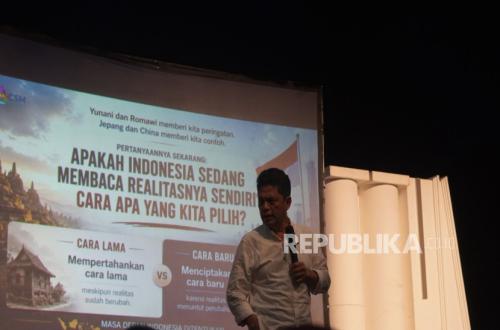
This question served as the central theme of the ‘Studying Education: The Rise and Fall of Civilisations’ seminar organised by the Gerakan Sekolah Menyenangkan (GSM) at the Kulonprogo Cultural Centre Auditorium on Saturday (29/8/2026). More than 700 teachers and educators from Yogyakarta, Central Java, East Java, West Java, and even Sumatra attended, alongside students, government representatives, and the Education Council. The GSM Kulonprogo community hosted the event.
GSM founder and UGM lecturer, Muhammad Nur Rizal, invited participants to study the histories of Greek, Roman, Japanese, and Chinese civilisations as a reflection for facing change. “Civilisations do not fall in a single day, nor do they rise due to a single policy. Civilisations are built every day through how a nation educates its people, treats ideas, and provides space to grow,” said Rizal.
When strength is no longer sufficient: Greece and Rome demonstrated that past glory does not guarantee a nation’s ability to face new problems. Systems that once succeeded can lose relevance when environments change and old methods become inadequate. Conversely, Japan used shocks as turning points by opening up, learning, and undergoing institutional reform. “Japan rose not because it already knew the answers, but because it dared to admit, ‘We do not know yet,’ and then proceeded to learn and transform its state institutions,” he stated.
China also learned through experimentation, evaluation, and openness to external knowledge. Following various failures during the Mao Zedong era, science and technology were placed at the forefront of national development to ensure China became more adaptive to the changing times. Change is achieved not by seeking perfect answers from the start, but by building the ability to learn, correct, and try again. From these four histories, one thing is clear: crisis does not automatically determine a nation’s fate. What matters is the ability to read and respond to change.
Indonesia: Rich in potential, but does its people have the capacity? Indonesia possesses significant capital: natural resources, cultural diversity, a large population, and an education budget of approximately Rp 724.3 trillion for 2025. This investment has expanded access to education across about 408,000 formal educational units, with 96.1 per cent of primary schools/madrasahs achieving A, B, or C accreditation.
However, as access expands and investment grows, the next question is no longer merely how many schools we have, but how much human capacity we have successfully built. Indonesia’s capital extends beyond education; the nation holds extraordinary strategic mineral wealth, including approximately 42.3 per cent of the world’s nickel reserves, a vital position in cobalt production, and about 136.2 million tonnes of rare earth element resources. Yet, minerals do not process themselves. They only become a strength when there are people capable of transforming them into technology, industry, and added value. This is where natural wealth meets education.
The challenge is reflected in the 2022 PISA results. Indonesia’s scores lagged by 106 points in mathematics, 117 points in literacy, and 102 points in science compared to the OECD average. According to the OECD, 20 points is roughly equivalent to one year of learning progress. Thus, these gaps represent a learning achievement gap of more than five years. Behind these figures lies the reality of how much Indonesian human capacity still needs to catch up—in understanding reality, using knowledge, solving problems, creating, and adapting. “A good institution is not one that regulates humans the most, but one that is most capable of developing human potential,” he said.
From talent to national strength: Education must be understood not as a process of standardising children, but as an effort to discover and develop the uniqueness of every individual. “Indonesia does not lack talent. The challenge is to find, develop, and connect that talent with knowledge, experience, and real-world problems,” he said. GSM defines this process as: TALENT → CONNECTED → MOVING → BECOMING CAPACITY.
The success of education cannot be measured solely by the number of schools, students, or the size of the budget. “The primary question is: How much Indonesian human potential has been successfully discovered, developed, connected, and mobilised into national strength?”
This change begins in the classroom and through the role of teachers. Teachers may not directly change policy, the economy, or civilisation, but teachers shape humans—and humans, in time, change nations. After 81 years of independence, the stake in education is whether Indonesians are increasingly capable of understanding their era, managing their wealth, cooperating, and determining their own future. Natural wealth only becomes a strength when there are people capable of understanding, processing, protecting, and developing it. Indonesia’s greatest wealth is the people capable of managing it. A great nation is not the one with the most potential, but the one most capable of developing it. “We must not be mere spectators to our own wealth,” concluded Rizal.
Source: jawawa.id (https://jawawa.id/newsitem/before-hundreds-of-teachers-in-kulonprogo-gsm-founder-education-is-an-effort-to-develop-individual-uniqueness-1788173963)
Originally published by Republika (https://rejogja.republika.co.id/berita/tkmo8w291/di-hadapan-ratusan-guru-di-kulonprogo-founder-gsm-pendidikan-upaya-kembangkan-keunikan-individu), translated from Indonesian