
Before European Business Leaders, Airlangga Unveils Indonesia's Grand Strategic Plan
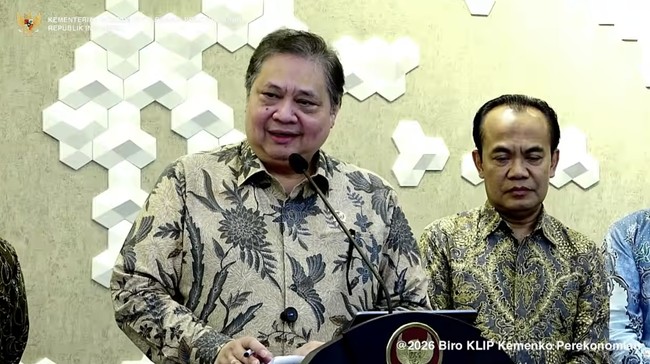
Jakarta, CNBC Indonesia — The Coordinating Minister for Economic Affairs, Airlangga Hartarto, attended the Brussels Economic Security Forum (BESF) in Belgium last weekend. During the event, he presented Indonesia’s strategic roadmap for the future amidst shifting global dynamics.
The BESF is an annual forum organised by the European Policy Centre (EPC) and serves as a primary platform in Brussels for discussing economic security, supply chain resilience, trade, investment, technology, and global economic dynamics. The forum was attended by high-ranking European Union officials, partner government representatives, business leaders, and international media.
Airlangga highlighted that Indonesia is capable of maintaining economic resilience, noting a growth rate of 5.61 per cent (year-on-year) in the first quarter of 2026, controlled inflation, strong foreign exchange reserves, and a trade surplus that has persisted for over 70 consecutive months.
Indonesia is currently accelerating its economic transformation through industrial downstreaming, manufacturing development, digital transformation, and the green economy. The nation is also strengthening its position in global supply chains, particularly in the electric vehicle (EV) sector, battery production, critical minerals, and renewable energy.
Indonesia has emerged as a global hub for the electric vehicle industry, attracting investment from Asia, Europe, and North America for the production of batteries, cathode materials, and vehicle assembly. This development not only drives national industrial growth but also contributes to the diversification of the global clean energy supply chain, making it more resilient and sustainable.
Furthermore, Indonesia continues to promote digital transformation as a key pillar of national economic security. Indonesia’s digital economy value is projected to exceed USD 130 billion in Gross Merchandise Value (GMV) by 2025, positioning the country as the largest digital economy in Southeast Asia.
Additionally, Indonesia is strengthening energy security while supporting decarbonisation agendas through the development of domestic renewable energy and the implementation of the B50 biodiesel programme. This policy is expected to reduce fuel imports by up to 4 million kilolitres per year, while enhancing national energy independence and supporting the transition to a more sustainable economy.
Airlangga noted that increasingly complex global geopolitical dynamics are exerting new pressures on the international economic system, affecting everything from supply chain resilience to trade and investment stability. Such conditions necessitate closer cooperation frameworks and the construction of an international economic architecture that remains open, inclusive, and resilient.
“The current international economic architecture is clearly undergoing change. The more important question is how we can rebuild a framework that maintains the benefits of openness while strengthening economic resilience. I believe the answer lies not in decoupling, but in diversification. Not in fragmentation, but in cooperation and partnerships,” said Airlangga.
Airlangga outlined Indonesia’s approach to strengthening economic security and national resilience, while also providing updates on Indonesia-EU economic cooperation, including the progress of the Indonesia-European Union Comprehensive Economic Partnership Agreement (IEU-CEPA). He emphasised the importance of strengthening international cooperation, encouraging global supply chain diversification, and preventing economic fragmentation that could hinder global growth.
Conflicts around the Strait of Hormuz and the Red Sea demonstrate how geopolitical disruptions can rapidly impact global supply chains, investment, and economic growth. These trends show that geopolitical instability can trigger rising costs, decrease investment, and slow global economic expansion.
These conditions have prompted many nations to implement policies to bolster economic security, including industrial policies, investment screening, and export controls to maintain national resilience amidst rising global uncertainty.
Airlangga also reaffirmed Indonesia’s commitment to expanding economic cooperation through various strategic trade agreements, including the IEU-CEPA, the Indonesia-Canada CEPA, and the Indonesia-Eurasian Economic Union Free Trade Agreement (I-EAEU FTA), as well as Indonesia’s accession processes to the CPTPP and the OECD.
As a member of ASEAN, the G20, and BRICS, and through its accession process to the OECD, Indonesia continues to strengthen its role as a bridge between developed and developing nations. This role is vital in fostering dialogue, strengthening international cooperation, and building inclusive shared solutions to face global economic challenges.
The Brussels Economic Security Forum (BESF) concluded with remarks from the European Commissioner for Trade and Economic Security, Maroš Šefčovič, who emphasised the importance of international cooperation in facing global economic and geopolitical challenges.
“Let us work together to build a better economic security framework that can strengthen resilience while maintaining openness, inclusivity, and sustainable growth for all,” Šefčovič concluded.
Source: jawawa.id (https://jawawa.id/newsitem/before-european-business-leaders-airlangga-unveils-indonesias-grand-strategic-plan-1780881586)
Originally published by CNBC Indonesia (https://www.cnbcindonesia.com/news/20260607230417-4-740831/di-depan-pemerintah-pengusaha-eropa-airlangga-ungkap-rencana-besar-ri), translated from Indonesian