
Beef Prices Remain Stubbornly High, Trade Minister Orders Importers to Act
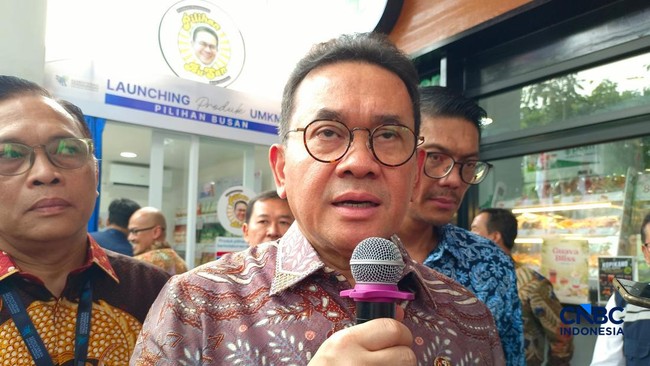
Jakarta, CNBC Indonesia - Beef prices in several regions remain above the national average. Trade Minister Budi Santoso revealed that one of the causes is that beef import realisation has so far only reached around 40%.
Budi said that, based on the Market and Basic Needs Monitoring System (SP2KP), the national average beef price is around Rp142,000 per kilogram (kg). However, he acknowledged that prices in several regions are recorded higher, especially in areas where distribution reach is not easy.
“Well, if you look at the national average, it is Rp142,000 (per kg) according to SP2KP. Indeed, in certain regions it is higher, especially where distribution reach may not be as easy as in other areas,” said Budi when met at his office in Jakarta, Wednesday (12/8/2026).
Following up on this condition, Budi said that his ministry has asked importers to immediately realise the beef import quotas that have been granted through the commodity balance (NK), considering that import realisation is still not optimal, still at around 40%.
“So we have asked the importers, because beef is also partly imported. Import realisation is now still below 50%, averaging 40%. So we ask them to immediately realise their imports, because they have already received the quota (for beef imports) during the commodity balance process,” he said.
He also said that importers have been asked to identify the obstacles they face, while encouraging them to seek suppliers from other countries with more competitive prices. The government will also hold another meeting with importers in the near future to discuss the issue.
“So we ask them to immediately find sources or suppliers abroad whose prices are certainly better, so that they can help bring down domestic prices. (Communication with importers?) Some have already been contacted directly, and we will also schedule a Zoom meeting in the next day or two to hold a joint meeting, so we can find out where the obstacles are (why import realisation is still low),” said Budi.
Logistics Costs Rise
Budi revealed that one of the obstacles keeping beef import realisation low is the increase in import costs, particularly logistics and transportation costs.
“So indeed one of the factors is that import costs have risen. So now some are still looking for beef products that are not too expensive, but they say they are ready to immediately increase their import realisation,” he said.
When asked how much logistics costs have increased, Budi admitted he did not yet know the exact figure. However, he said the increase in logistics costs was caused by rising world oil prices, which has pushed up transportation costs.
“I do not know the exact figure (for the logistics cost increase) yet, I will ask tomorrow. This is due to logistics costs, because oil prices have an impact on logistics costs, ship transportation costs have risen. That is why we will look for, for example, products (meat from countries) that may be closer, or something like that,” he explained.
Therefore, the government is encouraging importers to seek supply sources from countries with more efficient logistics costs. This step is expected to reduce import costs while helping to hold down beef prices in the domestic market.
Seeking Alternative Supply Sources
So far, Australia has been one of the main sources of Indonesia’s imported beef supply. However, the government is now opening up options to seek suppliers from other countries that offer more competitive prices and logistics costs.
“So we actually have several options, but indeed so far most has come from Australia, but we are trying from several countries that can supply, including we also actually have a quota for buffalo meat as well, right? That is also relatively cheaper, but the realisation (for buffalo meat) has also not been much,” said Budi.
“Later we will strive for all meat import realisations, both beef and buffalo, to be realised immediately,” he continued.
Thus, the government is not only asking importers to accelerate the realisation of beef import quotas, but also encouraging diversification of supply sources and optimising buffalo meat imports, which are relatively cheaper. This step is expected to increase supply and help bring down domestic meat prices.