
Bawaslu: Election Law Debate Competition Serves as a Space for Students to Test Theory
How can they test theory, how can they argue effectively, and how can they find future solutions for a better democratic process and system?
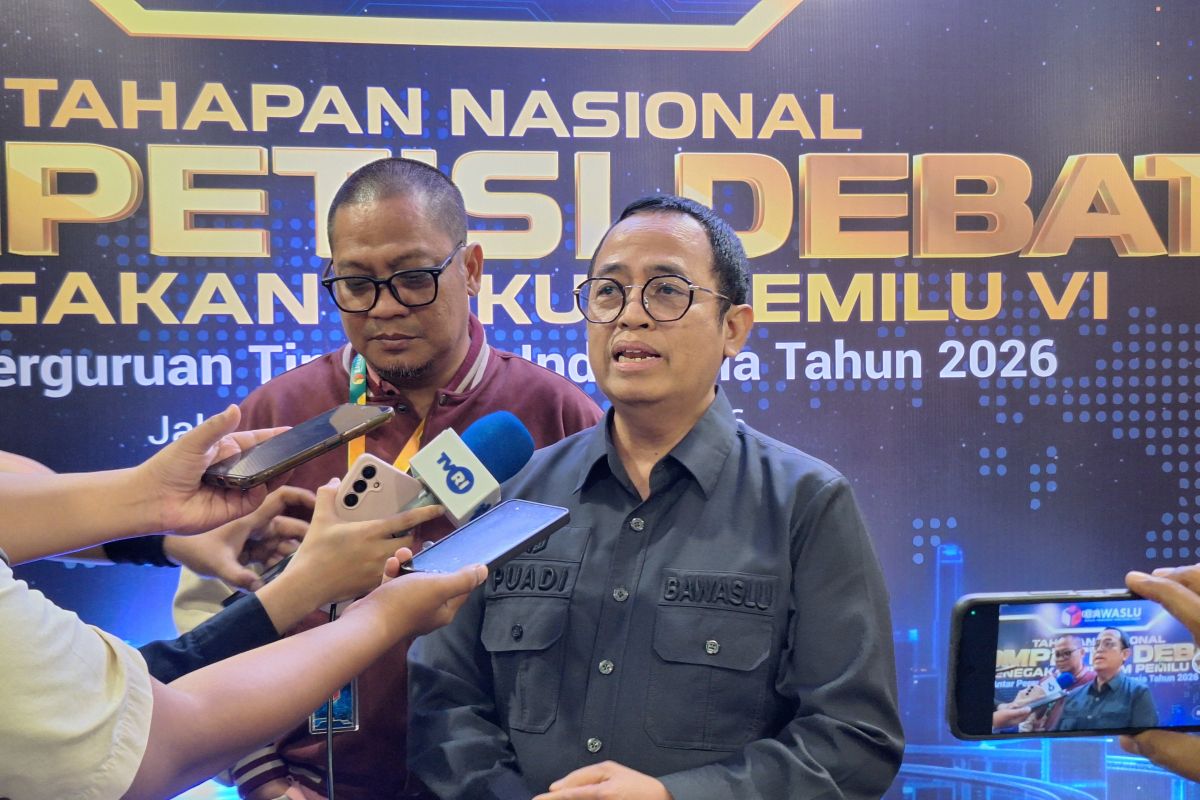
Puadi, the Coordinator of the Violation Handling, Data, and Information Division of the Indonesian Election Supervisory Body (Bawaslu RI), stated that the Election Law Enforcement Debate Competition organised by Bawaslu serves as a platform for students to test the theories acquired during their studies against real-world election law issues.
“Students and the academic community are expected to be able to test theory, analyse judicial decisions, and address legal issues, as well as formulate arguments that align with the mechanisms regulated by law,” said Puasting after attending the opening of the 6th National Election Law Enforcement Debate Competition for Universities across Indonesia 2026 in Jakarta on Monday.
Puadi noted that the competition is not merely designed as a contest, but also as a means for students to understand election administration through theoretical testing, the construction of arguments, and the provision of solutions for election law enforcement.
“We also need collaboration with students and the academic community, so that the ideas presented through the motions by students—from the preliminary rounds to the grand final—can become alternative solutions for carrying out Bawaslu’s supervisory duties and functions,” he added.
He explained that the competition also covers various motions regarding the institutional strengthening of Bawaslu, the legal system, and the democratic system.
The 6th Election Law Enforcement Debate Competition 2026 is being contested by 24 teams that passed the regional selection stages. Puadi stated that the initial stages of the competition involved 409 teams, with nearly 1,200 student participants.
“How they can test theory, how they are able to argue, and how they can seek solutions for the future towards a better democratic process and system,” concluded Puadi.