
Batu Tulis Huludayeuh: Legacy of the Sunda Kingdom in Cirebon
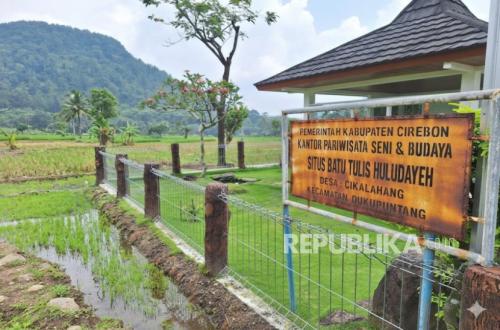
The Batu Tulis Huludayeuh site, located in Cikalahang Village, Dukupuntang District, Cirebon Regency, serves as evidence of the Sunda Kingdom’s legacy in Cirebon. Despite its historical importance, the site remains largely unknown to the public.
Standing 74 centimetres tall and 36 centimetres wide, the stone bears ancient script. It is one of two Sunda Kingdom stone inscriptions in West Java, according to local accounts.
Edi, the site’s custodian, confirmed the reports. He recounted that the stone inscription was first discovered by locals in the 1930s when the area was still a dense forest, not the rice fields seen today.
‘Originally, it was a forest. Apparently, a banyan tree had fallen, revealing the stone beneath,’ Edi said during a weekend visit to the site.
Although discovered decades ago, research on the site only began in February 1991. Following this, Batu Tulis Huludayeuh was designated as a cultural heritage site.
Edi emphasised its historical importance linked to the Sunda Kingdom. Experts state the inscription was commissioned by a king titled Sri Maharaja Ratu Haji.
‘This stone was inscribed under royal order to commemorate public works carried out for the community,’ he explained.
Beyond its historical value, the Batu Tulis Huludayeuh site is open to the public free of charge. Nestled among rice fields with panoramic hill views, it offers a serene setting.
Edi expressed delight at visitors, particularly students and youth, who come to learn about history and culture.
‘I am very pleased when people visit. Schools have come here before,’ he said.
He believes the site has potential as a historical and cultural education destination in Cirebon Regency. Visitors can view ancient inscriptions and learn about Huludayeuh, believed to have been an administrative centre during its time.
He explained that according to elders, ‘Hulu’ means head or centre, and ‘Dayeuh’ means city, so Huludayeuh is thought to have been the regional administrative hub in the past.
In the modern era, Edi hopes younger generations will remain committed to preserving local cultural and historical sites. ‘They must visit to understand the history and help preserve it,’ he said.
Meanwhile, archaeologist Hasan Djafar’s research in the 1994 journal Berkala Arkeologi, Volume 14, titled ‘Prasasti Huludayeuh’, accessed via kemdiktisaintek.go.id, notes that West Java has far fewer inscriptions compared to Central and East Java.
Hasan Djafar explained in his study that the inscription’s name derives from its discovery location. His research links Prasasti Huludayeuh to reverence for Sri Baduga Maharaja, also known as Prabu Siliwangi, whose name appears in the text.
‘The king mentioned in the Huludayeuh inscription is none other than Ratu Purana Sri Baduga Sri Maharaja Ratu Haji ri Pakwan Sya San Ratu Dewata,’ wrote Hasan Djafar in his research.
He added that the inscription was likely not issued directly by Sri Baduga Maharaja but by his successor, King Surawisesa, who ruled from 1521 to 1535.
‘Given the inscription’s purpose of commemorating Sri Baduga Maharaja’s benevolent deeds, it was probably issued by his successor, King Surawisesa (1521-1535),’ stated Hasan Djafar.
The study also noted the inscription is damaged, with parts broken and worn, making some text difficult to read. Nevertheless, it remains a crucial source for tracing the Sunda Kingdom’s history in Cirebon Regency.
Source: jawawa.id (https://jawawa.id/newsitem/batu-tulis-huludayeuh-legacy-of-the-sunda-kingdom-in-cirebon-1780321843)
Originally published by Republika (https://rejabar.republika.co.id/berita/tfkkwp487/batu-tulis-huludayeuh-jejak-peninggalan-kerajaan-sunda-di-cirebon), translated from Indonesian