
Battery-Powered Trains to Debut on Bandung-Cicalengka Line, Here's a Preview
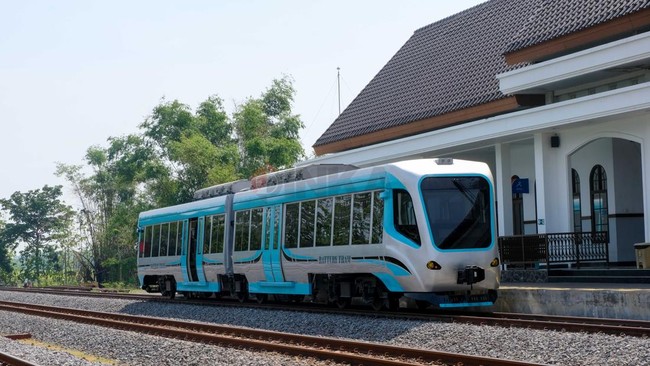
PT Kereta Api Indonesia (Persero) plans to introduce battery-powered trains, or Battery Electric Multiple Units (BEMU), in Indonesia starting next year. The Padalarang-Cicalengka line in Greater Bandung has been selected as the first route to utilise this electric train technology without overhead catenary wires (LAA).
KAI’s Director of Portfolio Management and Information Technology, I Gede Darmayusa, stated that the current development of electric vehicle and battery technology presents new opportunities for the national railway industry. “We are currently observing the development of electric vehicles or batteries, and we also see that batteries can be used in trains. Our challenge now is that we already have some rolling stock, diesel and electric motor units that need replacing. Furthermore, our electrification rate is very low, only 10 per cent,” Gede said during a hearing with Commission VI of the Indonesian House of Representatives in Jakarta, as quoted on Sunday.
According to him, the electrification level of railway lines in Indonesia remains very limited. Out of a total rail network exceeding 6,000 kilometres, only around 600 kilometres utilise an electrification system. “Of more than 6,000 kilometres, only 600 kilometres are electrified, and financing electrification is expensive,” he said. Besides requiring significant investment, conventional electrification systems are also considered to have their own operational challenges. “The potential for operational disruptions to electrification in Indonesia is also still high. If we want to adopt new technology, we certainly want to see that battery technology has advanced sufficiently to be adopted by trains, due to its large capacity. Likewise, it is not only capacity but the weight of batteries has also become increasingly sophisticated, now lighter and more flexible,” he explained.
Therefore, KAI plans to begin adopting battery-based trains for commuter services. Studies and exploratory cooperation with PT Industri Kereta Api (Persero) or INKA have commenced this year. “So we at KAI intend to adopt battery electric multiple units starting next year. The studies and engaging in principle with INKA also begin this year,” Gede revealed.
Greater Bandung will be the first region to experience this new technology. KAI chose the Padalarang-Cicalengka corridor as a pilot project due to the continuously increasing demand for commuter services. “Our first plan is to trial this new battery technology on the Padalarang-Cicalengka line. As is known, the commuter line here currently uses diesel multiple units and interest is growing day by day,” he said. With battery technology, KAI does not need to wait for the construction of an expensive electrification network to provide electric train services on the route. “So with this battery electric multiple unit plan, we can immediately create a Padalarang-Cicalengka commuter line without waiting for electrification,” he continued.
Gede explained that the planned battery train, which will operate on a route of approximately 42 kilometres, has a relatively fast charging capability. “The specification is that this will be around 42 km, and with current technology, charging takes only 15 minutes to be fully charged, so it can run immediately without LAA,” he clarified. KAI is targeting the procurement process to begin in September 2026. If it proceeds according to plan, the first battery trainset will arrive in the second quarter of 2027. “Our plan is to start the procurement process in September 2026, so that delivery of one train set is in Q2-2027,” Gede said.
According to him, if the pilot project in Bandung is successful, battery train technology has the potential to be applied in various other cities in Indonesia that currently lack electrification networks. “Hopefully, with this battery technology, it will also become a technology we adopt for commuter lines in other cities without the need for expensive electrification,” he stated.
The BEMU project in Bandung will serve the Padalarang-Cicalengka commuter corridor with a track length of about 42 kilometres. The line stretches from Padalarang, Cimahi, Bandung, to Cicalengka, with several intermediate stations such as Cimindi, Andir, Kiaracondong, Gedebage, Rancaekek, and Haurpugur. The scheme involves the train using a combination of battery-based operation and electrification support on certain segments. Charging is planned at points in Padalarang, the Bandung depot, and Cicalengka, with a full charging time of around 10-15 minutes. KAI estimates this service can operate at speeds of up to 120 km per hour with a headway of approximately 15-30 minutes.