
Batavia Was Once a Fruit Paradise, Now Its Orchards Have Vanished
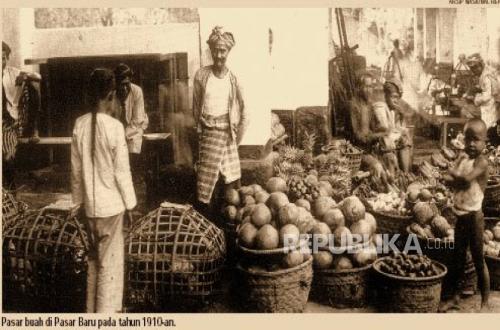
Batavia was once a fruit paradise. Orchards stretched from Pasar Minggu and Condet to Kuningan. Unfortunately, today fruit orchards are almost nowhere to be found in the Jakarta area. They have all vanished, transformed into various buildings.
Various photographs of fruit traders have been preserved. One such photo shows a fruit seller at Pasar Baru, Central Jakarta, in the 1910s. The trader, dressed in Betawi attire resembling a Central Javanese blangkon with a striped lurik shirt, is serving a Chinese customer dressed in clothing from his ancestral homeland. The young Chinese man, with his hair in a taucang queue tied at the back and barefoot, is haggling over the price of a chicken confined in a basket.
Apparently, the attire of Betawi traders around 100 years ago still included head coverings similar to those of Javanese people. This was later replaced by the black kopiah popularised by Bung Karno from the 1930s. At that time, Chinese men were required to wear the taucang, a custom of the Manchu people who established the Qing dynasty in China (1644-1911). During the dynasty’s rule, they required Chinese sojourners to follow the tradition of braiding their hair and shaving the front part of the head. Although the Qing dynasty was no longer in power in mainland China by 1911, the Dutch colonial government continued to maintain this centuries-old tradition, as the colonial administration imposed a head tax or long-hair tax on Chinese citizens.
As seen in the photo, fruit markets generally sold local produce such as salak, pineapples, oranges, and coconuts. These have now been replaced by imported fruits that dominate trade in malls and supermarkets, and even among traders in villages. In fact, until the early 1970s, apples and grapes were fruits whose prices were unaffordable for the lower classes. These fruits were smuggled into Indonesia by nannies from Singapore. Until the 1960s, Betawi villages had many durian, duku, rambutan, and mango trees. Today, local durians are hard to find, having lost out to Thai durians in shopping malls.