
Batam Urged to Become an Export-Oriented MSME Special Economic Zone
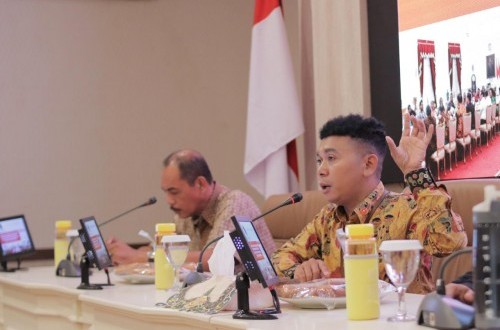
The large scale of investment and export activity in Batam has not been fully matched by an increased role for micro, small, and medium enterprises in the regional economy. As a result, an idea has emerged to form a Special Economic Zone specifically to accommodate MSMEs and encourage them to enter export markets.
The proposal was put forward by Executive Committee member of President Prabowo Subianto, Billy Mambrasar, at an event attended by the Ministry of Cooperatives and SMEs, the Riau Islands Provincial Government, the Batam City Government, BP Batam, and representatives of MSME players.
Billy assessed that the large foreign investment entering Batam needs to be accompanied by strengthening the economic activities of local communities. One way to do this is by providing a special area for MSMEs equipped with facilities to run business activities and cross-border trade.
“Remember that MSMEs are from and by the community. So I ask the Provincial Government, BP Batam and the Central Government, such as the Ministry of Cooperatives and SMEs, and the Ministry of Trade to accommodate MSME players in one special area with the aim of preparing them to become exporters, with all the existing facilities,” Billy said in his statement on Wednesday (26/8/2026).
According to Billy, Batam’s economic structure is still largely supported by investment and exports, while household consumption is in the range of 20-30 percent of gross regional domestic product. This condition, he said, shows the need to strengthen economic turnover at the community level.
“One of the biggest drivers of household consumption is MSME activity, whose main actors are the community,” Billy said.
MSMEs also play a major role in absorbing labour, both formal and informal. Therefore, strengthening MSMEs is considered to have the potential to expand employment opportunities while increasing people’s incomes.
Billy said the existence of a special MSME SEZ could be directed at increasing the capacity of business players to become exporters. Thus, Batam’s economic activity is expected not to depend solely on investment and the manufacturing sector.
In addition to trade, the area is also considered to be developable to support tourism activities, especially culinary and hospitality, thereby creating other sources of economic activity for MSME players.
“This MSME SEZ could become a centre for foreign tourist visits, for culinary and hospitality tourism, as long as we manage it very professionally and world-class,” Billy said.
Head of the Cooperatives and SMEs Office of the Riau Islands Province, Riki Rionaldi, welcomed the idea. According to him, the regional government has been looking for a formulation to strengthen MSME development in the Riau Islands and Batam.
“So far we have been trying to find the best formulation to encourage the progress of MSMEs in the Riau Islands Province and Batam City, and in my opinion, this could be the best idea to answer that,” Riki said.
BPS data records that there are more than 75,000 MSMEs in Batam City and around 102,000 micro businesses. The sector is estimated to absorb up to 156,000 workers with a money turnover estimated to reach Rp9.1 trillion per year.
If realised, a special MSME SEZ would require further arrangements, especially regarding trade facilities, access to financing, product standardisation, logistics, and mentoring so that business players are able to meet export market requirements.