
Batam Investment Hits Rp 29.9 Trillion, Local Government and Apindo Commit to Local Labour Absorption
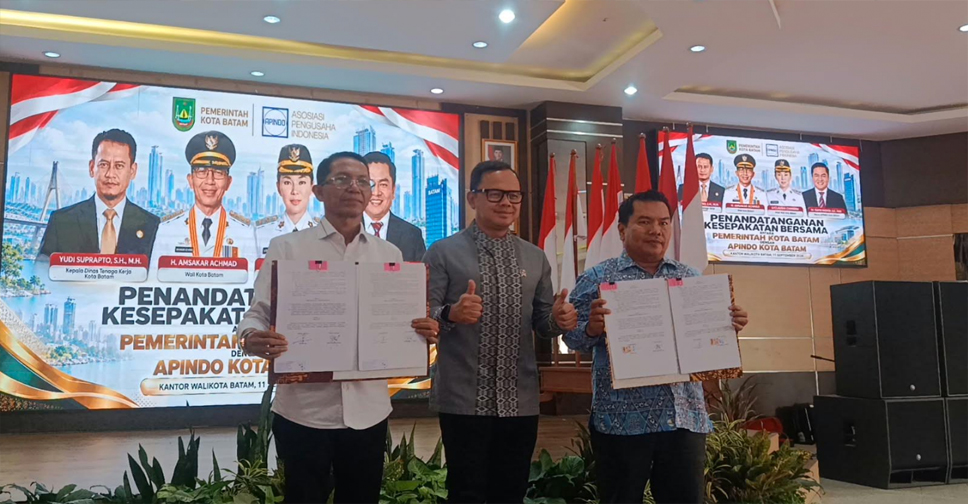
Batam’s continuous economic and investment growth has not yet been fully reflected in local labour absorption. This issue has prompted the Batam City Government and the Batam City Indonesian Employers Association (Apindo) to establish a joint commitment to prioritise local residents in recruitment.
The agreement was formalised in a Memorandum of Understanding (MoU) signed by the Mayor of Batam and Head of BP Batam, Amsakar Achram, alongside the Chairman of Apindo Batam, Rafky Rasyid, on Friday (11/9/2026). The signing was witnessed by the Deputy Minister of Home Affairs, Bima Arya.
Amsakar stated that employment remains a key challenge amidst Batam’s rapid economic and investment expansion. “It has always been noted that our economic growth and investment growth in Batam are not directly proportional to labour absorption. This has been a constant subject of public discourse,” said Amsakar.
He noted that the Batam City Government had previously allocated approximately Rp40 billion, sourced from Foreign Worker Employment Permits (IMTA), for employment training programmes and job fairs. However, these programmes have not yet been fully effective in reducing the Open Unemployment Rate (TPT) in Batam.
Consequently, the Batam City Government is attempting to drive changes in corporate recruitment patterns to ensure local workers receive greater opportunities. “We are initiating efforts so that business actors in Batam, who previously relied on migrant labour agencies (PJTKI) to bring in outside workers, will now prioritise local labour,” he added.
This initiative began with meetings with Human Resources departments of various companies in Batam, where it was agreed that 15 to 20 per cent of recruitment should prioritise local citizens. Amsakar emphasised that verbal agreements were insufficient, necessitating the MoU to ensure concrete implementation and monitoring.
Amsakar reported that during his 18-month leadership alongside the Vice Mayor and Vice Head of BP Batam, Li Claudia Chandra, several economic indicators in Batam have shown positive trends. Batam’s economic growth reached 6.76 per cent in 2025 and rose to 7.28 per cent in the first semester of 2026. Meanwhile, realised investment, which stood at Rp18.37 trillion in the first semester of 2025, surged to Rp29.9 trillion during the same period in 2026.
Poverty rates also declined from 4.85 per cent in 2024 to 3.81 per cent in 2025, while the Human Development Index (HDI) increased from 83.3 to 83.8. Despite this, unemployment remains a concern. The Open Unemployment Rate in Batam dropped from 7.68 per cent in the first semester of 2025 to 6.76 per cent in the first semester of 2026, but remains above the national average.
Amsakar cited high migration rates as a contributing factor to Batam’s employment challenges. According to data from the Directorate General of Population and Civil Registration, Batam ranked fifth among cities with the highest migration inflows in Indonesia in 2025. By 2026, Batam’s position rose to second nationally, following Jakarta.
“If the government does not take a stand in efforts to resolve and minimise the open unemployment rate, we do not want to see an increase in crime rates in Batam,” Amsakar asserted. Consequently, he has instructed the Batam City Manpower Office (Disnaker) to finalise agreements with the business sector, especially as labour issues are currently under scrutiny due to student demonstrations.
Thirty companies were involved in the agreement, with approximately 200 company representatives present at the signing ceremony. Amsakar emphasised that the commitment must not remain merely on paper, noting that local labour absorption can be monitored via the Batam Manpower Office’s application.
Regarding technology investments, Amsakar mentioned the influx of new high-tech investments into Batam. He noted that the development of Artificial Intelligence (AI) and data centres in Batam has attracted international media attention from Reuters and Bloomberg. These investments involve collaborations with technology firms and Nvidia for the construction of Graphics Processing Units (GPU), planned to commence in the first quarter of 2027.
Amsakar also expressed appreciation to the President of the Republic of Indonesia for implementing five regulations over the last 18 months to accelerate investment in Batam. He claimed that under his leadership, there have been no demonstrations regarding minimum wage determinations.
The Chairman of Apindo Batam, Rafky Rasyid, stated that Batam’s economic growth of approximately 7.25 per cent and investment realisation, which reached 106 per cent of the target, must deliver a tangible impact on the community. He likened economic growth to an expanding cake, noting that the issue is not just the size of the cake, but who gets to enjoy the results of that growth.
Source: jawawa.id (https://jawawa.id/newsitem/batam-investment-hits-rp-29-9-trillion-local-government-and-apindo-commit-to-local-labour-absorption-1789231912)
Originally published by batamtoday.com (https://batamtoday.com/news/investasi-batam-tembus-rp-299-triliun-pemko-dan-apindo-ikat-komitmen-serap-tenaga-kerja-lokal), translated from Indonesian