
Batam as National Investment Locomotive: KAHMI Urged to Transform from Alumni Network into Economic Driver
Batam is no longer merely an industrial zone and an investment gateway. The city, situated in the strategic Malacca Strait, is being pushed to ascend to the status of a locomotive for national economic growth and investment, with competitiveness supported by legal certainty, public services, talent, innovation, and global economic networks.
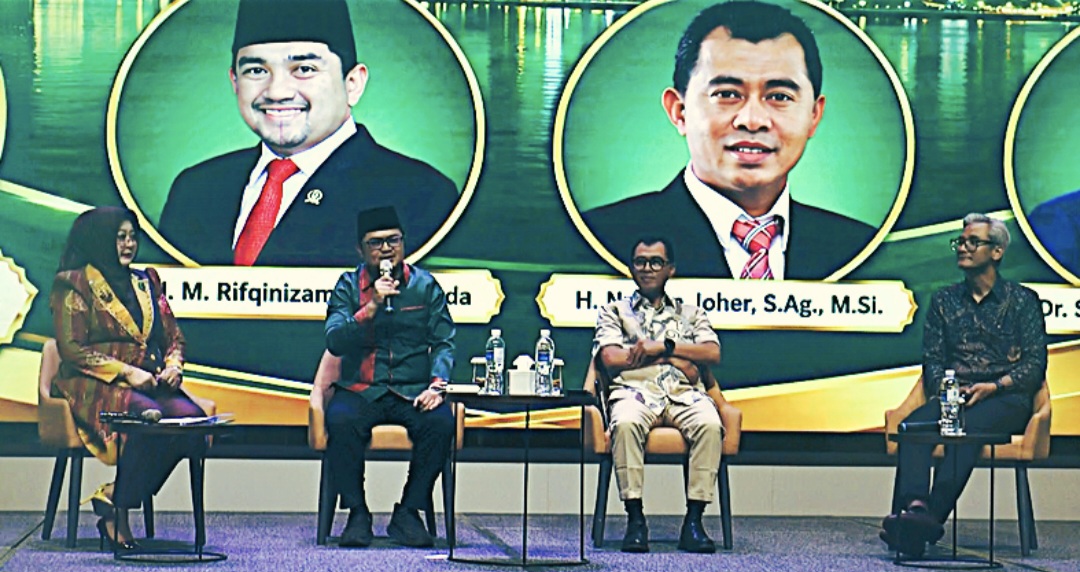
This idea emerged during the MD KAHMI Batam City National Public Dialogue, which brought together the Chairman of Commission II of the Indonesian House of Responsibility (DPR RI), representatives from BP Batam, the Indonesian Ombudsman, and academics. The forum also produced several strategic recommendations regarding the strengthening of governance, ease of investment, talent development, and the transformation of KAHMI’s role in Batam’s economic development.
The theme adopted was “Strengthening the Role of KAHMI in Driving Batam’s Competitiveness as a Locomotive for Economic Growth and Investment in Indonesia.” The forum placed one major question at the centre of the discussion: as Batam moves towards becoming a global economic hub, what is the position and contribution of KAHMI in this transformation?
The Chairman of Commission II of the DPR RI, M. Rifqinizamy Karsayuda, who also serves as the Presidium of the National KAHMI Council for the 2022–2027 period, opened the dialogue by addressing the issue of population administration reform while challenging the HMI alumni community to increase their contribution to Batam.
Rifqinizamy explained that Commission II of the DPR RI is currently pushing for the strengthening of the National Population Identity Number (NIK) as a single national identity through the revision of the Population Administration Law. The concept aims to ensure that in the future, citizens do not need to carry multiple identity cards for various services.
“In the future, people will only need one identity in their wallet. It will no longer be filled with KTP, driving licences, BPJS Employment, BPJS Health, and various other cards,” he said.
However, for Rifqinizamy, the transformation of state administration is not the only important agenda. He instead posed a question to the HMI alumni in Batam: “Of all the progress achieved by Batam, where is the HMI alumni family playing a role?”
According to Rifqinizamy, Batam should provide greater space for HMI alumni to participate, particularly in the business world. He reminded the forum that HMI and KAHMI possess significant intellectual capital, as HMI regeneration forms academic, creative, and dedicated individuals. However, this capital needs to be translated into more concrete economic power. One challenge he highlighted is the limited number of HMI alumni who are truly active business owners.
“We have HIPKA, but those who truly run businesses can still be counted on one hand,” he remarked.
This message serves as a challenge for HMI alumni not to stop at bureaucracy, politics, and organisations, but to increasingly emerge as entrepreneurs, job creators, and economic drivers.
From an investment development perspective, the Director of Planning and Investment Development of BP Batam, Irfan Syakir Widyasa, presented the concept of “Land to Talent: The Seven Pillars of Batam’s Competitiveness.”
According to Irfan, Batam’s competitiveness cannot be built solely by offering land and industrial zones. Investment requires an integrated ecosystem, ranging from institutions, regulation, spatial planning, and infrastructure to industrial sectors, licensing, and human resources. Therefore, Batam’s development must move from a zone-based approach to a more comprehensive investment ecosystem.
“Batam’s competitiveness is built as an ecosystem where location, infrastructure, ease of doing business, industrial sectors, and people must move together,” said Irfan.
Talent is a key component. This is because investments entering Batam ultimately require a workforce and human resources with competencies that match industrial developments. Consequently, Batam’s competition is not just about who has the largest industrial zone or the most complete infrastructure, but also who can provide quality talent, rapid service, and a competitive business ecosystem.
Ombudsman: Maladministration Can Hinder Investment
A different issue was raised by the Chairman of the Indonesian Ombudsman, Nuzran Joher, who discussed the Ombudsman’s role in accelerating Batamin as an economic and investment locomotive.
Nuzran highlighted several potential instances of maladministration that could hinder investment, particularly undue delays, overlapping regulations, and procedural vulnerabilities. Delays in issuing business licences, land utilisation issues, or certification problems can cause direct losses to business actors.
On the other hand, dualism or friction in authority regarding regional management can create legal uncertainty, which ultimately affects the investment climate. Another issue is long and complicated bureaucratic procedures. Such conditions are considered potential breeding grounds for illegal transactional practices that harm both the public and the state.
To address these issues, the Ombudsman is pushing three main agendas: full digitalisation of services, the eradication of illegal levies, and the strengthening of rapid complaint channels.
According to Nuzran, sustainable economic growth cannot be separated from the quality of public services. Clean public services and legal certainty are part of the investment infrastructure. In this context, KAHMI is encouraged to take a position as a civil society force that helps accelerate governance improvements.
The formula emerging from the forum was simple: the Ombudsman oversees, KAHMI accelerates, and Batam strengthens its position as Indonesia’s investment locomotive.
Batam Grows by 6.76 Percent, but Must Move Upwards
Meanwhile, academic Dr. Suyono Saputro placed the issue of Batam’s competitiveness in a broader perspective. He noted that investment in Batam is already significant. The challenge is how that investment can move up the value chain and generate greater added value.
Source: jawawa.id (https://jawawa.id/newsitem/batam-as-national-investment-locomotive-kahmi-urged-to-transform-from-alumni-network-into-economic-driver-1790153497)
Originally published by batamstraits.com (https://batamstraits.com/2026/09/23/batam-lokomotif-investasi-nasional-kahmi-dorong-transformasi-dari-jaringan-alumni-jadi-kekuatan-ekonomi/), translated from Indonesian