
Bareskrim Uncovers 55 Online Gambling Cases Throughout 2026, 123 Suspects Arrested
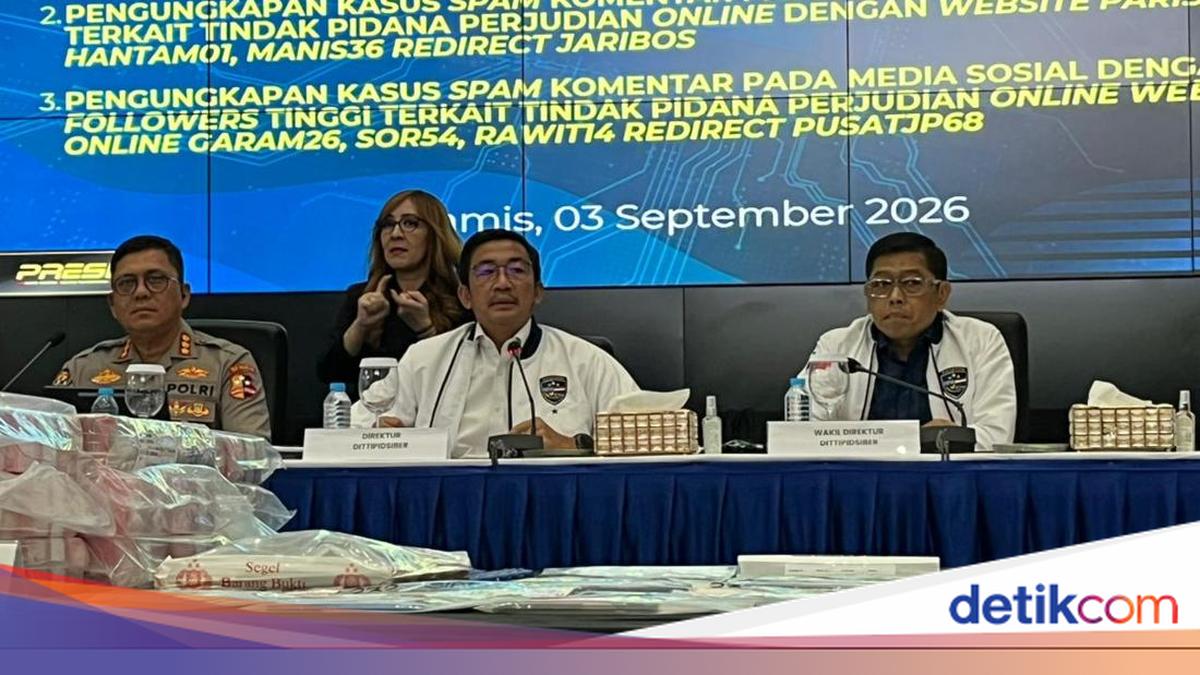
The Indonesian National Police’s Criminal Investigation Agency (BARS KRIM) continues its crackdown on online gambling across the country. Throughout 2026, Bareskrim has recorded the dismantling of 55 online gambling cases, resulting in the arrest of 123 suspects.
Brigadier General Adex Yudiswan, Director of Cyber Crimes at Bareskrim Polri, stated that these enforcement actions are part of the police’s efforts to break the chain of online gambling. “From the beginning of 2026 until this September, based on available data, 55 cases and 123 suspects have been recorded,” Adex said during a press conference at the Bareskrim Polri Building, South Jakarta, on Thursday (3/9/2026).
Adex explained the trend of handling gambling cases over the last three years. In 2024, the police uncovered 1,626 cases with 1,999 suspects, and in 2025, they took action against 665 cases involving 744 suspects.
Alongside legal enforcement, Adex noted that the circulation of gambling funds within society is showing a downward trend, citing data from the Indonesian Financial Transaction Reports and Analysis Centre (PPATK). “The decline is also evident in the circulation of online gambling funds. According to PPATK data, in 2024, the circulation of online gambling funds reached approximately Rp 359.8 trillion,” said Adex.
“In 2025, that figure dropped to Rp 286.8 trillion. Subsequently, in the first semester of 2026, the circulation of online gambling funds was recorded at around Rp 86.8 trillion,” he added.
In addition to arresting perpetrators, the Cyber Crime Directorate of Bareskrim Polri is emphasising the seizure of assets believed to be proceeds from online gambling. To date, police have seized hundreds of billions of rupiah.
“In tracing the flow and circulation of funds, based on updated data as of 2 September 2026, our Cyber Crime Directorate has successfully executed seizures amounting to Rp 131.1 billion from 353 accounts, as well as USD 4,738 from one account,” he stated.
Furthermore, Adex mentioned that eradicating online gambling is no easy task. According to him, perpetrators use various methods to disguise fund flows and their operations. “In handling online gambling, investigators often face complex challenges. The development of digital infrastructure and the modus operandi of perpetrators are moving very rapidly,” said Adex.
“To disguise fund flows, perpetrators also utilise various methods, ranging from layering patterns, nominee accounts, and e-wallets, to transactions via crypto assets,” he added.
Additionally, Adex stated that gambling syndicates frequently switch domains quickly or create mirror sites when access to a primary site is severed. The borderless nature of online gambling presents a unique challenge, as servers and operators are often located abroad under different legal systems.
“When one domain is blocked, perpetrators can quickly move to another domain and create mirror sites or change their promotion patterns through various social media platforms,” he said.
Nevertheless, Adex emphasised that the National Police continue to work in synergy with the Ministry of Communication and Digital (Komdigi), PPATK, the Financial Services Authority (OJK), and Bank Indonesia to block access to gambling sites and the fund flows of syndicates in Indonesia.
“The Bareskrim Polri Cyber Crime Directorate continues its efforts in blocking, asset tracing, and seizing all infrastructure to anticipate and prevent these activities from expanding. We are certainly not alone in this task, as we are supported by many parties,” he said.
As information, the Bareskrim Polri Cyber Crime Directorate recently dismantled an online gambling operation running sites such as 1XBET, AJ8KEREN, and EMPIRE88. The transaction value of this network is reported to have reached Rp 1 trillion.
Bareskrim Polri also uncovered a gambling syndicate that used spam comments on Instagram as a promotional tactic. From this illegal practice, the syndicate was known to have generated a turnover of up to Rp 90 billion per year.